

You approved a perfect sample, but the bulk order that arrived is different. This inconsistency ruins your final product, creates waste, and destroys your production schedule.
Buyers ensure consistent quality by partnering with suppliers who adhere to global standards (FCC/E202), operate under a certified ISO 9001 system, and provide a detailed, batch-specific Certificate of Analysis (COA). Verifying these elements is key to a reliable supply.
Quality is not an accident. It is the result of a disciplined, professional system. For a serious buyer, the cost of one bad batch is a disaster. My role is to be responsible for this quality system, giving you the confidence that every single bag you receive meets the same high standard. Let's look at how we build and verify that system.
What Quality Specifications Apply to Potassium Sorbate?
You see terms like "FCC IV" and "E202" on data sheets. Do these technical terms really matter? Using a product that does not meet the right standard is a major compliance risk.
The key quality specifications for Potassium Sorbate are the internationally recognized Food Chemicals Codex (FCC) and the European designation E202. These standards define the required purity (assay) and set strict limits for heavy metals and other impurities.

Standards are the common language of quality. The two most important for Potassium Sorbate are the Food Chemicals Codex (FCC)1, which is the global benchmark, and E202, the European standard. Both define the required purity (99.0% - 101.0%)2 and, critically, set strict safety limits for heavy metals like lead and arsenic. Adherence to these standards is your baseline guarantee of a safe and effective product.
Key Quality Standards Compared:
| Parameter | FCC Standard | E202 (Europe) Standard | Importance for a Buyer |
|---|---|---|---|
| Assay (Purity) | 99.0% - 101.0% | 99.0% - 101.0% | Guarantees the product's preservative strength. |
| Lead | Max 2 mg/kg | Max 2 mg/kg | A critical food safety parameter. |
| Arsenic | Max 3 mg/kg | Max 3 mg/kg | A critical food safety parameter. |
How Is Potassium Sorbate Purity Controlled During Production?
You received one great batch, but the next one was slightly different. Why does this happen? The answer is not in the final testing, but in the production process itself.
Purity is controlled through a rigorous system of in-process controls (IPC) that monitor critical parameters like temperature, pH, and reaction time. This is all managed under a certified quality system like ISO 9001 to ensure batch-to-batch consistency.

Consistent quality comes from a consistent process. A high-quality producer uses In-Process Controls (IPC)3, constantly monitoring key parameters like temperature and pH during production to prevent deviations. This entire system is managed under a ISO 9001 Quality Management System. The ISO 9001 certification is your guarantee that the factory has a documented, repeatable, and professional system designed to produce the same high-quality product every single time.
Controlled vs. Uncontrolled Production Process:
| Process Step | Uncontrolled Process (Low-Quality Supplier) | Controlled Process (ISO 9001 Supplier) |
|---|---|---|
| Raw Materials | Buys cheapest available, inconsistent quality. | Strict inspection and testing of all inputs. |
| Process Control | Manual, inconsistent monitoring. | Real-time, automated monitoring of critical parameters. |
| Final Product | Inconsistent, variable quality. | Consistent, reliable, batch-to-batch quality. |
What Quality Documents Are Required for Potassium Sorbate?
Your supplier says their product is "high quality." How can you get objective, verifiable proof for your records and your own quality control team?
The most critical quality document is the batch-specific Certificate of Analysis (COA). This is supported by the supplier's system certifications, like ISO 9001 (Quality) and ISO 22000 (Food Safety), and often market-specific certificates like Halal and Kosher.
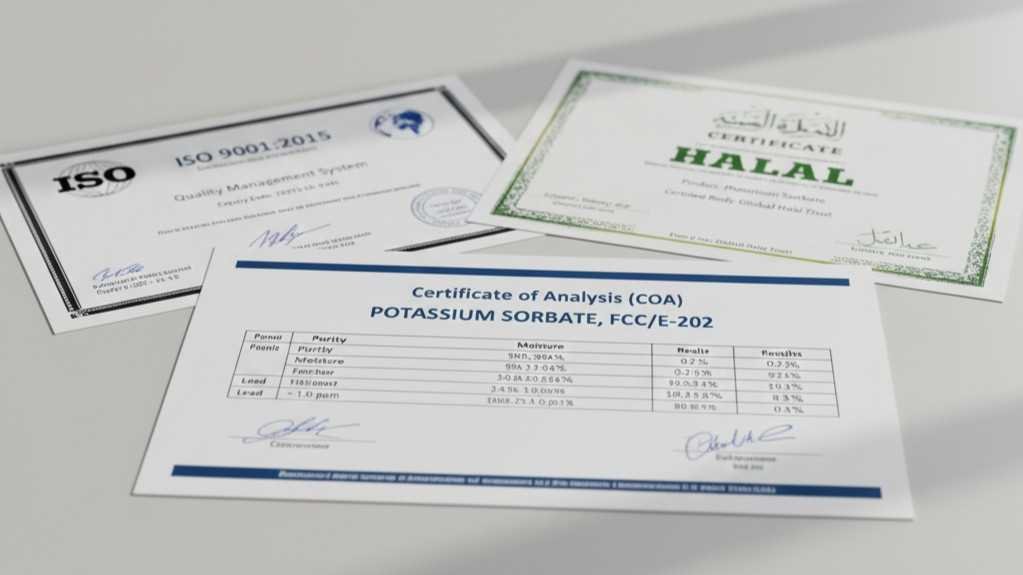
Documentation is the language of proof. The most important document is the Certificate of Analysis (COA), which is the quality report for your specific batch. You must receive this with every order. System certifications prove the supplier's overall capability. ISO 9001 proves they have a quality system, and ISO 22000 proves they have a food safety system. Market-specific documents like Halal and Kosher certificates are also essential for many buyers.
Key Quality Documents Checklist:
| Document | What It Proves | When You Should Receive It |
|---|---|---|
| COA | The specific quality test results for your batch. | With every single order. |
| ISO 9001 | The factory has a consistent quality system. | Once, kept on file. |
| ISO 22000 / HACCP | The factory has a robust food safety system. | Once, kept on file. |
| Halal / Kosher | The product meets specific religious dietary standards. | Once, kept on file. |
Why Is Batch Stability Important for Potassium Sorbate?
Your food product passed its initial shelf-life tests. But a few months later, you start getting customer complaints about spoiled products. What went wrong?
Batch stability is critical because Potassium Sorbate's entire purpose is to guarantee the shelf life of your product. An inconsistent or unstable batch of preservative will fail to perform, leading directly to product spoilage, customer complaints, and severe brand damage.

The consistency of your preservative is directly linked to your brand's reputation. The purpose of Potassium Sorbate is to inhibit mold and yeast, protecting your product for its entire shelf life. If you receive an inconsistent batch with lower potency, it will fail to do its job. This is a silent failure that you only discover months later when you start getting customer complaints about spoiled products. A professional supplier understands that their batch-to-batch consistency4 is the foundation of your product's promise to your customers.
Impact of Inconsistent Preservative Quality:
| Quality Factor | Consistent Batch (Good Supplier) | Inconsistent Batch (Poor Supplier) |
|---|---|---|
| Purity / Potency | Predictable preservative action. | Unpredictable, reduced preservative action. |
| Final Product | Achieves its stated shelf life. | Risk of premature spoilage. |
| Business Impact | Happy customers, strong brand reputation. | Customer complaints, product recalls, brand damage. |
How Can Buyers Avoid Quality Disputes in Potassium Sorbate Orders?
You have a quality issue with a shipment. Your supplier disagrees. Now you are facing a long and expensive dispute that has halted your production.
Buyers avoid quality disputes by establishing clear, written quality agreements upfront, insisting on pre-shipment inspections with third-party sampling, and agreeing in advance on a neutral "referee" laboratory to resolve any disagreements. Proactive alignment is the key.

The best way to win a dispute is to prevent it. Three proactive steps are key. First, have a clear written agreement on the exact quality specifications in your contract. Second, use a pre-shipment inspection (PSI)5. A third-party inspector draws an unbiased sample before shipment, which becomes the definitive sample for testing. Third, agree on a referee lab in your contract. If there is a disagreement, this neutral lab's result is final, providing a fast and fair resolution.
Dispute Prevention Checklist:
| Step | Action | Purpose |
|---|---|---|
| 1. Clear Written Agreement | Define all quality specifications in the purchase contract. | Creates a single, clear definition of "acceptable quality." |
| 2. Pre-Shipment Inspection (PSI) | Always use a third party to draw a representative sample. | Provides an objective, unbiased sample for testing. |
| 3. Agree on a Referee Lab | Name a neutral third-party lab in the contract for final testing. | Provides a fast, fair, and pre-agreed method to resolve disagreements. |
Conclusion
Consistent Potassium Sorbate quality is not a matter of luck. It is a result of robust systems, clear documentation, and a strong, transparent partnership with your supplier.
-
Understanding the FCC helps ensure product safety and quality, making it essential for anyone in the food industry. ↩
-
Exploring the significance of purity levels can enhance your knowledge of food safety and regulatory compliance. ↩
-
Understanding IPC is crucial for maintaining quality in production processes, ensuring consistency and efficiency. ↩
-
Learn why maintaining batch-to-batch consistency is crucial for your brand's reputation and customer satisfaction. ↩
-
Learning about PSI can enhance your quality control processes and prevent costly disputes before they arise. ↩