
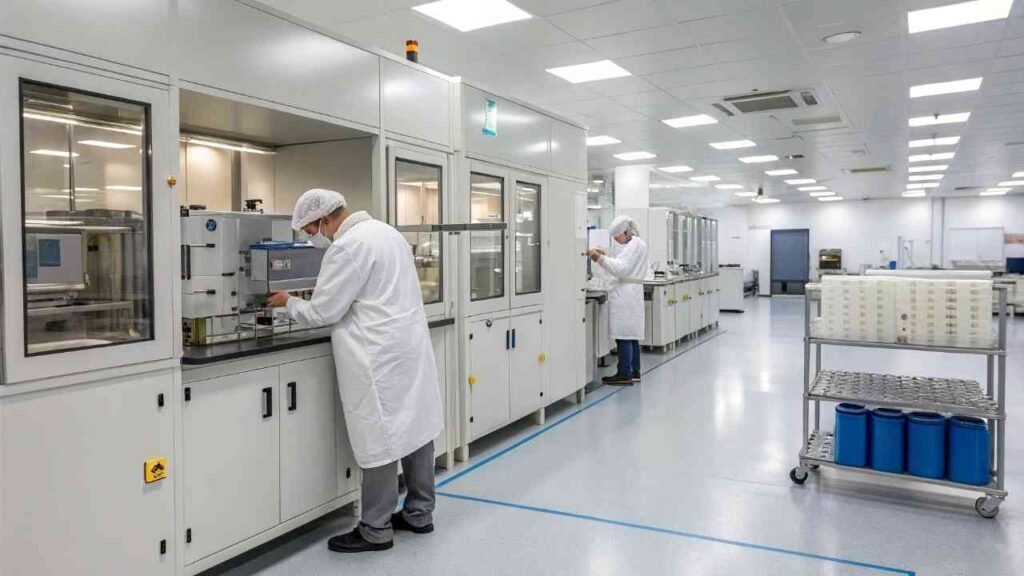
Low-quality Vitamin B1 introduces toxins and ruins the nutritional value of your food products. These failures lead to health risks and brand damage. Strict quality control ensures your additives are safe.
Vitamin B1 quality is controlled through laboratory testing for purity, heavy metals, and residual solvents. Manufacturers adhere to USP, BP, and FCC standards. Every batch undergoes HPLC testing and moisture analysis to ensure safe and consistent performance in food fortification and supplements for the global market.
Let me explain the technical steps we take to ensure every bag of Vitamin B1 meets strict industrial standards.
What Are the Key Specifications of Vitamin B1 (Thiamine)?
Incorrect chemical specifications lead to product instability and short shelf life. These technical errors waste your money and resources. Understanding key metrics helps you buy the right material for your factory.
The key specifications for Vitamin B1 include an assay level of 98.0% to 102.0% and heavy metal limits. Lead must be under 2mg/kg. Physical appearance must be a white crystalline powder. Exact thresholds for moisture and pH ensure the Thiamine performs correctly in food recipes.
Understanding Chemical Purity and Physical State
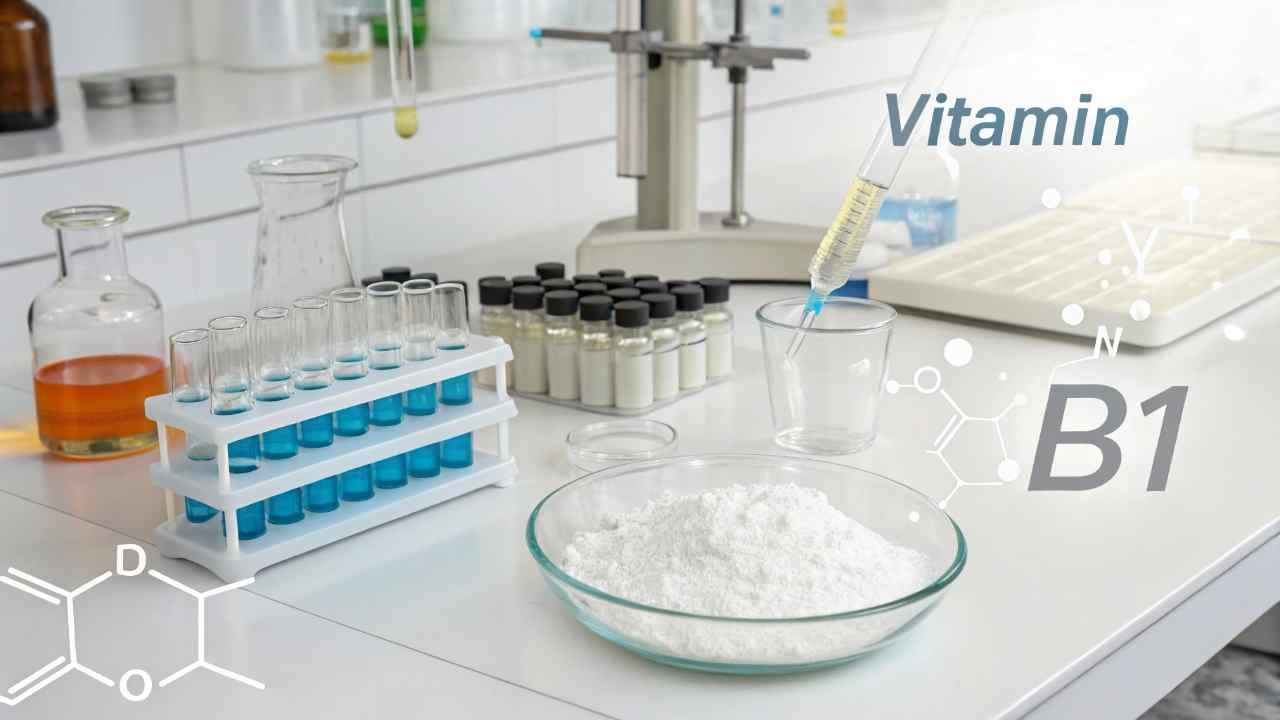
I prioritize the assay level because it determines the active Thiamine content. Food processors1 need this range to ensure their fortification recipes are accurate. If the assay is too low, you must add more powder to your mix. This increases your production costs and wastes your budget. We also verify the physical appearance of the powder. Vitamin B1 should be pure white. Any yellowing or dark spots indicate oxidation or chemical contamination. I check the solubility and the pH of the solution for every batch. Thiamine Hydrochloride is for liquid products, while Thiamine Mononitrate is for dry mixes like flour. If the pH is outside the standard range, the vitamin might react poorly with other ingredients in your final food product.
Safety metrics are the most vital part of the specification sheet. We limit heavy metals like lead and arsenic to very low parts per million (ppm). This is necessary for consumer safety2 and legal compliance in Europe and the Middle East. Synthesis chemicals, called residual solvents, must also be removed during the production process. I check that our factories use advanced vacuum drying to eliminate these traces. For my clients, I verify these safety markers personally. Using high-purity Vitamin B1 protects your brand from health risks and product recalls.
| Metric | Range (USP) | Why It Matters |
|---|---|---|
| Assay (Dry) | 98.0% - 102.0% | Strength of the vitamin |
| Appearance | White crystalline | Freshness and purity marker |
| pH Level | 2.7 - 3.4 (HCl) | Chemical compatibility |
| Lead (Pb) | Max 2 ppm | Consumer safety limit |
| Loss on Drying | < 1.0% (Mono) | Prevents clumping |
How Is Purity Tested in Vitamin B1 (Thiamine)?
Undetected impurities in vitamins can cause toxic reactions in consumers. These risks damage your brand reputation and invite lawsuits. Rigorous analytical testing is the only way to guarantee a safe product.
Purity is tested using High-Performance Liquid Chromatography (HPLC) to measure active content. Gas Chromatography (GC) detects residual solvents from the synthesis process. Labs also use Atomic Absorption Spectroscopy (AAS) for trace heavy metals to meet international safety requirements for food-grade chemicals.
Advanced Analytical Methods for Quality Assurance
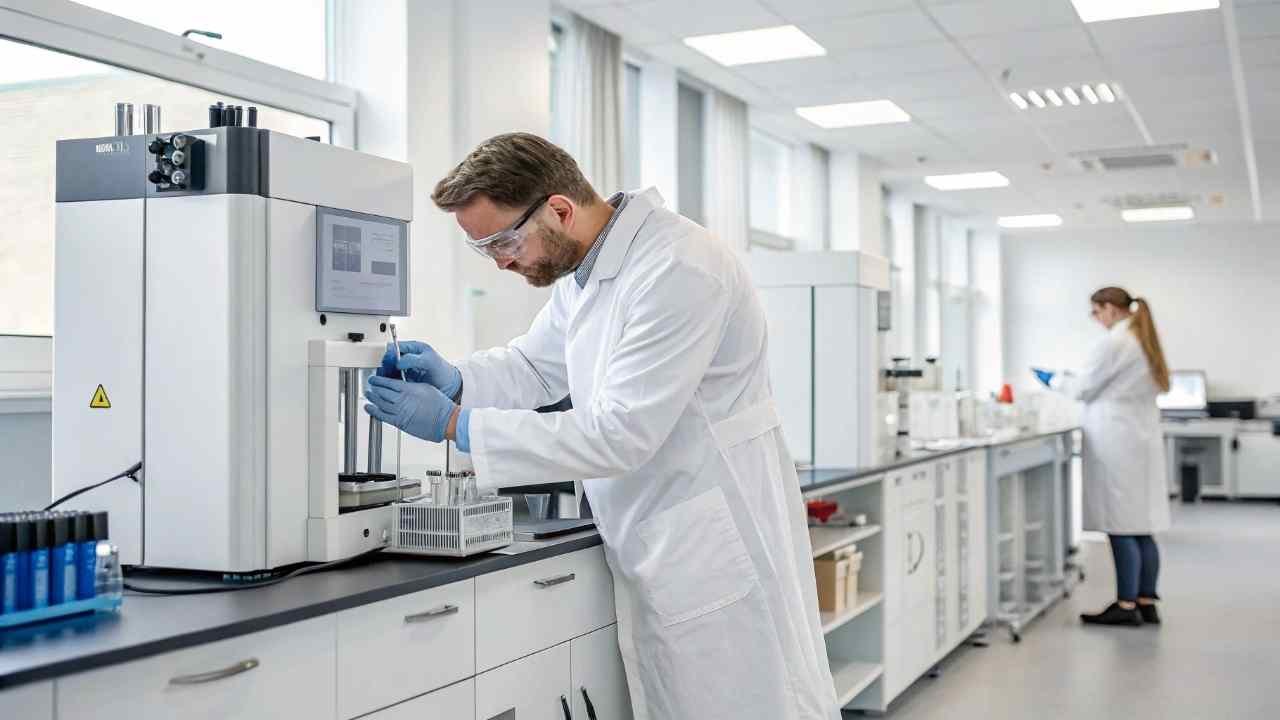
In our quality control process, HPLC3 is the most important tool. This machine separates chemical components to show the exact concentration of Vitamin B1. It also identifies any unwanted organic by-products. If the test graph shows extra peaks, we know the batch is not pure enough. This test is mandatory for meeting pharmacopeia standards. It provides technical data that simple visual checks cannot find. I review these HPLC logs before any bags are packed in the factory. GC is another critical safety test we perform. Vitamin B1 synthesis uses solvents like ethanol. These must be removed entirely during the drying phase. GC can detect these traces at the parts per million level.
Heavy metal testing requires highly sensitive equipment like AAS or ICP-MS. These machines can find a tiny grain of lead in a whole ton of product. This level of detail is required for shipments to the European Union and the USA. Wholesalers in Southeast Asia also demand these reports to prove they are selling safe goods. We also test for moisture content using a Halogen Moisture Meter. If the powder has too much water, it will clump and lose its strength quickly. I ensure every batch passes these physical and chemical hurdles before loading the container. We record all results on the Certificate of Analysis (COA) for full transparency.
| Test Type | Method Used | Success Target |
|---|---|---|
| Active Content | HPLC | 99% Minimum |
| Residual Solvents | GC | Below safety limits |
| Heavy Metals | AAS / ICP-MS | Max 10 ppm total |
| Moisture | Moisture Balance | < 1.0% (Mononitrate) |
| Identity | IR Spectroscopy | Matches standard spectrum |
What Standards Apply to Food-Grade Vitamin B1 (Thiamine)?
Using uncertified vitamins leads to legal penalties and rejected shipments. These regulatory hurdles stop your business growth. International standards provide a legal and safety framework for global food additive trade.
Food-grade Vitamin B1 must comply with FCC, European Pharmacopoeia (EP), or United States Pharmacopeia (USP) standards. Compliance with ISO 22000 and HACCP ensures the factory follows global hygiene protocols. HALAL and KOSHER certifications are also required for regional and religious markets.

Regulatory Frameworks and Facility Standards
I see that the boundary between food and pharmaceutical grade for Vitamin B1 is very small. Most large food manufacturers demand USP (United States Pharmacopeia) or BP (British Pharmacopeia) grade material. These standards define the exact testing methods and purity limits required. The Food Chemicals Codex (FCC) is another major global standard for food ingredients. Our products are made to meet all these standards at once. This allows my clients to sell their finished food products in different global markets without any compliance issues. I manage the documentation to ensure every shipment has the correct certifications for your local customs.
Beyond chemical specs, the factory must have a safe management system. ISO 22000 and HACCP4 are the top requirements for this industry. HACCP requires the factory to find and control risks in production. For example, they use fine mesh filters and magnets to stop foreign particles from entering the bags. These systems prevent accidents before the cargo reaches your port. I visit our partner factories to verify they follow these plans every day. For the Middle East and Southeast Asia, HALAL certification is mandatory. It proves no forbidden substances are used. KOSHER certification is also common for the USA and Europe. These certificates show professional management and high hygiene levels.
| Standard | Focus Area | Market Relevance |
|---|---|---|
| USP / BP | Chemical Purity | Global Pharma and Food |
| FCC | Ingredient Safety | USA and International |
| ISO 22000 | Safety Management | Global wholesale |
| HALAL | Religious Law | Middle East / SE Asia |
| KOSHER | Religious Law | USA / Europe |
How Is Batch Consistency Maintained for Vitamin B1 (Thiamine)?
Batch variation causes inconsistent nutrition and color in your final food product. These surprises make it hard to maintain quality. Process control is essential for providing a uniform product every time.
Batch consistency is maintained through automated reactor controls and standardized raw material sourcing. Manufacturers use "retainer samples" to compare new batches against previous production. Regular internal audits and batch tracking ensure uniform purity and color for every international wholesale shipment.
Standardizing the Synthesis Process and Traceability
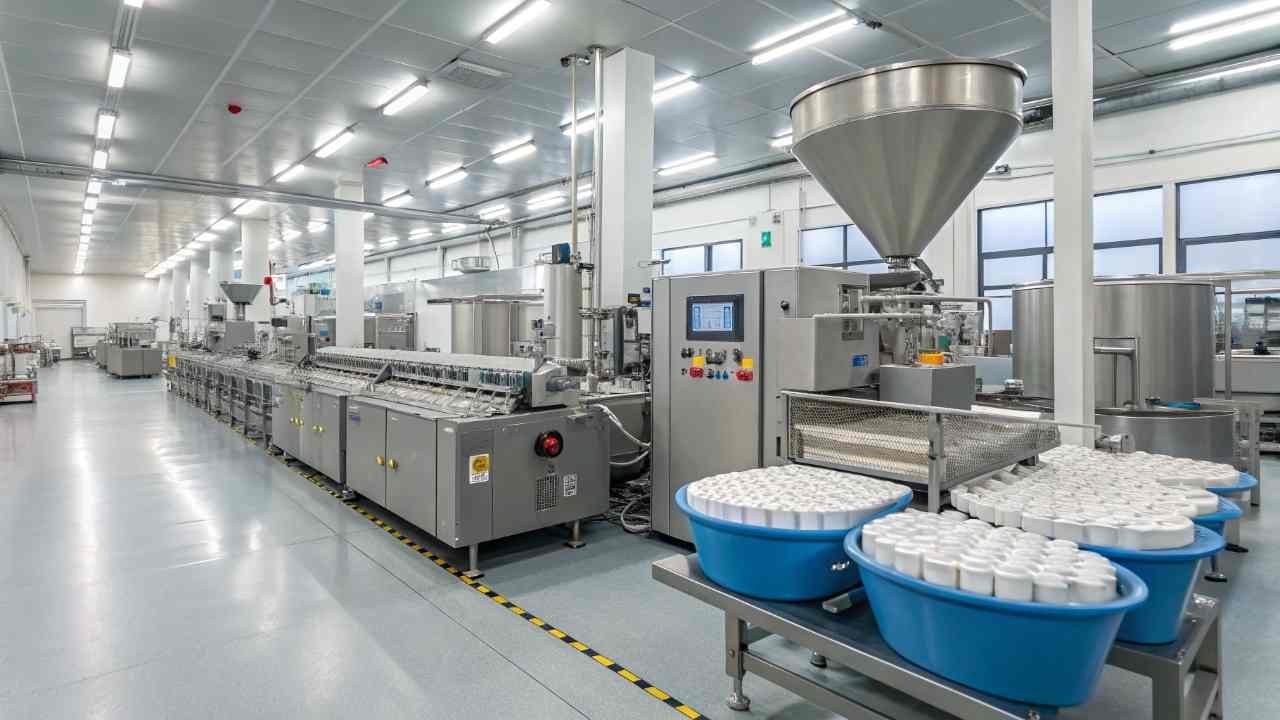
Vitamin B1 is produced through a complex chemical synthesis. If temperature, pressure, or mixing time changes even slightly, the purity drops. Modern factories in China use automated sensors to monitor reactors 24 hours a day. These sensors adjust the internal settings automatically. This removes the risk of human error during production. By keeping the environment stable, we get the same crystalline structure in every batch. This ensures the product always has the same white color and dissolution speed. I prioritize these automated factories when selecting suppliers for my clients. Consistency is the most important factor for large-scale manufacturing.
Sourcing raw materials is also key to batch stability. We use high-purity precursor chemicals. If these starting chemicals have impurities, the final vitamin will be unstable. I monitor the supply chain to ensure factories do not use lower-quality chemicals to save money. A professional factory also keeps a "retainer sample" from every single batch for two years. If a buyer in Russia or Germany has a question, we can test that sample again. we compare new production to these old samples to ensure performance is identical. This is called batch-to-batch verification. Every 25kg carton has a unique batch number for full traceability from the farm to your warehouse.
| Control Tool | Action Taken | Benefit for Buyer |
|---|---|---|
| Sensors | Real-time monitoring | Stable chemical reaction |
| Audits | Precursor testing | Uniform final purity |
| Retainers | Storing batch samples | Long-term quality tracking |
| Batch Numbers | Labeling every carton | Fast problem resolution |
How Can Buyers Verify Vitamin B1 (Thiamine) Quality?
Trusting a supplier without verification is a massive business risk. You might buy fake or expired material. Implementing your own verification steps ensures you receive exactly what you paid for.
Buyers verify Vitamin B1 quality by reviewing the Certificate of Analysis (COA) and performing independent lab tests. Using third-party inspections like SGS before shipment provides unbiased proof that the material matches international standards and your specific industrial requirements.

Independent Verification and Testing Steps
The first step for any professional buyer5 is reading the COA carefully. You must check the date of manufacture and the expiration date. Vitamin B1 usually has a 24 to 36-month shelf life. If the batch is already old, you are losing valuable time in your supply chain. I also teach my clients to check if the test results change between different shipments. If the numbers on the COA are exactly the same every time, the document might be fake. Real lab results always show small variations. I encourage large company buyers to run their own tests. When the cargo arrives, send a random sample to a local lab.
Test the assay to confirm the purity matches the report. If your results match our factory COA, we build a strong relationship based on truth. For extra safety, you can use a Pre-Shipment Inspection (PSI). You hire an independent company like SGS. Their inspector goes to the factory in China before the container is sealed. They check the labels and take random samples for their own lab. This gives you a guarantee of quality before you pay the final balance. I welcome these steps because they prove that FINETECH delivers high-quality Vitamin B1 every time. My goal is to make your procurement process transparent and safe.
| Method | Timing | What it Proves |
|---|---|---|
| COA Review | Every order | Freshness and basics |
| Local Lab Test | Upon arrival | Supplier honesty |
| PSI (SGS) | Pre-loading | Unbiased quality proof |
| Factory Audit | Periodic | Safety system validity |
Conclusion
Quality control for Vitamin B1 requires strict specs, advanced testing, and reliable tracing. I manage these details to ensure your food products stay safe and nutritious.
-
Food Processing – An industry resource for food enterprises and manufacturers to stay updated on processing trends and technological advancements. ↩
-
Food Safety Magazine – A leading publication covering news and best practices in food safety and regulatory compliance for consumer safety. ↩
-
Waters Corporation – A specialized resource for technical personnel detailing HPLC methods and application notes in laboratory testing. ↩
-
U.S. FDA – Federal guidelines on HACCP principles, which are essential for technical staff managing safety and risk in food processing plants. ↩
-
CIPS – A professional organization providing procurement knowledge and trade-oriented skills for buyers in international supply chains. ↩