
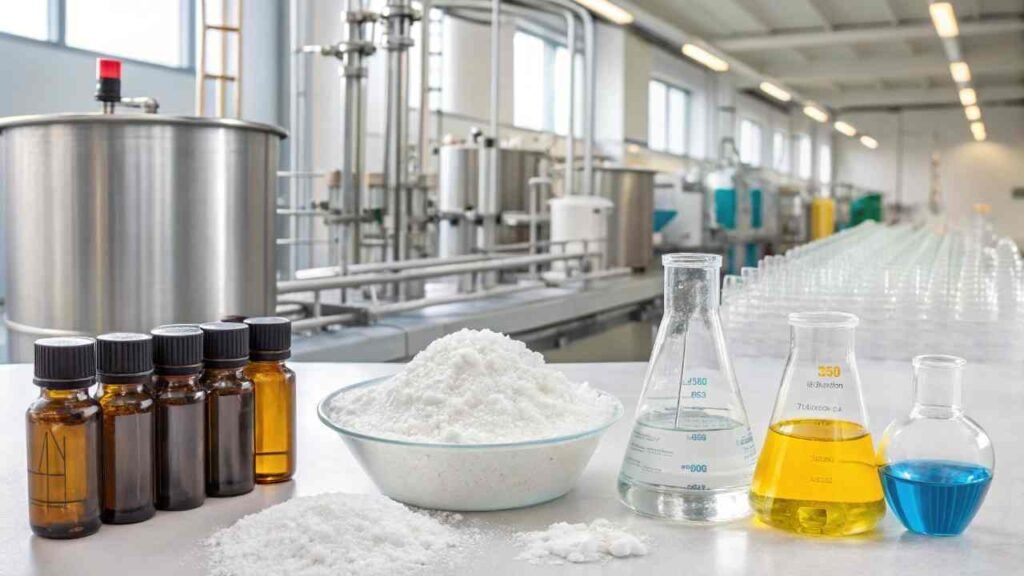
Using the wrong form of Vitamin B5 ruins your product stability. This mistake wastes your money. I explain the technical differences to help you choose the right material for your business.
D-Calcium Pantothenate is the preferred form for food, supplements, and feed because it is highly stable. While pure Pantothenic Acid is unstable and rarely sold, D-Panthenol is used for liquids and cosmetics. Most B2B buyers choose the 98% or 99% crystalline powder for fortification.
I manage factory selection and quality oversight for my clients at FINETECH. I want to explain the technical facts about Vitamin B5 forms to help you protect your inventory and manufacturing results.
What Is the Difference Between Vitamin B5 (Pantothenic Acid) and D-Calcium Pantothenate?
Pure Pantothenic Acid is too unstable for trade. It breaks down before it reaches your factory. I help you understand why D-Calcium Pantothenate is the industrial gold standard for supply.
D-Calcium Pantothenate is the calcium salt of Vitamin B5. It is a stable, white crystalline powder. Pure Pantothenic Acid is a sticky, unstable oil that degrades easily. Therefore, nearly all Vitamin B5 products in the global wholesale market are D-Calcium Pantothenate.
Chemical Stability and Industrial Usage
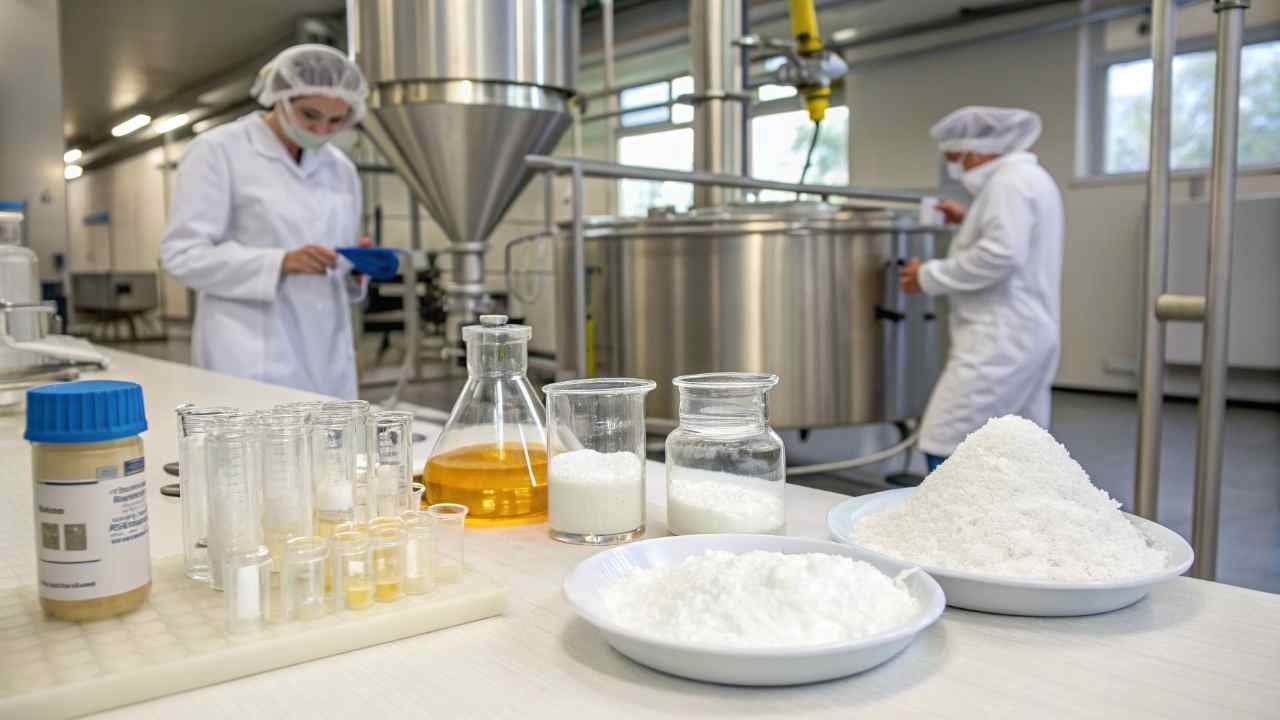
I see that many new buyers get confused by the names. But in the chemical industry, stability is everything. Pure Pantothenic Acid is a viscous oil. It is very hygroscopic, which means it absorbs water from the air very fast. This makes it impossible to ship in 25kg drums. It would turn into a sticky mess and lose its potency. To solve this, factories in China react the acid with calcium to create a salt. This salt is D-Calcium Pantothenate1. It is a dry, white powder. It is easy to weigh, easy to mix, and very stable during long-distance shipping to the Middle East or Europe.
I prioritize this salt form because it protects your investment. D-Calcium Pantothenate has a long shelf life of 36 months. It does not react easily with light or air if it is sealed. When I audit factories, I check their synthesis process. They must ensure the calcium bond is strong. This ensures the powder stays free-flowing. Also, the "D" in the name is critical. Only the "D" isomer is biologically active. The "L" isomer is useless for human or animal nutrition. I ensure every batch I ship is 100% D-isomer. This technical detail2 ensures your final product has the nutritional power you claim on your label.
Comparison of Chemical Properties
| Property | Pantothenic Acid (Pure) | D-Calcium Pantothenate (Salt) |
|---|---|---|
| Physical State | Yellowish Oil | White Crystalline Powder |
| Stability | Very Low (Degrades fast) | Very High (3-year shelf life) |
| Handling | Very Difficult / Sticky | Easy / Free-flowing |
| Solubility | Soluble in Water | Highly Soluble in Water |
| Commercial Form | Rare | Global Standard |
| Main Use | Laboratory Research | Food / Feed / Pharma |
How Does Solubility Affect Vitamin B5 (Pantothenic Acid) Performance?
Poor solubility leads to uneven mixing and sediment. This ruins your beverages or supplements. I explain how to manage solubility to ensure your products meet high-quality standards every time.
D-Calcium Pantothenate is highly soluble in water, making it perfect for fortified drinks and liquid supplements. It dissolves quickly without leaving residues. For oil-based applications, different formulations are needed, but the standard powder is ideal for aqueous systems.
Processing Efficiency in Liquid Applications
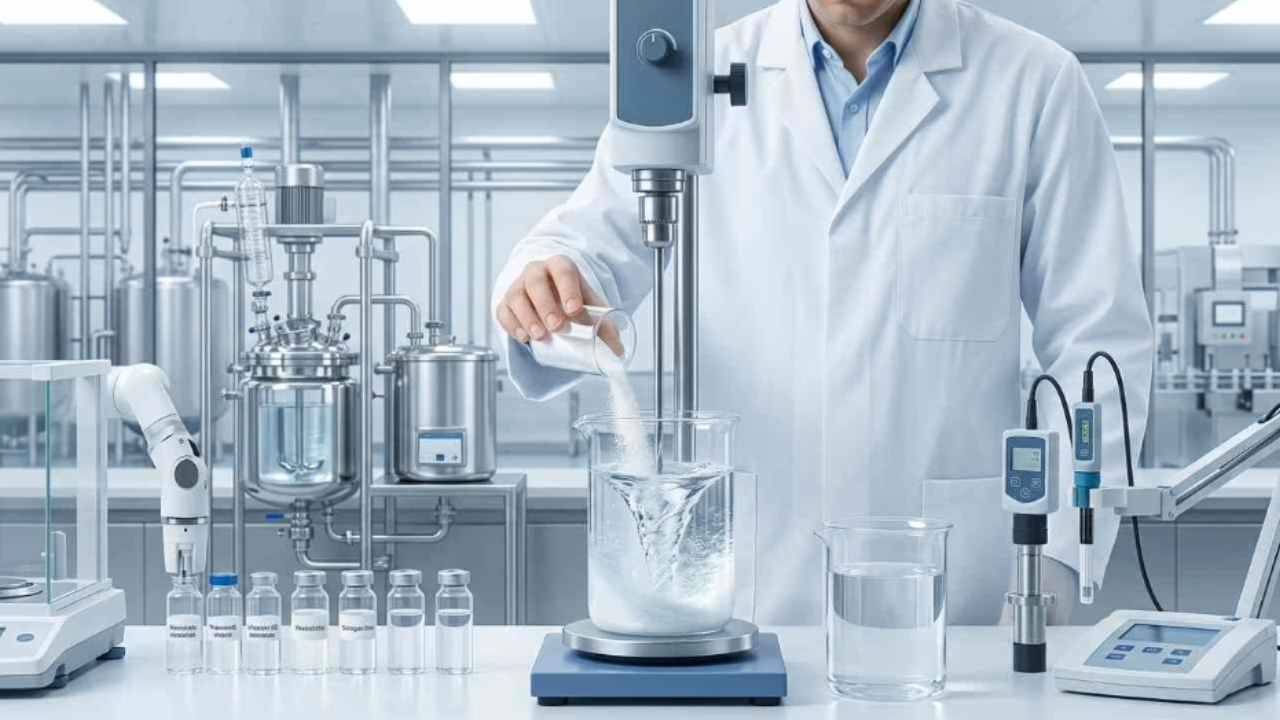
I see a high demand for Vitamin B5 in the energy drink and functional water sectors. In these applications, solubility is a technical requirement. D-Calcium Pantothenate is very friendly to water. It dissolves at a rate of about 1 gram in 3 ml of water. This is very fast. It does not need high heat to dissolve. This is good because high heat can damage other vitamins in your mix. I suggest using the fine-mesh powder for liquids. Smaller particles have more surface area. They go into solution even faster. This prevents "cloudy" drinks and ensures your customers3 see a clear, professional product.
But you must be careful with the pH of your liquid. Vitamin B5 is most stable at a pH between 5.0 and 7.0. If your drink is too acidic, the vitamin can slowly break down over time. I help my buyers in Southeast Asia and the Middle East understand these chemistry facts. We also look at the interaction with other minerals. Since our B5 is a calcium salt, it adds a tiny amount of calcium to the water. In most cases, this is not a problem. But for very sensitive formulas, you must account for this. I oversee the selection of 99% purity material for these liquid clients. High purity means fewer impurities that could cause off-flavors or weird colors in your drink.
Solubility and Processing Factors
| Factor | Performance | Business Result |
|---|---|---|
| Cold Water | Fast Dissolving | Efficient cold-mix production |
| Hot Water | Very Fast Dissolving | Safe for pasteurized drinks |
| High pH (>8) | Less Stable | Risk of potency loss |
| Low pH (<4) | Unstable over time | Needs buffer for long shelf life |
| Alcohol | Partially Soluble | Used in some tinctures |
| Glycerin | Soluble | Good for cosmetic bases |
Which Form of Vitamin B5 (Pantothenic Acid) Is More Stable in Feed?
Heat and moisture in feed mills destroy vitamin potency. This loss hurts livestock growth and your profits. I help you select the most robust Vitamin B5 grade to survive harsh processing conditions.
D-Calcium Pantothenate is the most stable form for animal feed. It resists high temperatures and humidity during pelleting. Feed-grade 98% powder is the industry standard because it maintains its bio-activity much longer than other vitamin derivatives in mixed rations.
Feed Mill Survival and Bio-activity
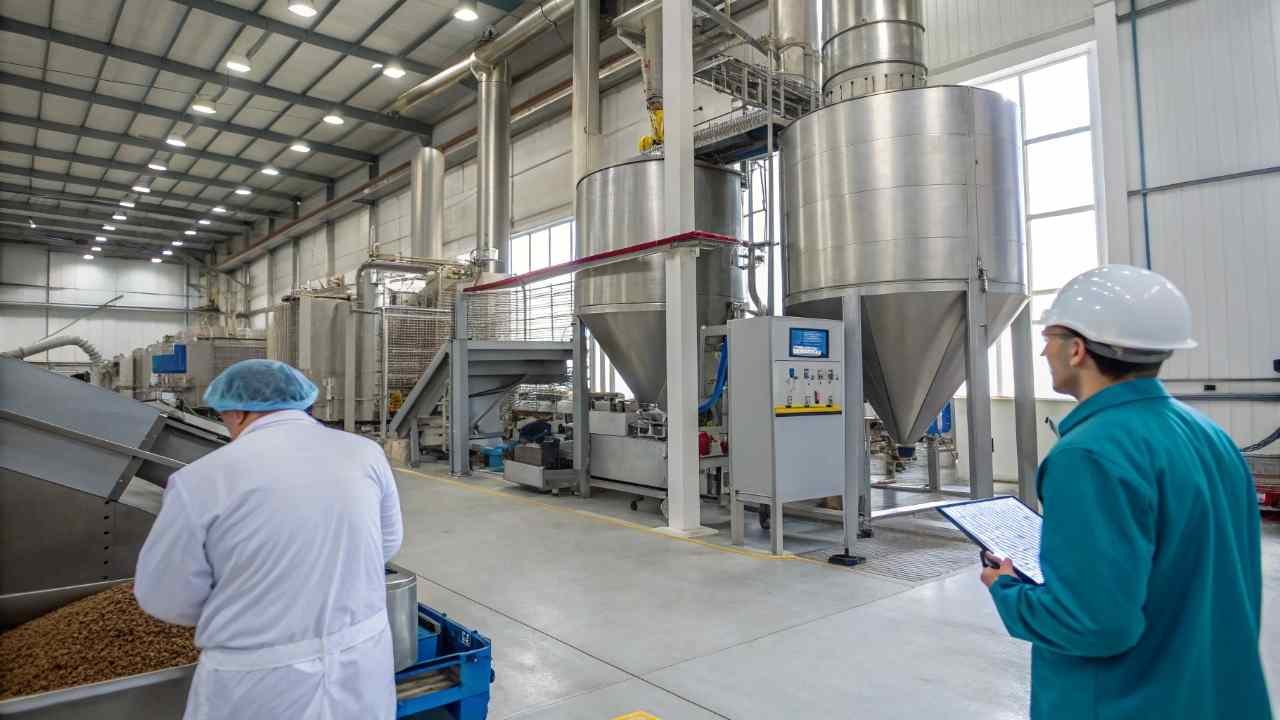
I observe that the animal feed industry is a high-volume market with tough conditions. Feed mills use steam and pressure to make pellets. This process is called "pelleting" or "extruding." It creates a lot of friction and heat. Vitamin B5 must survive this heat to reach the animal. D-Calcium Pantothenate is a technical winner here. It has a high melting point and resists thermal degradation. I only source 98% feed-grade material that has been tested for stability. This ensures that even after the pelleting process, the animals still get the nutrition they need. This protects the reputation of the feed wholesaler4.
Also, we must consider the shelf life inside the feed premix. Feed premixes contain minerals like copper and iron. These minerals can act as catalysts and destroy vitamins. D-Calcium Pantothenate is less reactive than the liquid Panthenol used in cosmetics. It stays stable in the bag for many months. I suggest my buyers in Russia and Indonesia use the crystalline form. This form has a lower surface area than a spray-dried powder. It is more resistant to oxidation. I check the moisture content of every batch. It must be below 5.0%. Low moisture prevents the powder from caking and ensures it mixes evenly with the corn and soy in the feed.
Stability Factors in Feed Production
| Risk Factor | Impact on Vitamin | B5 Resistance Level |
|---|---|---|
| Pelleting Heat (80°C+) | Potential breakdown | High |
| Steam / Humidity | Caking risk | Moderate (Requires dry storage) |
| Mineral Interaction | Oxidation | High (Salt form is stable) |
| Long-term Storage | Potency loss | Low (36-month stability) |
| Pressure / Friction | Physical crushing | High |
How Should Buyers Choose the Right Vitamin B5 (Pantothenic Acid) Grade?
Choosing the wrong grade leads to regulatory fines or manufacturing failures. This risk is too high for your brand. I provide the technical facts to help you select the correct USP/EP grade for your needs.
Buyers should choose based on end-use: USP/EP food-grade for human nutrition and FAMI-QS/ISO for animal feed. Always check the assay purity, heavy metal limits, and certifications like HALAL to ensure the grade matches your local market requirements and safety laws.
Navigating Regulations and Certifications
I see that different regions have different rules. If you are selling to a food factory in Germany, you must have the EP (European Pharmacopeia) or FCC (Food Chemicals Codex) grade. These grades have very low limits for heavy metals. For example, Lead must be below 2 mg/kg. I manage this by selecting factories in China that have dedicated food-grade lines. These lines are audited for HACCP5 and ISO 22000. This is the only way to ensure the product is safe for humans. For my buyers in Saudi Arabia and the UAE, I also provide HALAL and KOSHER certificates. These are not just papers. They are a requirement for market entry.
Wholesalers often ask if they can use feed-grade for food. My answer is always "No." Feed-grade 98% is excellent for livestock. But it does not have the same strict testing for impurities. It might have higher microbial counts or different residual solvents. For a supplement distributor in Korea or Malaysia, the USP grade is the standard. It has a purity of 99.0% or higher. I check the COA (Certificate of Analysis) for every batch. I look at the "Specific Rotation." It must be between +25.0° and +28.5°. If it is outside this range, it is not pure D-isomer. I act as your technical gatekeeper to ensure you never receive the wrong grade for your application.
Grade Selection Guide for B2B Buyers
| Industry | Required Grade | Key Certification | Assay Requirement |
|---|---|---|---|
| Food Fortification | FCC / USP / EP | ISO 22000 / HACCP | 99.0% Min |
| Dietary Supplements | USP / EP | GMP | 99.0% Min |
| Animal Feed | FAMI-QS | ISO 9001 | 98.0% Min |
| Cosmetics | Cosmetic Grade | ISO 22716 | Varies (D-Panthenol) |
| Pharmaceutical | Pharma Grade | GMP / CEP | 99.5% Min |
How Do Specifications Influence Vitamin B5 (Pantothenic Acid) Applications?
Incorrect mesh size or assay levels cause production errors. These mistakes stop your factory and waste your time. I manage the technical specifications to ensure the material fits your specific production lines perfectly.
Specifications like particle size (mesh) and assay purity determine application success. Fine powders are best for dry mixes, while specific rotation proves bio-activity. Accurate specs prevent clumping and ensure even distribution in large-scale food and supplement manufacturing processes.

Particle Size and Homogeneity
I see that "homogeneity" is a big word in food science. It means that every gram of your final product has the same amount of vitamins. To get this, you need a consistent mesh size. Most of my buyers prefer an 80-mesh or 100-mesh powder. This is a very fine powder. It mixes perfectly with flour, sugar, or milk powder. If the particles are too large, they will sink to the bottom of the bag during shipping. This is called "segregation." It means the customer at the top of the bag gets no vitamins. I check the sieve analysis at the factory. We ensure that 95% of the powder passes through the specified mesh.
Assay purity is also a technical fact you must track. Most food-grade D-Calcium Pantothenate is 99%. This is the "assay on dried basis." It tells you how much active vitamin is in the powder after you remove the moisture. I provide a detailed COA that shows the "Loss on Drying." It should be below 5.0%. If it is higher, you are paying for water, not vitamins. Plus, high moisture causes the powder to cake. Caked powder is a nightmare for your warehouse and your machines. I oversee the packaging to ensure we use double PE liners and fiber drums. This keeps the specs stable from my office in China to your warehouse.
Technical Specification vs. Application Success
| Specification | Technical Detail | Application Result |
|---|---|---|
| Assay (Purity) | 99.0% Min | Accurate nutritional labeling |
| Specific Rotation | +25.0° to +28.5° | Guaranteed bio-activity |
| Particle Size | 80 - 100 Mesh | Even mixing / No segregation |
| Loss on Drying | < 5.0% | Free-flowing / No clumping |
| Heavy Metals | < 10 ppm | Safety compliance |
| Appearance | White Powder | No effect on final product color |
Conclusion
Choosing the right Vitamin B5 form and grade ensures product stability and business growth. I manage these technical choices at FINETECH to keep your procurement safe, simple, and profitable.
-
PubChem - Detailed chemical database for D-Calcium Pantothenate (Vitamin B5) providing properties and manufacturing safety data. ↩
-
ScienceDirect - Professional resource for managing technical documentation and engineering details for technical personnel in chemical supply chains. ↩
-
Food Processing - An industry hub for food enterprises and manufacturers to stay updated on production and technology trends. ↩
-
Investopedia - Explaining the role of wholesalers and buyers in the global distribution and bulk procurement network. ↩
-
U.S. FDA - Official guidelines on HACCP principles used by technicians and safety managers to prevent contamination in food production. ↩