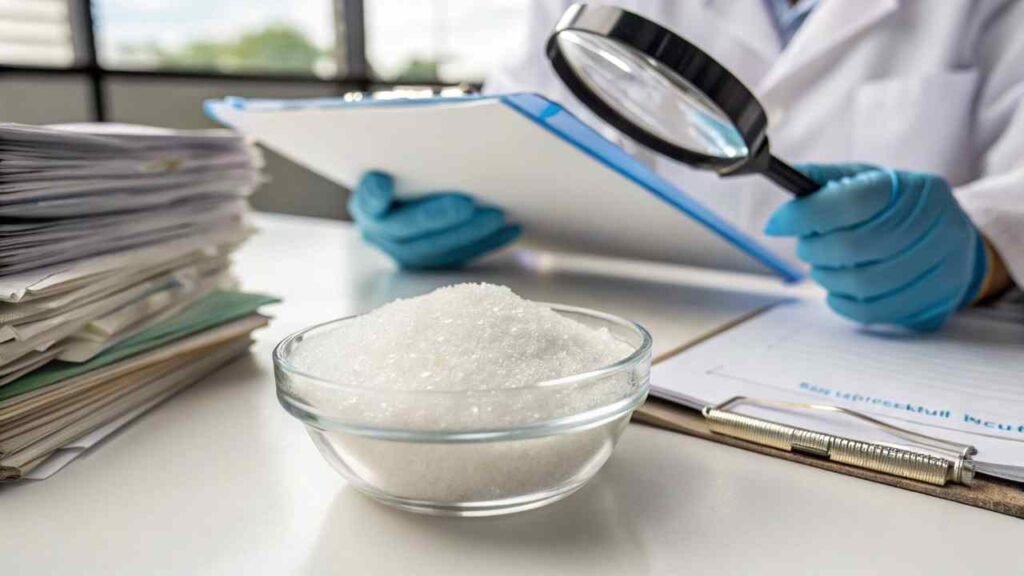
Importing Erythritol involves complex quality issues and potential payment fraud. These risks threaten your capital and business stability. I offer professional strategies to secure your international procurement and minimize trade risks.
To reduce Erythritol import risks, buyers must verify batch-specific COAs, use third-party inspections like SGS, and choose secure payment terms such as L/C or T/T with Sinosure. Selecting vetted manufacturers with ISO, GMP, and Halal certifications ensures product compliance and supply chain safety.
I manage factory selection and quality oversight for my B2B clients at FINETECH. I want to share the technical facts about risk reduction so you can protect your wholesale business and profit margins.
What documents are required for Erythritol import?
Missing paperwork stops your cargo at the port and leads to heavy fines. This delay kills your distribution schedule. I list the essential documents you need for a smooth customs clearance.
Mandatory documents include the Bill of Lading, Commercial Invoice, Packing List, and a batch-specific Certificate of Analysis (COA). For food safety, you also need a Health Certificate, a Non-GMO Statement, and Halal or Kosher certificates depending on your local market regulations.

Ensuring Legal and Technical Compliance
I see that "Paperwork" is the first line of defense in international trade. If your documents are wrong, your container stays at the dock. You then pay high storage fees. The most important document is the Certificate of Analysis (COA). It must match the batch number on the bags exactly. I check that the COA includes the assay, mesh size, and heavy metal results. If these numbers are missing, your local health department might reject the goods. I also ensure the Health Certificate is issued by the GACC (General Administration of Customs of China). This is an official proof that the factory follows food safety laws.
For my clients in the Middle East and Southeast Asia, Halal and Kosher certificates are technical requirements. I check the expiration dates on these papers every month. If a certificate is expired, you cannot sell the product as Halal. I also provide a Material Safety Data Sheet (MSDS). This tells your warehouse staff how to handle the Erythritol safely. It also lists the HS Code1, which is 2905499000. Using the correct HS Code prevents tax disputes with your customs office. I act as your administrative office in China to manage these details. By getting the documents right, I ensure your Erythritol moves through the port without any questions.
Essential Document Checklist
| Document Name | Technical Purpose | FINETECH's Verification Method |
|---|---|---|
| COA | Proves chemical purity | Match batch ID to bag labels |
| Health Certificate | Official safety proof | Verify GACC official seal |
| Packing List | Details weight/pallets | Check net vs gross weight logs |
| MSDS | Safety/HS Code info | Confirm HS Code 2905499000 |
| Non-GMO Statement | Verification of origin | Trace corn starch source |
| Halal/Kosher | Religious compliance | Verify validity and body name |
| Invoice | Commercial record | Match prices to signed PI |
How to avoid counterfeit or low-quality Erythritol?
Receiving off-spec sweetener ruins your food formulation and upsets your customers. This quality failure destroys your brand. I provide technical ways to filter out low-quality batches before they ship.
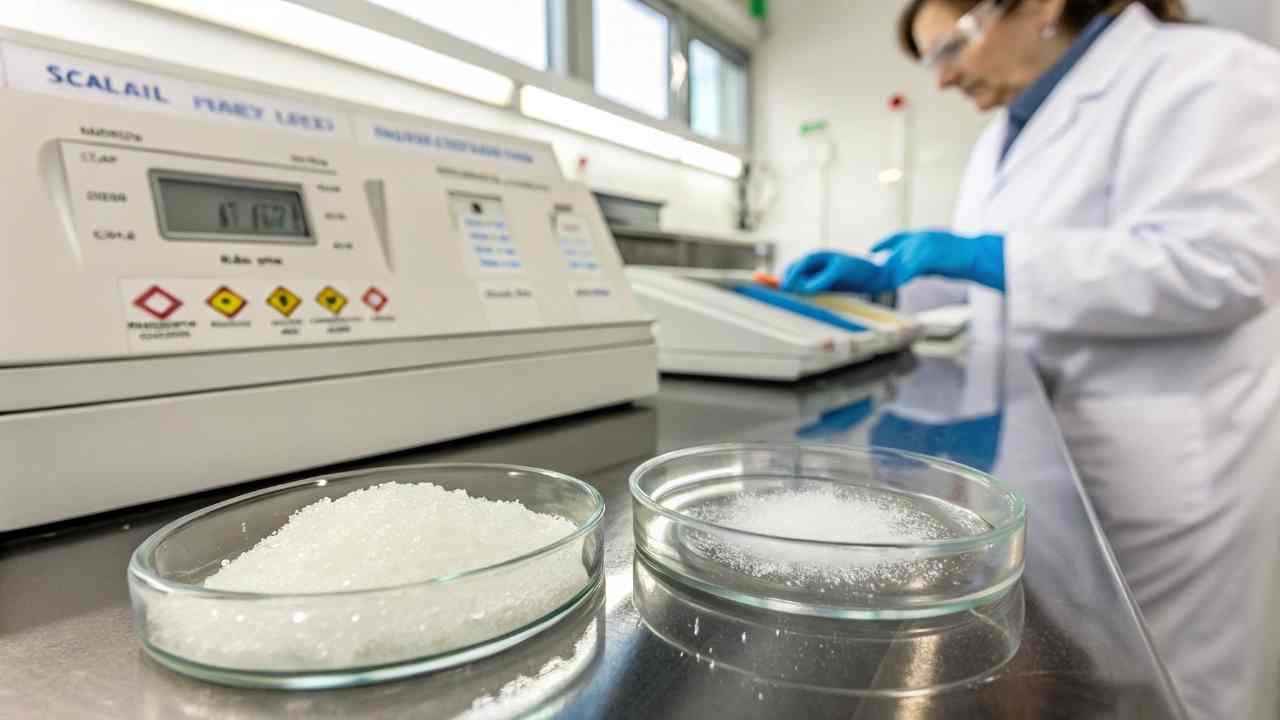
Avoid low-quality Erythritol by requesting pre-shipment samples and comparing them with the final cargo. Verify factory certifications like BRC, ISO 22000, and GMP. Conducting an independent lab test for assay, moisture, and heavy metals ensures the product meets USP or FCC standards.
Critical Thinking on Quality Sourcing
I see that "Cheap" is often the most expensive choice. If a supplier offers a price 20% below the market, you should be careful. They might be blending Erythritol with cheaper fillers like Maltodextrin. This changes the sweetness and the glycemic index2. I use a "Retention Sample" system. I keep a sample of every batch I ship. If you have a problem, we test my sample. This prevents factories from sending a good sample and a bad cargo. I also check the physical properties. Erythritol should be snow-white. If it is yellow, the purification was poor. I also check the moisture. It must be below 0.2%. If it is higher, the powder will turn into a hard block.
I also focus on the "Clean Room" standards. I visit the packing areas to ensure workers wear full gear. This prevents hair or dust from getting into your bags. I use magnetic separators on the production line. These catch any tiny metal bits from the machines. This level of technical oversight is how I protect your brand. I also check the yeast strain used in fermentation. A stable strain leads to a stable taste. If the factory changes the yeast to save money, the Erythritol might have an off-smell. I act as your technical gatekeeper in China to avoid these risks. Quality is not an accident. It is the result of strict management and honest lab work.
Quality Red Flags vs. Solutions
| Quality Red Flag | Potential Risk | FINETECH's Protective Solution |
|---|---|---|
| Yellowish Color | Poor filtration / Impurities | Visual audit of every batch |
| Caked / Hard Powder | High moisture content | Use double-layer PE liners |
| Strange Smell | Fermentation failure | Sensory test before loading |
| Price Too Low | Adulteration / Blending | HPLC test for purity |
| Dusty Packing | Cleanroom failure | On-site packing supervision |
| No Batch Number | Lack of traceability | Reject and request relabeling |
What payment terms are safest for Erythritol trade?
Sending full payment upfront to an unverified supplier is a massive gamble. Losing your deposit ruins your cash flow. I explain the safest payment structures to protect your money and your business capital.
The safest payment terms include an Irrevocable Letter of Credit (L/C) at sight or a 30% T/T deposit with the 70% balance paid against shipping documents. For established buyers, using Sinosure-backed credit terms (OA) provides the best financial protection and capital flexibility in B2B trade.

Protecting Capital and Cash Flow
I see that cash flow is the lifeblood of a wholesaler. You should never pay 100% upfront for a sea shipment. This gives you zero leverage. I suggest a 30/70 T/T structure. You pay 30% to start production. I monitor the factory progress for you. When the goods are on the ship, I send you a copy of the Bill of Lading (BL)3. You pay the balance only after you see the proof of shipment. This balances the risk between you and the producer. For very large orders, an L/C is best. Your bank and the factory bank manage the risk. The factory only gets paid if they provide the correct documents. This is a technical requirement for high-value trade.
I also help my long-term clients use Sinosure4. This is the China Export & Credit Insurance Corporation. If your company has a good credit rating, I can apply for an "Open Account" (OA) limit. This means you can pay 30, 60, or even 90 days after the goods arrive. This is the ultimate tool for growth. It lets you sell the Erythritol before you pay the bill. I manage the application process and provide your financial papers to the insurance office. This reduces your financial stress. I act as your strategic partner to optimize these payment paths. Safe payments ensure that even if there is a dispute, your money is not lost.
Payment Term Risk Comparison
| Payment Method | Risk to Buyer | Risk to Seller | Best Application |
|---|---|---|---|
| 100% Prepay | Extremely High | Zero | Samples only |
| L/C at Sight | Very Low | Low | Large bulk orders |
| T/T 30% / 70% | Moderate | Moderate | Standard B2B orders |
| D/P (Documents) | Moderate | Moderate | Regular partners |
| OA (Sinosure) | Low | Low (Insured) | VIP long-term clients |
How to evaluate Erythritol supplier reliability?
Working with an unstable factory leads to delivery delays and inconsistent quality. This lack of reliability blocks your business growth. I show you how to audit suppliers like a professional to ensure a steady supply.
Evaluate reliability by checking the supplier's export history, financial stability, and manufacturing scale. A reliable partner should have an in-house lab, valid ISO and GMP certificates, and positive references from buyers in your region. On-site audits or video inspections provide further proof of capacity.
Auditing Beyond the Website
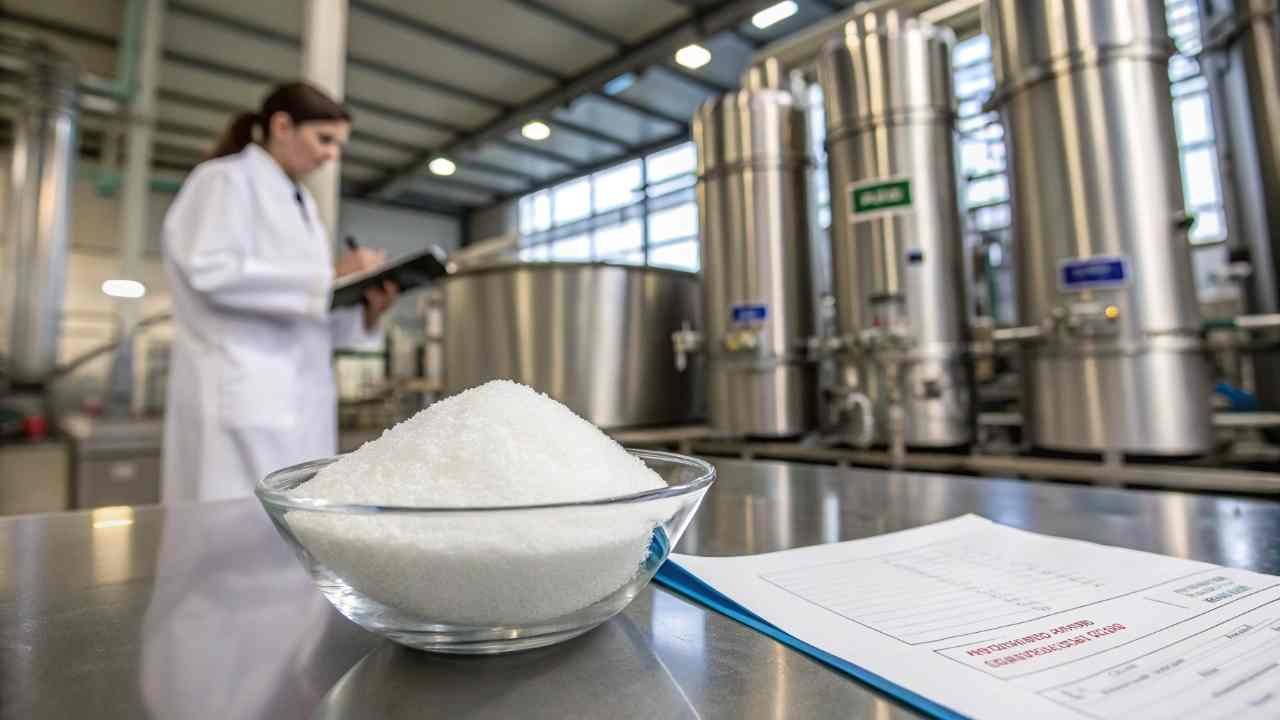
I see that every factory has a beautiful website. But you cannot buy based on photos. You must look at the technical facts. I check their "Export Credit" status in China. This tells me if they have legal problems or unpaid debts. I also look at their production capacity. If they only have small tanks, they cannot handle a large surge in demand. I prioritize factories with 100,000-liter fermentation tanks. This scale ensures they are professional. I also check their "GACC" registration number. This is the license to export food to your country. If the license is expired, your cargo will be blocked. I verify this in the government database for you.
Responsiveness is another sign of reliability. If a supplier takes three days to answer a simple question about mesh size, they will be slow when there is a real problem. I test their technical knowledge. I ask about their yeast strains and waste water treatment. A reliable producer knows their process perfectly. I also look for "Third-Party Audits." If they have a BRC or FSSC 22000 certificate, it means an outside expert has checked their safety. I act as your office in China to perform these audits in person. I visit the control rooms and the labs. This physical check is the only way to be 100% sure. Trust is built on data and site visits, not just emails.
Supplier Evaluation Matrix
| Evaluation Factor | Weight | Ideal Indicator | FINETECH's Check Method |
|---|---|---|---|
| Certification | 25% | BRC, ISO, GMP, Halal | Verify certificate numbers |
| Capacity | 20% | > 20,000 Tons / Year | Check tank count & size |
| Compliance | 20% | GACC Registered | Government database check |
| Lab Ability | 15% | HPLC / AAS in-house | Audit lab equipment |
| Reputation | 10% | 5+ Years Exporting | Check shipping records |
| Response | 10% | < 12 Hours | Track email reply speed |
What inspection methods ensure Erythritol compliance?
Hidden impurities or wrong particle sizes lead to production line failures. You cannot fix these problems after the goods arrive at your warehouse. I implement strict inspection methods to catch errors early and ensure compliance.
Ensure compliance by using Pre-Shipment Inspection (PSI) from firms like SGS or Intertek to verify weight, packaging, and quality. Lab tests should use HPLC for assay and Atomic Absorption for heavy metals. A loading supervision service ensures the container is clean and the goods are handled correctly.
Technical Inspection Protocols
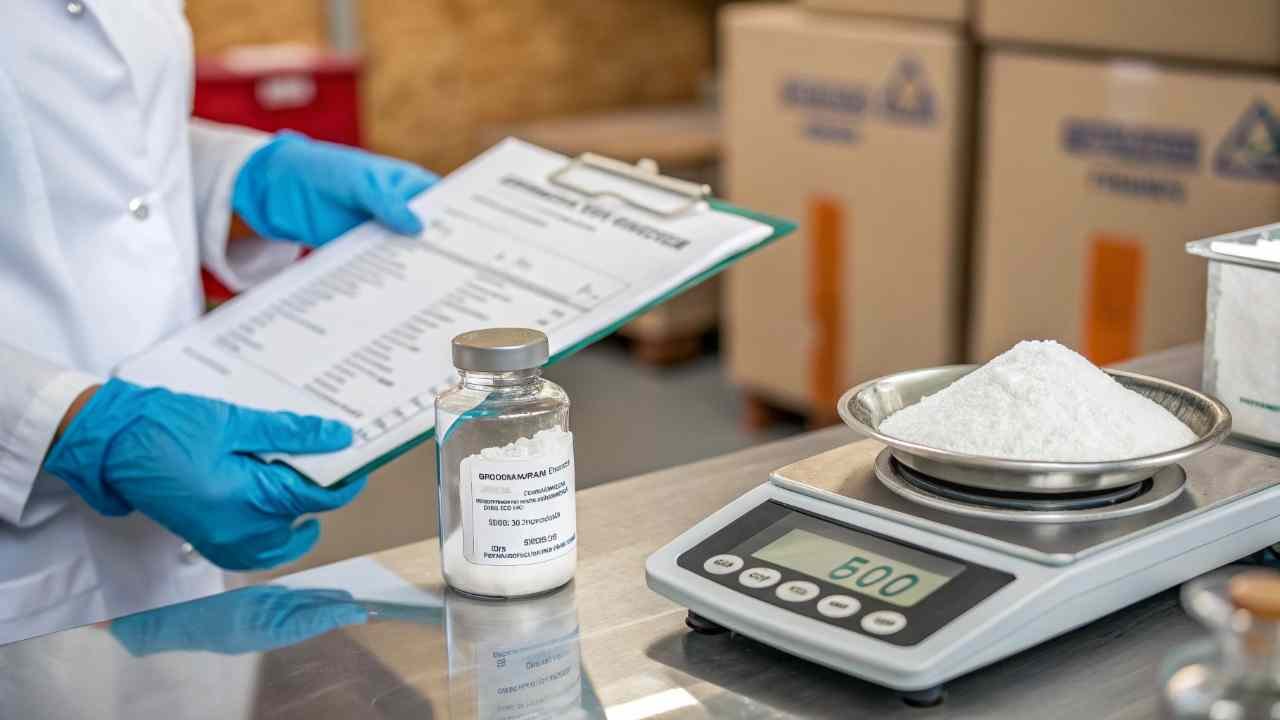
I see that "Verification" is the final step of risk management. You must not skip it. I hire third-party inspectors like SGS to visit the factory before the container is sealed. They take random samples from different drums. They check the mesh size using a sieve shaker. If you ordered 30-60 mesh, and they find too many fines, we stop the shipment. This is a technical requirement for your filling machines. The inspectors also weigh the bags. If a 25kg bag is only 24.5kg, you lose money on every pallet. I ensure the scale is calibrated. This physical oversight prevents "Short Weight" scams.
The lab test is the most technical part. We use HPLC5 (High-Performance Liquid Chromatography) to prove the purity is 99.5%. We also test for "Reducing Sugars." These should be below 0.3%. If they are higher, the product is not truly sugar-free. I also supervise the loading process. I check the container for smells, holes, or dampness. I ensure the pallets are wrapped tightly with corner protectors. This prevents the bags from falling during the sea voyage. I also check the security seal. The seal number must match the Bill of Lading. This prevents cargo theft or swapping. I act as your strategic partner to manage these technical protocols. Proper inspection is the only way to sleep well after you send the payment.
Technical Inspection Standards
| Inspection Point | Technical Standard | Tool / Method | Importance |
|---|---|---|---|
| Purity Assay | 99.5% - 100.5% | HPLC | Ensures sweetener value |
| Mesh Size | 18-60 or 100 Mesh | Sieve Analysis | Production compatibility |
| Heavy Metals | Lead < 0.1 ppm | Atomic Absorption | Health and safety |
| Net Weight | 25.0 kg / bag | Calibrated Scale | Commercial honesty |
| Contamination | Zero black specks | Visual / Light box | Brand reputation |
| Moisture | < 0.20% | Drying Oven | Prevents caking |
Conclusion
Reducing Erythritol import risks requires strict document management, quality audits, and secure payment terms. I manage these technical details at FINETECH to ensure your procurement is safe, profitable, and efficient.
-
World Customs Organization – Official repository for the Harmonized System used to classify traded products for customs purposes. ↩
-
Glycemic Index Foundation – In-depth explanation of how various sweeteners and additives affect blood glucose levels. ↩
-
Investopedia – A detailed look at the legal and logistical importance of the Bill of Lading in international shipping. ↩
-
Sinosure Official – Homepage of the China Export & Credit Insurance Corporation, outlining credit insurance services for global buyers. ↩
-
Chromatography Today – Industry insights into the application and technical mechanics of High-Performance Liquid Chromatography. ↩