

Poor quality MSG ruins your food formulas and causes customer complaints. This inconsistency destroys your brand trust. I ensure strict quality control to protect your wholesale business and profit margins.
Quality control in MSG trade is essential to ensure purity above 99%, maintain crystal size consistency, and prevent contamination. Proper testing ensures compliance with international food safety standards, avoids customs rejections, and guarantees the flavor profile remains stable in large-scale food manufacturing.
I manage factory selection and oversee production for my B2B clients at FINETECH. I want to share the technical facts about quality control so you can secure a stable and safe supply chain for your food business.
How is MSG quality tested before shipping?
Shipping untested MSG is a huge gamble with your capital. One bad container leads to total rejection. I oversee rigorous lab testing to ensure every bag meets your exact specs.
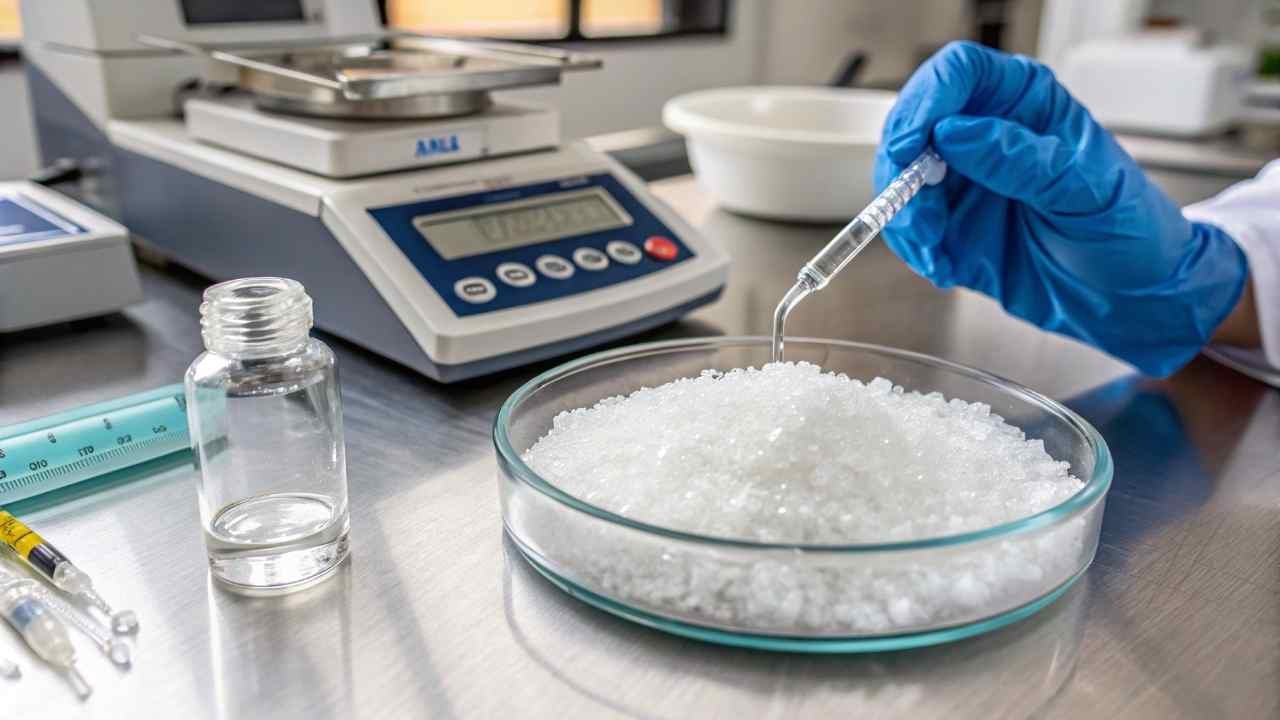
MSG is tested using High-Performance Liquid Chromatography (HPLC) for purity, drying ovens for moisture content, and titration for sodium chloride levels. Pre-shipment inspections also include mesh size analysis and heavy metal testing for lead and arsenic to meet global food safety regulations.
Technical Testing Methods and Metrics
I see that testing is the only way to prove quality before the goods leave China. The most important test is the Assay. We use the HPLC method1 or the perchloric acid titration method to check the purity. Food-grade MSG must be at least 99% pure. I also check the moisture levels very carefully. We use a vacuum drying oven for this. If the moisture is higher than 0.5%, the MSG will clump. This makes it impossible for your customers to use in their automatic machines. I visit the factory labs to check their equipment calibration. This ensures the results on the paper are the same as the product in the bag.
We also perform a mesh size analysis. This is a physical test. We use different sieves to check the crystal size. If you order 30-mesh crystals, 95% of the crystals must stay on that sieve. If the size is wrong, the MSG will not dissolve correctly in soups or sauces. I also manage the "Heavy Metal2" testing. We use Atomic Absorption Spectroscopy to look for Lead and Arsenic. These levels must be very low to pass health inspections in the Middle East and Europe. I act as your technical partner to ensure these lab results are accurate. This protects you from the risk of receiving off-spec material.
Pre-shipment Test Benchmarks
| Test Parameter | Industry Standard | FINETECH Target | Test Method |
|---|---|---|---|
| Assay (Purity) | > 99.0% | > 99.5% | HPLC / Titration |
| Moisture Content | < 0.5% | < 0.2% | Oven Drying |
| Sodium Chloride | < 0.1% | < 0.05% | Volhard Method |
| Lead (Pb) | < 1.0 mg/kg | < 0.1 mg/kg | AAS / ICP-MS |
| Arsenic (As) | < 0.5 mg/kg | < 0.1 mg/kg | AAS / ICP-MS |
| Specific Rotation | +24.8° to +25.3° | +25.1° | Polarimetry |
What purity standards apply to MSG?
Using low-purity MSG dilutes the umami taste and forces you to use more product. This inefficiency raises your costs. I only source MSG that meets the highest international purity standards.
Standard food-grade MSG must have a purity (assay) of at least 99.0%. Purity standards are defined by the Food Chemicals Codex (FCC), the European E621 additive code, and local regulations like the SFDA or FDA, ensuring no harmful by-products or excessive salt.

Understanding Global Compliance
I see that every market has different rules. In the USA and Middle East, we follow the FCC (Food Chemicals Codex) or USP standards. These are very strict. They limit the "Loss on Drying" and "Specific Rotation." If the rotation is wrong, it means the molecule is not in the correct L-form. This results in a weak umami taste. I check the polarimetry logs at the factory. This is a technical step that most traders skip. For my clients in Europe, we follow the E621 standard. This standard also focuses on the absence of by-products from the fermentation process. I ensure the MSG is free from residual glucose and bacterial proteins.
Purity also affects the color of the crystals. Pure MSG is clear or white. If the purity is low, the crystals look yellow or dull. This is often caused by poor decolorization with active carbon. I audit the "Refining Section" of the factory. I want to see a high-power carbon filtration system. This ensures the final crystal is 99.5% pure and visually perfect. For wholesalers3, high purity is a selling point. It shows your brand is reliable. I act as your eyes in China to verify these standards. This level of oversight ensures you can sell to large food factories in Korea or Indonesia without fear of rejection.
Comparison of International Standards
| Standard | Assay Requirement | Moisture Limit | Key Region |
|---|---|---|---|
| FCC / USP | 99.0% - 101.0% | < 0.5% | USA / Global |
| E621 (EU) | > 99.0% | < 0.5% | Europe |
| GB 1886.1 | > 99.0% | < 0.5% | China / Asia |
| SFDA | > 99.0% | < 0.5% | Saudi Arabia / Gulf |
| BP (British) | 99.0% - 101.0% | < 0.5% | UK / Commonwealth |
What common quality issues affect MSG?
Hidden impurities or high moisture can cause MSG to cake and rot in your warehouse. This waste drains your profit. I identify and eliminate these issues before the goods leave China.
Common quality issues include caking due to high moisture, yellowing from poor decolorization, and inconsistent mesh sizes. Impurities like excessive sodium chloride or heavy metals also occur if the fermentation and purification processes are not strictly controlled by the factory.

Identifying and Preventing Defects
I see that moisture is the biggest enemy of MSG wholesalers. If the factory does not dry the crystals enough, they will "Cake." This means the 25kg bag turns into a hard brick. It is a technical failure in the drying bed. I check the online moisture sensors during production. If the moisture is too high, the bag will also grow mold if it sits in a hot container. For my clients in the Middle East, this is a major risk. I insist on a moisture level below 0.2%. I also check the bag liners. We use a double PE liner to block the humidity4 from the sea air. This keeps the MSG free-flowing.
Discoloration is the second issue. If the fermentation broth is not filtered perfectly, the MSG looks yellow. This is caused by organic impurities. I use a "Whiteness Meter" to check the crystal color. It must be clear like glass. Another issue is "Mesh Variation." This happens when the factory screens are old or broken. Small dust mixes with large crystals. This looks unprofessional and affects the mixing speed in food factories. I audit the factory's "Equipment Maintenance Logs5." They must change their sieves every month. I act as your quality gatekeeper to find these defects before the container is loaded. This prevents the high cost of returning bad goods to China.
MSG Quality Defect Guide
| Defect | Visual Sign | Technical Cause | FINETECH's Fix |
|---|---|---|---|
| Caking | Hard lumps in bag | Moisture > 0.5% | Use vacuum dryers |
| Yellowing | Dull, yellow crystals | Poor carbon filtration | Audit decolorization |
| Grittiness | Mixed crystal sizes | Broken sieves | Monthly screen check |
| Bad Smell | Chemical odor | Incomplete washing | Check purification logs |
| Off-Taste | Metallic or salty | High NaCL or impurities | Test assay and chloride |
| Black Specks | Dark particles | Contamination in pipes | Use magnetic separators |
Which documents should support MSG quality control?
Missing paperwork leads to blocked containers and heavy port fines. This administrative failure ruins your schedule. I manage all technical documents to ensure your MSG passes customs without any issues.
Essential quality documents include the Certificate of Analysis (COA), Health Certificate, and MSDS. For international trade, Halal, Kosher, and ISO 22000 certifications are also required to prove that the production process meets safety, ethical, and religious standards for food ingredients.

Managing the Technical Paperwork
I see that the COA (Certificate of Analysis) is the most important paper for a buyer. It is a technical record of the batch you are buying. It must show the batch number, production date, and all the lab results I mentioned before. I check that the batch number on the bag matches the batch number on the COA. If they do not match, you cannot prove the quality to your customer. I also oversee the "Health Certificate." This is issued by the Chinese government (CIQ). It proves the MSG was made in a safe, food-grade factory. For my clients in Saudi Arabia or the UAE, this document is a mandatory requirement for customs clearance.
Certifications are also part of quality control. ISO 22000 and HACCP prove the factory has a food safety system. But for many markets, religious certificates are more important. Halal and Kosher certificates prove no animal products were used. Since MSG is made through fermentation, we must prove the bacteria "food" is clean. I check the annual audit reports for these certificates. I also manage the "Non-GMO" statement. Many buyers in Europe need this. I collect the starch sourcing records to prove the corn is not genetically modified. I act as your document office in China to ensure every paper is perfect. This saves you from paying storage fees at the port.
| Document Name | Purpose | FINETECH's Verification |
|---|---|---|
| COA | Batch-specific lab results | Cross-check with bag label |
| Health Cert | Government safety proof | Verify CIQ stamp |
| Halal Cert | Religious compliance | Check JAKIM/MUI recognition |
| ISO 22000 | System safety proof | Audit the latest renewal date |
| MSDS | Safety and handling data | Check transport requirements |
| Non-GMO Cert | Ingredient origin proof | Trace starch supply chain |
How can buyers confirm MSG batch consistency?
Batch variance makes your final products taste different every time. This inconsistency drives away your customers. I implement batch-tracking systems to guarantee every shipment matches the sample you approved.
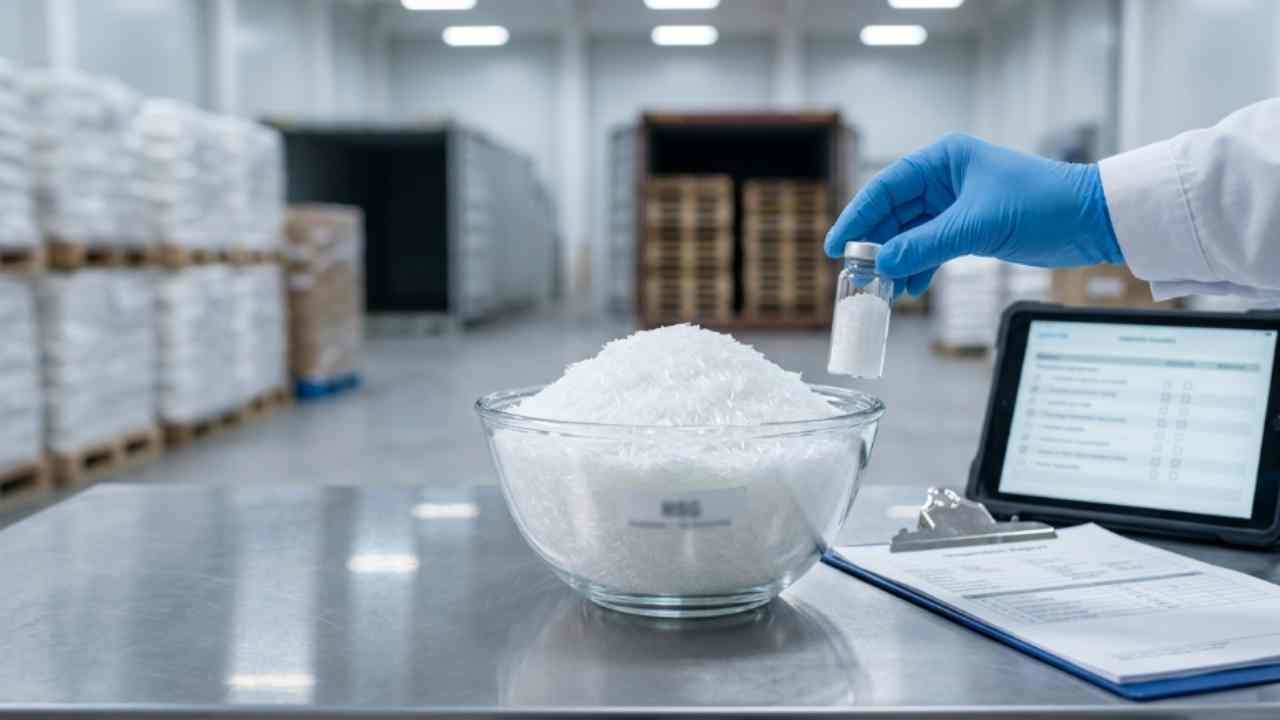
Buyers confirm batch consistency by requesting retention samples from each production run and comparing COAs across multiple shipments. Independent third-party inspections (PSI) by firms like SGS or Intertek provide an unbiased verification of crystal size, color, and chemical composition before loading.
Strategies for Long-term Stability
I see that many buyers make the mistake of only testing the first shipment. But factories change their raw materials or their methods over time. To ensure consistency, I keep "Retention Samples" for every batch I ship to you. If there is a problem later, we can test the sample from my office. I also compare the COAs of your last three orders. The results should be very similar. If the moisture was 0.1% last time and 0.4% this time, it shows the factory is getting sloppy. I catch these trends early. I act as your strategic partner to hold the factory to the same high standard every single month.
Third-party inspection is another powerful tool. I suggest my B2B clients use SGS or Intertek for large orders. These inspectors go to the port or the factory. They pull random bags from the pallets. They test them in their own independent labs. This provides an "Unbiased" report. They also check the quantity and the bag condition. I manage these inspections for you. I ensure the inspector looks at the "Batch Uniformity." This means the MSG in the front of the container is the same as the MSG in the back. This level of technical oversight is how I provide a quality guarantee. It gives you the confidence to sign long-term contracts with your own customers.
Consistency Verification Checklist
| Action Item | Technical Detail | Target Result | FINETECH's Role |
|---|---|---|---|
| Sample Check | Compare bulk to sample | < 5% variance in specs | Perform visual check |
| Batch Tracking | Review COA history | Stable trends in purity | Monitor factory logs |
| Independent Lab | Use SGS / Intertek | Pass 100% of specs | Arrange port inspection |
| Retention | Save 500g per batch | Keep for 12 months | Manage sample library |
| Visual Audit | Color and clarity check | No yellowing or dust | Inspect loading process |
| Bag Integrity | Check PE liner seals | No air leaks / No moisture | Oversight of packaging |
Conclusion
Quality control is the foundation of a safe MSG supply chain. I manage every technical detail at FINETECH to ensure your business receives top-quality, consistent food additives.
-
Waters Corporation – A technical guide to High-Performance Liquid Chromatography (HPLC) and its role in analytical testing for purity. ↩
-
WHO – Fact sheet on food safety focusing on chemical hazards and the international health implications of heavy metal contamination. ↩
-
Investopedia – Explains the wholesaling business model, covering large-scale procurement and its role in industrial supply chains. ↩
-
Food Safety Magazine – Technical article on the critical importance of controlling moisture and humidity in food storage and processing to prevent spoilage. ↩
-
UpKeep – Comprehensive guide on maintaining equipment logs to ensure operational consistency and quality control in a manufacturing environment. ↩