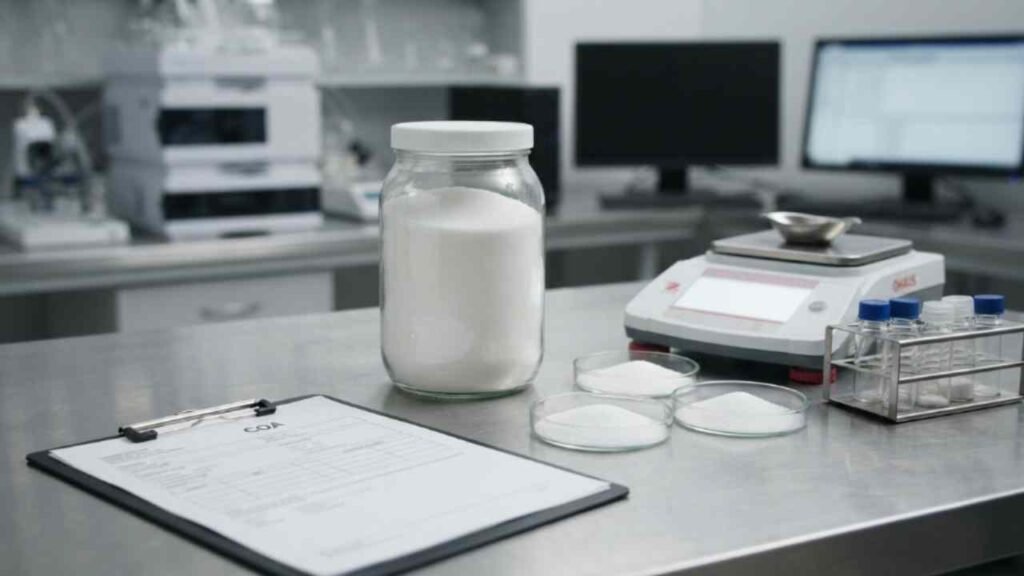
Importing substandard food-grade glycine leads to unexpected product caking, bitter off-tastes, and severe custom rejections. Unverified raw materials threaten brand safety. Verifying strict quality standards protects food formulations.
Evaluating food-grade glycine quality requires verifying compliance with Food Chemicals Codex standards, checking active assay levels, confirming the absence of chiral impurities, monitoring trace heavy metals, and demanding internationally recognized food safety certifications.
Successfully optimizing food ingredient sourcing requires a disciplined approach to analyzing technical and biological parameters. Sourcing managers must examine detailed chemical monographs to ensure formulation performance and legal compliance. Sourcing partners like FINETECH simplify factory checks, verify production compliance, and secure competitive pricing directly in China to guarantee bulk deliveries. This guide explains how to evaluate the quality of food-grade glycine.
What Quality Specifications Should Buyers Check for Food Grade Glycine?
Ordering bulk ingredients without matching precise chemical limits can cause manufacturing failures and regulatory rejections in destination markets. Unmatched specifications waste capital. Confirming technical parameters prevents formulation errors.
Buyers must check specifications including an active assay of 98.5% to 101.5% on a dried basis, maximum moisture levels of 0.2%, sulfated ash below 0.1%, and maximum limits of 0.007% for chlorides.
Dive Deeper into Chemical Monographs and Solute Characteristics
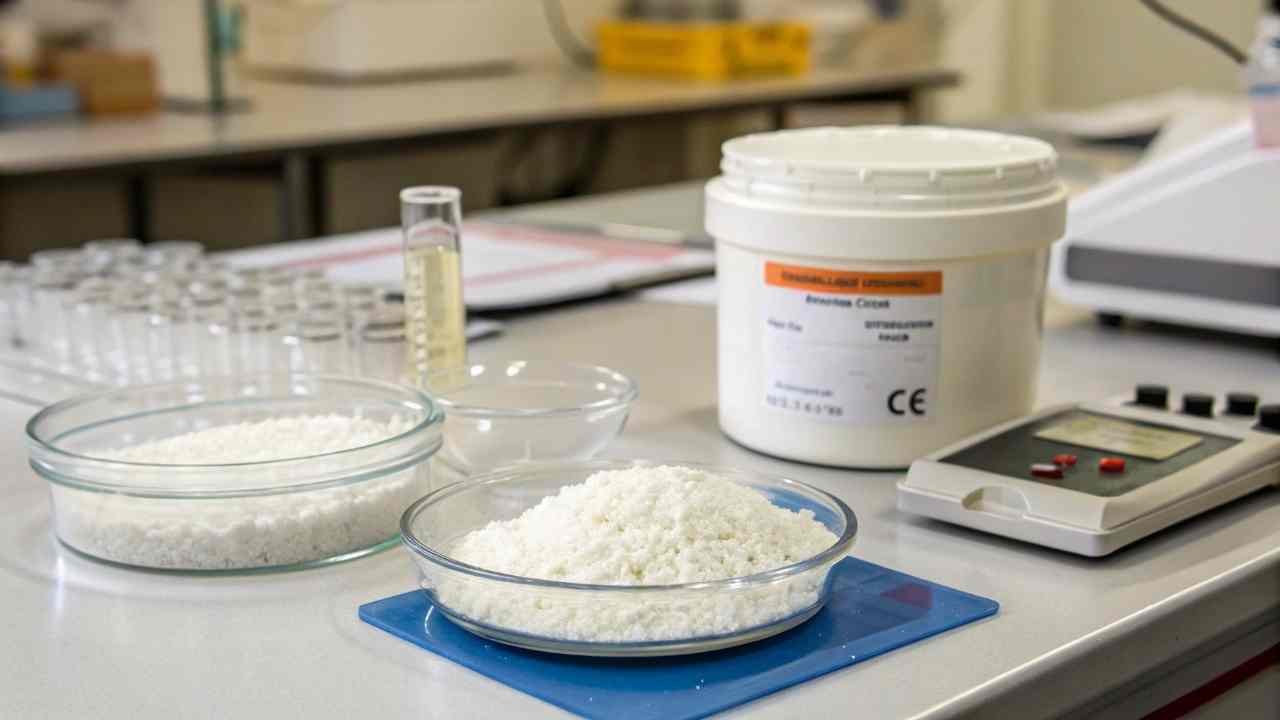
When procuring food-grade glycine (aminoacetic acid), buyers must verify that the raw material complies with established global pharmacopoeia standards, primarily the Food Chemicals Codex (FCC) or United States Pharmacopeia (USP). The first specification to inspect is the active assay, which must fall strictly between 98.5% and 101.5% on a dried basis. Because glycine is a white, odorless crystalline powder with a sweetish taste, physical inspection should confirm a clean crystal structure that dissolves completely in water to form a clear, colorless liquid.
Furthermore, limits on volatile residues are critical. The moisture content, measured as loss on drying1, must not exceed 0.2%, as excess water can cause the hygroscopic crystals to cake or promote microbial development. The residue on ignition (sulfated ash) must be limited to a maximum of 0.1%, which indicates a highly efficient refining process that has eliminated inorganic salt impurities. Buyers must also verify maximum limits for inorganic salts: chloride levels must remain below 0.007%, and sulfate levels must not exceed 0.0065%. Sourcing partners like FINETECH help buyers verify these parameters with direct factory certifications, ensuring that bulk shipments match the precise technical specifications required for food and beverage formulations.
| Chemical Parameter | USP / FCC Standard Limit | Technical Significance | Industrial Importance |
|---|---|---|---|
| Active Assay (Dried) | 98.5% to 101.5% | Active amino acid content | Ensures correct nutritional dosing |
| Loss on Drying | Maximum 0.2% | Measures residual water | Prevents powder caking in storage |
| Residue on Ignition | Maximum 0.1% | Measures inorganic ash | Indicates efficient filtration purity |
| Chloride (Cl) | Maximum 0.007% | Measures halogen impurities | Prevents metallic off-tastes in food |
How Is Glycine Purity Tested Before Shipment?
Accepting bulk chemicals based only on printed reports can leave your company vulnerable to receiving heavily adulterated or low-potency shipments. Paper claims carry hidden risks. Implementing verification testing guarantees chemical purity.
Purity is tested before shipment using non-aqueous acid-base titration, Infrared Absorption Spectrophotometry for molecular identification, melting point checks with decomposition, and gas chromatography for residual solvent levels.
Dive Deeper into Titration and Chromatographic Verification
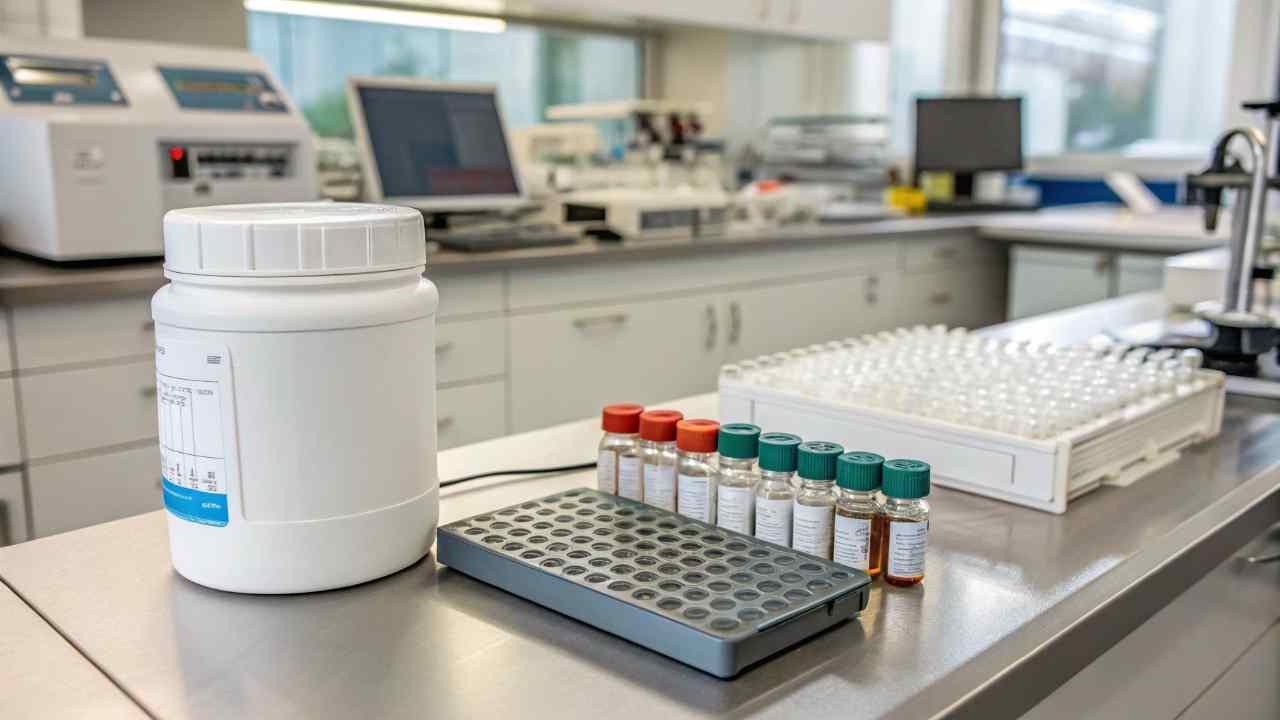
Ensuring that bulk food-grade glycine maintains its declared purity before it leaves the manufacturing facility requires rigorous instrument-based laboratory testing. Since glycine is the smallest and simplest of all amino acids, it possesses unique chemical properties. Unlike other proteinogenic amino acids, glycine lacks a chiral stereocenter and is not optically active. Consequently, polarimetry and specific optical rotation tests—commonly used to check other amino acids—are not applicable to glycine. Instead, chemists rely on non-aqueous acid-base titration2 or High-Performance Liquid Chromatography (HPLC) to measure the exact active assay of each batch.
To identify the compound, laboratories use Infrared Absorption Spectrophotometry (FTIR), comparing the infrared spectrum of the raw crystal sample against a certified USP or FCC reference standard. The melting point of the crystals, which occurs with decomposition around 245 degrees Celsius, is also measured to confirm molecular identity. For chemical purity, Thin-Layer Chromatography (TLC) or Gas Chromatography (GC) is executed to analyze residual solvents, ensuring that antisolvent crystallization3 residues (typically methanol or ethanol) are completely evaporated. Sourcing partners like FINETECH oversee these analytical tests on the ground in China, verifying raw testing chromatograms to ensure that every export batch satisfies strict food safety requirements.
| Analytical Test | Target Parameter | Laboratory Equipment | Minimum Standard Result |
|---|---|---|---|
| Active Assay | Percent molecular purity | Non-aqueous titrator / HPLC | 98.5% to 101.5% |
| Molecular Identity | Chemical fingerprint | FTIR spectrophotometer | Matches reference standard |
| Melting Point | Physical decomposition | Melting point apparatus | Approximately 245 degrees Celsius |
| Residual Solvents | Organic extraction agents | Gas chromatograph (GC-MS) | Complete absence of toxic residues |
Why Are Heavy Metal and Microbiological Tests Important for Glycine?
Utilizing unvetted chemical inputs runs the risk of introducing toxic impurities and causing severe product recalls. Substandard quality control threatens business longevity. Strict quality controls safeguard consumer health.
Heavy metal and microbiological tests are vital to prevent trace lead and arsenic toxicity, eliminate yeast and mold development in moist foods, and ensure complete freedom from dangerous pathogens.

Dive Deeper into Contaminant Limits and Pathogen Prevention
Running comprehensive tests for heavy metals and microbiological activity is a critical requirement to ensure consumer safety and satisfy import regulations in strict destination markets. Because industrial glycine is synthesized chemically using monochloroacetic acid (MCA) and ammonia, any inefficiency in process purification can leave trace chemical residues. Furthermore, water and air systems in packaging zones can introduce environmental heavy metals. Laboratories utilize Inductively Coupled Plasma Mass Spectrometry (ICP-MS)4 to detect trace elemental impurities. Under Food Chemicals Codex (FCC) standards, lead levels must remain strictly below 5 milligrams per kilogram (ppm) to prevent systemic physiological toxicity.
Microbiological contamination is another serious hazard, especially for glycine used as a nutrient or sweetening modulator in dairy and protein beverages. In moist food systems, bacteria can multiply rapidly. Standard microbiological specifications require a Total Plate Count (TPC) below 1000 colony-forming units per gram (cfu/g) and a Yeast and Mold count below 100 cfu/g. High-risk pathogens like Salmonella and Escherichia coli must be completely absent in 25-gram and 10-gram samples, respectively. Sourcing partners like FINETECH manage this safety step by coordinating with ISO 17025 accredited laboratories, providing buyers with independent contaminant analyses that guarantee clean imports.
| Contaminant Group | Specific Target Test | Testing Method | Maximum Allowed Limit |
|---|---|---|---|
| Heavy Metals | Lead (Pb), Arsenic (As) | ICP-MS spectrometer | Below 5.0 ppm (lead) |
| Aerobic Bacteria | Total Plate Count (TPC) | Pour plate agar method | Below 1,000 cfu/g |
| Fungal Activity | Yeast and Mold count | Plate count incubation | Below 100 cfu/g |
| Pathogens | Salmonella, E. coli | Selective broth incubation | Completely absent |
Which Certifications Should a Glycine Supplier Provide?
Exporting bulk ingredients without the correct certifications leads to immediate border seizures and expensive warehouse fines. Missing paperwork halts logistics. Verifying active safety certificates avoids customs locks.
Suppliers must provide food safety certificates (FSSC 22000, ISO 22000), religious dietary certifications (Kosher, Halal), clean-label validation (Non-GMO, Allergen-free), and environmental safety clearances.

Dive Deeper into Food Safety Systems and Clean-Label Standards
Vetting a supplier's third-party certifications is an essential step to ensure that the imported raw glycine satisfies national food safety laws and global market compliance. For food and beverage formulations, the manufacturing plant must hold active FSSC 22000 or ISO 22000 certifications. These internationally recognized food safety management systems verify that the factory operates under strict Hazard Analysis Critical Control Point (HACCP) protocols, ensuring that the crystalline powder is shielded from chemical, physical, and biological hazards throughout the synthesis, crystallization, and packaging cycles.
Additionally, suppliers must provide dietary and clean-label certifications to appeal to modern consumer segments. Because glycine is synthesized from petrochemical intermediates (chlorinated acetic acid and ammonia), it is naturally free from animal-derived materials, allowing manufacturers to secure Vegan-friendly5, Kosher, and Halal certifications. To comply with strict import rules in the European Union and North America, suppliers must also provide Non-GMO statements and allergen-free declarations, proving that no genetically modified crop materials were used in the production process or as crystallization agents. Sourcing partners like FINETECH simplify this audit process by verifying certificate registration numbers directly with global standard boards, protecting buyers from invalid documentation.
| Certificate Category | Standard Name | Target Industry | Sourcing Significance |
|---|---|---|---|
| Food Safety System | FSSC 22000 / HACCP | Human food & beverage | Confirms strict process hygiene |
| Dietary Access | Kosher & Halal | Global retail markets | Assures compliance for religious diets |
| Clean-Label Status | Non-GMO / Allergen-free | Premium wellness items | Proves freedom from genetic crops |
| Technical Standard | REACH registration | European Union imports | Permits legally compliant chemicals |
How Can Buyers Ensure Consistent Glycine Quality Between Batches?
Relying on manual production steps leads to high variance between batches and failed product quality checks. Uncontrolled manufacturing processes compromise quality. Automated process control secures consistent purity.
Buyers can ensure batch consistency by choosing suppliers that operate automated continuous crystallization lines, establishing formal Quality Agreements, and utilizing local sourcing agents to manage pre-shipment sampling.
Dive Deeper into Automated Crystallization and Quality Agreements
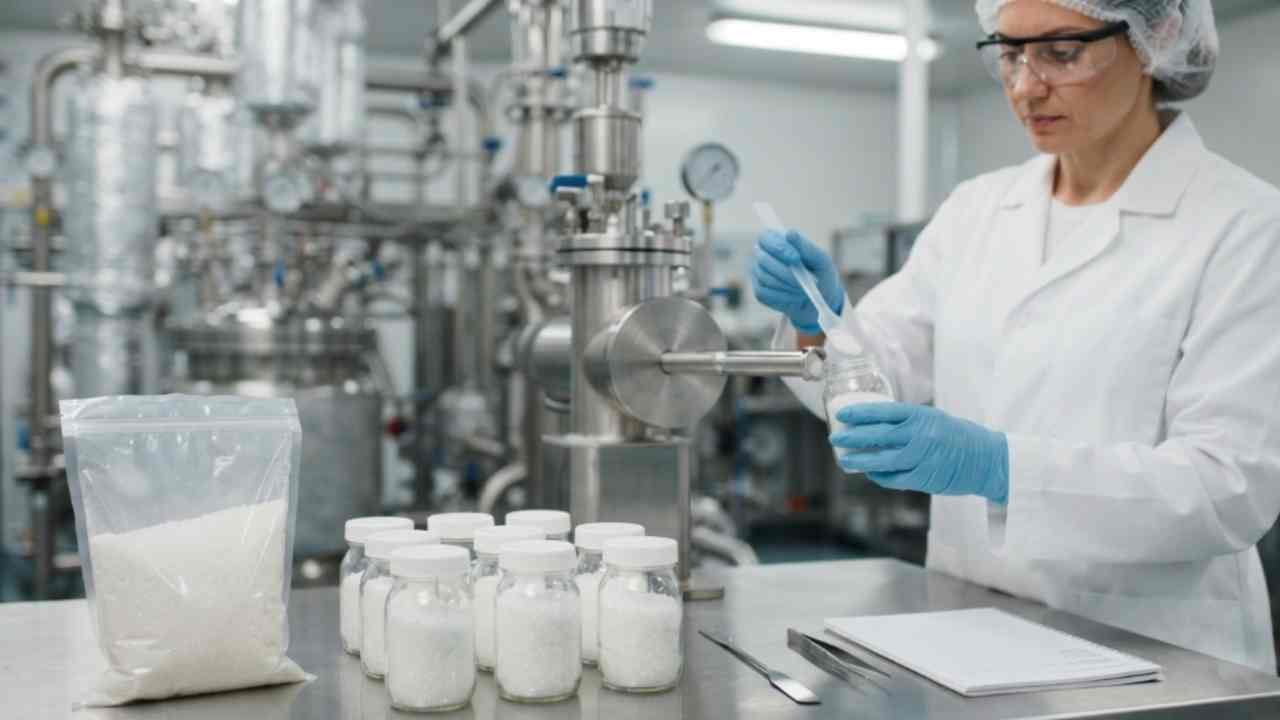
Maintaining batch-to-batch consistency is vital for food manufacturers to prevent production halts and ensure the uniform taste and texture of finished consumer products. In food formulation, glycine is frequently utilized as a mild sweetener, bitterness mask, or pH buffer. If a supplier delivers raw material with inconsistent physical properties, such as variable particle size distribution or fluctuating bulk density, it can disrupt automated dry-blending and liquid-mixing lines. Fine powders can cake or segregate, while larger crystals may dissolve slowly, altering the sensory profile of the final food item.
To prevent these physical discrepancies, manufacturers must use automated, continuous crystallization and sieving systems rather than manual batch processing. Automated controls ensure uniform crystal growth and prevent local overheating during salt formation. Furthermore, buyers must establish a formal Quality Agreement that outlines strict specifications, sampling methods, and corrective protocols. Sourcing partners like FINETECH help enforce these quality standards on the ground. By conducting physical audits of Chinese production facilities, checking historical batch records, and managing pre-shipment composite sampling, they help international buyers secure a reliable, consistent, and highly competitive supply of food-grade glycine.
| Consistency Tool | Operational Action | technical Benefit | expected Quality Outcome |
|---|---|---|---|
| Continuous Lines | Automated crystal growth | Uniform bulk density | Free-flowing powder in hopper |
| Quality Agreement | Drafts target chemical limits | Sets dispute resolution steps | Eliminates off-spec shipments |
| Sieving Calibration | Monitors crystal mesh sizes | Controls physical size bounds | Prevents segregation in dry mixers |
| Local Agent Audits | Direct factory quality checks | Pre-shipment batch tracking | Guarantees consistent purity |
Conclusion
Evaluating food-grade glycine quality requires verifying FCC/USP monograph parameters, confirming purity via FTIR, testing for heavy metals and pathogens, and utilizing local sourcing partners to manage batch consistency.
-
A detailed technical guide by News-Medical explaining the principles, methodologies, and industrial applications of the gravimetric Loss on Drying (LOD) analysis for volatile residues and moisture control. ↩
-
A peer-reviewed study in The Analyst (on PubMed) demonstrating potentiometric and conductimetric perchloric acid titration methodologies for alpha-amino acids (like glycine) in non-aqueous environments. ↩
-
A peer-reviewed study in Heliyon evaluating polymorphic transformations and residual solvent behaviors in the antisolvent crystallization of glycine utilizing water-alcohol and alternative green solvent mixtures. ↩
-
The official FDA landing page for the Elemental Analysis Manual (EAM), containing Method 4.7 which regulates microwave-assisted acid decomposition and ICP-MS testing for toxic metals in foods. ↩
-
Official homepage of V-Label, the internationally recognized quality seal for certifying vegan and vegetarian products and raw ingredients globally. ↩