

Unreliable Vitamin B5 suppliers cause production delays and quality recalls. This instability ruins your reputation and profit. I provide a vetting framework to secure your supply chain and protect your brand.
To evaluate a reliable Vitamin B5 supplier, check for ISO 22000, HACCP, and GMP certifications. Verify their annual production capacity, regional export experience, and willingness to accept third-party audits. Consistency in assay levels (98%-101%) and professional documentation like batch-specific COAs are key reliability indicators for wholesalers.
I manage factory selection and quality oversight for my B2B clients at FINETECH. Understanding these technical criteria helps you avoid bad sources and secure top-quality D-Calcium Pantothenate for your specific business needs.
What Certifications Should Vitamin B5 (Pantothenic Acid) Suppliers Hold?
Fake or missing certifications lead to customs rejection and legal fines. This stops your business growth immediately. I identify the mandatory papers needed for safe and legal food additive trade globally.
Reliable Vitamin B5 suppliers must hold ISO 22000, HACCP, and GMP for factory safety. For specific markets, HALAL and KOSHER are essential. High-purity pharmaceutical grades also require CEP or DMF documentation to ensure compliance with global pharmacopeia standards like USP or BP.
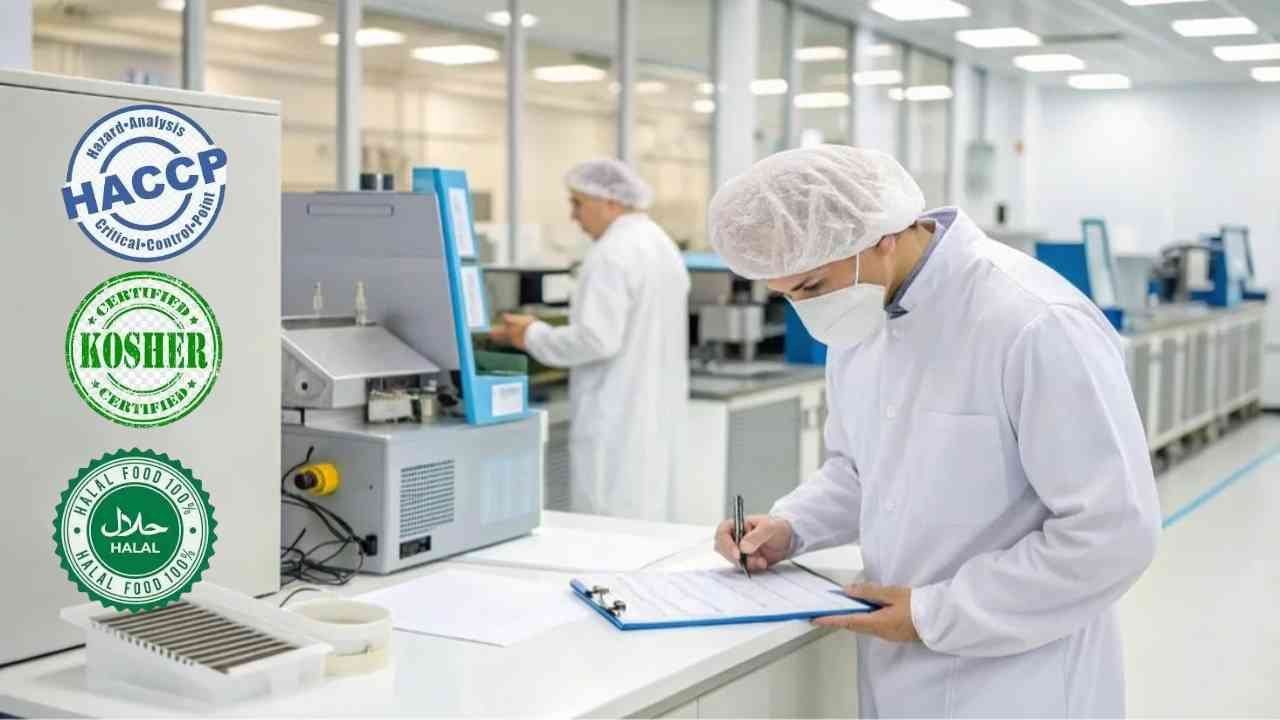
Essential Quality Management Systems
I see that many buyers focus only on the price. But certifications are your first line of defense. ISO 220001 is the global standard for food safety management. It proves the factory has a system to control hazards. HACCP (Hazard Analysis and Critical Control Points) is also vital. It means the factory checks every step of the Vitamin B5 synthesis for risks like heavy metal contamination. When I audit factories in China, I check their internal audit records. If they have a certificate but no records, the paper is useless. I only work with factories that take these systems seriously.
GMP (Good Manufacturing Practice) is another requirement you must check. Vitamin B5 is made through chemical synthesis. GMP ensures the environment is clean and the process is consistent. This is very important for the high-purity 99% powder. Also, consider religious compliance. If you sell to the Middle East or Southeast Asia, HALAL and KOSHER2 are mandatory. These certificates prove no forbidden substances were used in the factory. I verify these documents with the issuing bodies like MUI or JAKIM. This oversight is how I protect your business from regulatory problems in your local market.
Comparison of Critical Certifications
| Certification | Focus Area | Market Requirement | Business Value |
|---|---|---|---|
| ISO 22000 | Safety Management | Global Food Industry | High safety guarantee |
| HACCP | Process Risk | Bulk Wholesale | Prevents contamination |
| GMP | Quality Consistency | Pharma / Cosmetics | Ensures high purity |
| HALAL | Religious Law | Middle East / SE Asia | Legal market access |
| KOSHER | Religious Law | Europe / USA | Broad customer appeal |
How Important Is Production Capacity for Vitamin B5 (Pantothenic Acid)?
Small factories often stop during market shortages or government audits. This leaves you empty-handed and stops your sales. I analyze why production scale is critical for your long-term supply security and pricing.
Production capacity is vital for ensuring supply during market peaks and environmental audits in China. Large-scale producers (5,000+ tons per year) offer more stable pricing and better batch consistency. High capacity allows a supplier to fulfill bulk orders even when global supply is tight.
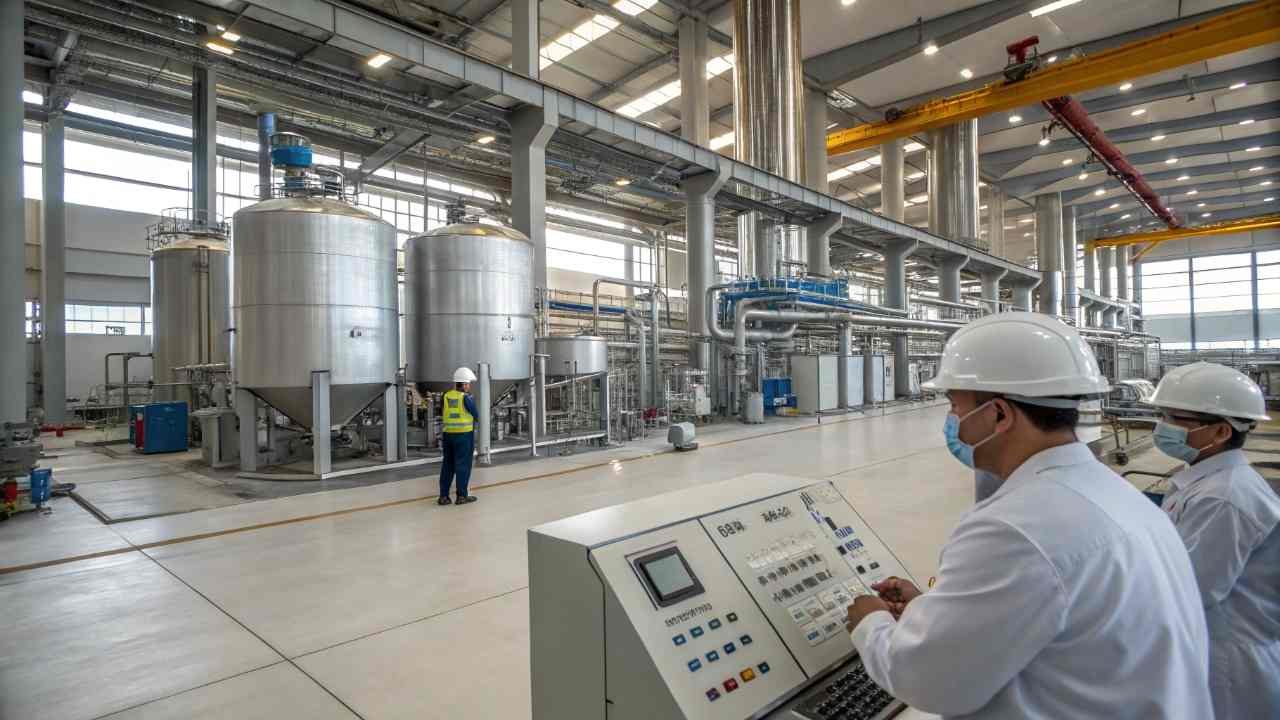
Scale and Vertical Integration
I observe that China produces over 80% of the world's Vitamin B5. In this market, scale is power. I visit large factories in Zhejiang and Shandong provinces. These factories have giant reactors and automated packing lines. High capacity means the factory can run 24/7. This lowers the labor cost per kilogram. It also ensures that the "Assay" stays the same from drum to drum. Smaller plants might stop and start their machines. Every time they start, the quality can change. I prioritize large partners to give my buyers the most consistent product possible.
Vertical integration is another technical factor of capacity. Some of the best factories in China produce their own intermediates, like isobutyraldehyde3. This chemical is the main raw material for Vitamin B5. If a factory makes their own raw material, they are very stable. They do not have to worry about shortages in the petrochemical market. I help my buyers find these integrated sources. This scale also helps with price. Large factories can lock in energy and material costs for the whole year. I negotiate based on this volume to get you a stable price for your annual contracts.
Supplier Scale vs. Risk Level
| Factory Level | Annual Output | Risk Level | Supply Stability |
|---|---|---|---|
| Global Leader | > 10,000 Tons | Very Low | Maximum market security |
| Large Hub | 5,000 - 10,000 Tons | Low | Very stable production |
| Medium Plant | 1,000 - 5,000 Tons | Moderate | Subject to power limits |
| Small Producer | < 1,000 Tons | High | Frequent stops for audits |
How Can Audits Improve Vitamin B5 (Pantothenic Acid) Procurement Safety?
Trusting a website photo is a dangerous gamble in international trade. You risk receiving off-spec or caked material. I explain how physical and document audits remove the fear and risk from your Vitamin B5 procurement.
Audits verify the factory’s actual equipment, lab capabilities, and hygiene standards. On-site or third-party audits by companies like SGS ensure the supplier follows claimed protocols. This process prevents quality fraud and ensures the D-Calcium Pantothenate meets your exact technical specifications before you pay.

Physical Inspections and Lab Verifications
I always suggest a Pre-Shipment Inspection (PSI) for new partners. You can hire an independent company like SGS. Their inspector goes to the factory in China. They count the drums and check the labels. They also take random samples from the pallets. These samples are tested in an independent lab. This proves the COA from the factory is honest. I manage this coordination for my clients. A PSI report gives you total confidence before the ship leaves the port. It is the best way to avoid "surprises" when the container arrives at your warehouse.
I also perform my own audits at the factory level. I look at the lab equipment. A reliable supplier must have their own HPLC (High-Performance Liquid Chromatography) machine. Without this, they cannot test the assay level accurately. I also check the warehouse. Vitamin B5 is sensitive to moisture. The warehouse must be cool, dry, and clean. I look at the "Retainer Samples" room. Factories must keep a sample from every batch for three years. This is a technical requirement for traceability4. If a supplier refuses an audit, I do not buy from them. My goal is to be your eyes on the ground in China to ensure 100% safety.
Audit Checklist for Professional Buyers
| Audit Point | Target Standard | Importance |
|---|---|---|
| Lab Equipment | Calibrated HPLC / Polarimeter | Critical |
| Packing Area | HEPA filtered clean room | High |
| Storage | Temperature & Humidity logs | High |
| Traceability | Batch codes on all drums | Critical |
| Export Record | History to your specific region | Moderate |
How Does Experience Affect Vitamin B5 (Pantothenic Acid) Reliability?
Inexperienced exporters make costly mistakes with HS codes and customs documents. This leads to high storage fees and port delays. I show how trade experience ensures your Vitamin B5 cargo arrives without any trouble.
Experience ensures a supplier knows regional document requirements, such as Health Certificates for the Middle East. It allows them to anticipate price cycles in China and manage complex logistics. Experienced exporters handle customs clearance faster and provide superior technical support for food and feed applications.
Navigating Global Trade Logistics
I see that many "new" traders make big mistakes with paperwork. For Vitamin B5, the correct HS code5 is 293624. If this code is wrong, your customs will stop the goods. I have managed many shipments to Russia, Germany, and Indonesia. I know exactly what each port needs. For example, buyers in the UAE need a legalized invoice. Buyers in Indonesia need an import permit from BPOM. I prepare the technical file to match these rules exactly. This experience saves you from paying high demurrage fees at the port. I oversee the document preparation at my office to ensure zero errors.
Market experience is also a technical tool. The price of Vitamin B5 changes based on chemical market cycles. I track the price of intermediates in China every week. Because I have years of data, I can see when a price spike is coming. I tell my regular buyers to increase their safety stock before the price goes up. Also, experience helps with "telex release" and L/C (Letter of Credit) terms. These financial tools are complex. An experienced partner like FINETECH handles these smoothly. We know how to work with the banks to ensure the payment and the goods move fast. This knowledge is how I help you stay competitive in your local market.
Experience vs. Reliability Traits
| Feature | New Exporter | Experienced Partner (FINETECH) | Result for Buyer |
|---|---|---|---|
| Doc Accuracy | Low | Very High | No customs delays |
| Market Insight | None | High | Better buying timing |
| Logistic Speed | Slow | Fast | Lower inventory risk |
| Tech Support | Limited | Deep | Better formula advice |
| Crisis Response | Panic | Strategic | Continuous supply |
How Can Strategic Partnerships Strengthen Vitamin B5 (Pantothenic Acid) Supply?
Switching suppliers every month creates chaos and quality gaps. You lose your priority during global shortages. I provide a path to build partnerships that protect your annual supply and improve your profit margins.
Strategic partnerships enable annual volume contracts and fixed pricing, protecting you from market surges. They ensure you receive priority during global shortages. Shared demand forecasts allow the factory to reserve production slots specifically for your warehouse needs, ensuring a continuous flow of fresh material.
Building Trust and Priority Supply
I treat my clients as partners and expect the same. A partnership is a two-way street. You should share your sales goals for the next year. This data helps me plan production cycles with the factory. If I know you need 50 tons in Q3, I can lock in the price when the market is low. This shared planning reduces stress for both sides. It makes your supply chain much more efficient. Also, trust is built through consistency. If you pay on time, I will always prioritize your orders. When global supply gets tight, I use my influence with the factories to protect my best partners.
Long-term cooperation also helps with technical needs. If you need a specific particle size for your feed premix, I ensure the factory produces it for you every time. We keep retainer samples for your specific shipments for three years. This creates a deep history of quality. If you have a problem with a new recipe, our lab team can help you solve it. This level of support is only possible in a strategic relationship. I focus on long-term growth because if you grow, I grow. By working together for years, we create a supply chain that is almost impossible to break. This is how I support wholesalers in Korea and the Middle East.
Partnership Benefits Timeline
| Phase | Interaction Type | Strategic Benefit | Competitive Gain |
|---|---|---|---|
| 1 - 2 Orders | Trial Phase | Quality verification | Test the source |
| 1 - 2 Years | Growth Phase | Price discounts | Lower procurement cost |
| 3 - 5 Years | Stability Phase | Annual Price Locks | Budget security |
| 5+ Years | Strategic Partner | Credit terms / Custom grades | Market dominance |
Conclusion
Evaluating reliable Vitamin B5 suppliers requires checking certifications, production capacity, trade experience, and audit willingness. I manage these technical details at FINETECH to ensure your business stays safe, stable, and profitable.
-
ISO – The official international standard for food safety management systems used by food enterprises to control hazards and ensure compliance. ↩
-
IFANCA – A global resource explaining Halal certification requirements, crucial for buyers and food processors targeting the Middle East and Southeast Asia. ↩
-
PubChem – Comprehensive technical database for isobutyraldehyde, a primary chemical building block in the synthesis of food-grade vitamins. ↩
-
GS1 – International standards organization providing the framework for end-to-end traceability in the food processing and additive industry. ↩
-
Trade.gov – Official U.S. government resource for trade orientation, explaining the Harmonized System (HS) codes required for customs documentation. ↩