

Are you constantly placing urgent orders? This reactive buying leads to high prices, shipping delays, and the constant stress of potential stock-outs that could shut down your production.
Buyers can improve planning by providing suppliers with an accurate rolling forecast, ordering at least 10-12 weeks in advance, and analyzing their own historical sales data. This proactive approach creates a stable, predictable, and cost-effective supply chain.
The most successful partnerships I build are with buyers who plan effectively. A professional Purchasing Director understands that strong planning is the most powerful tool for controlling costs and eliminating risk. A resilient supply chain is built on a foundation of proactive planning and clear communication. Let’s explore how to build this foundation for your business.
Why Is Forecast Accuracy Important for Potassium Sorbate?
Are you just guessing your future needs? This leads to either holding too much expensive inventory or, worse, running out of stock and halting your production line.
Forecast accuracy is critical because it allows your supplier to reserve production capacity and book vessel space for you in advance. This prevents stock-outs, minimizes the need for expensive safety stock, and builds a foundation for a reliable, low-cost supply chain.

A good forecast is the most valuable information you can share. It transforms our relationship from transactional to strategic. When you give me an accurate forecast, it allows me to reserve production capacity for you, guaranteeing your supply. For you, it means you can optimize your inventory levels1, reduce the need for costly safety stock, and free up your cash flow. It is the key to an efficient, low-cost supply chain.
Accurate vs. Inaccurate Forecasting Outcomes:
| Factor | Inaccurate Forecast (Guessing) | Accurate Forecast (Planning) |
|---|---|---|
| Inventory | Either too much (high cost) or too little (stock-out risk). | Optimized inventory levels, lower holding costs. |
| Supply Chain | Reactive and chaotic. | Proactive, stable, and predictable. |
| Costs | High risk of urgent shipping fees. | Lower, predictable logistics costs. |
| Supplier Relationship | Transactional and stressful. | Collaborative and strategic. |
How Far in Advance Should Potassium Sorbate Orders Be Placed?
Are you placing your order and expecting it to arrive in 30 days? This common mistake ignores the full lead time and is the number one cause of unexpected stock-outs.
For sea freight from China, Potassium Sorbate orders should be placed at least 10-12 weeks before you need the product in your factory. This accounts for the entire lead time, from production and inland logistics to sea transit and final customs clearance.
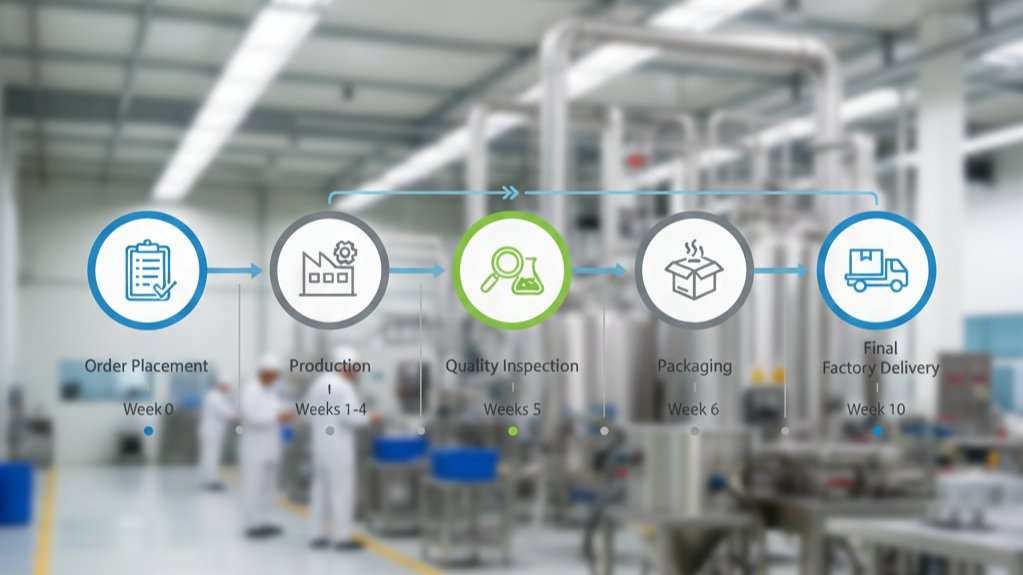
The biggest planning error is confusing "sea transit time2" with "total lead time3." The total lead time is the entire journey from order to delivery. You must plan for production (3-4 weeks), inland logistics in China (1-2 weeks), sea transit (3-5 weeks), and customs clearance at your end (1 week). When you add it all up, a realistic lead time is 10-12 weeks. Planning for anything less is a major risk.
Sample Lead Time Calculation (to Middle East):
| Phase | Conservative Time Allowance | Cumulative Time |
|---|---|---|
| 1. Order Placed | Day 0 | 0 Weeks |
| 2. Production | 4 Weeks | 4 Weeks |
| 3. Inland & Port | 2 Weeks | 6 Weeks |
| 4. Sea Transit | 4 Weeks | 10 Weeks |
| 5. Destination & Customs | 1 Week | 11 Weeks |
What Data Helps Predict Potassium Sorbate Demand?
Are you still relying on your "gut feeling" to predict your future needs? This is a risky way to manage a critical ingredient for your business.
The most reliable data for predicting demand comes from your own historical sales data. This should be combined with your sales team's forecasts for new products or promotions and an awareness of broad seasonal market trends.

Professional planning is a data-driven process. Use three key sources to build an accurate picture of your future needs. The most important is your own historical sales data4, which provides a reliable baseline. Next, add your internal sales and marketing plans to account for new products or promotions. Finally, consider the external market context, like the predictable peak demand season in Q4.
Forecasting Data Source Comparison:
| Data Source | Type | Reliability | What It Tells You |
|---|---|---|---|
| Historical Sales Data | Internal | High | The "normal" baseline consumption pattern of your business. |
| Sales & Marketing Forecast | Internal | Moderate | Expected changes due to promotions or new product launches. |
| Seasonal Market Trends | External | Good | The broader market context for demand and pricing. |
How Does Planning Reduce Potassium Sorbate Supply Gaps?
Is your biggest fear running out of a critical ingredient, causing a "supply gap" that stops your factory? This is a preventable crisis.
Proactive planning directly prevents supply gaps by creating buffers throughout the supply chain. It allows your supplier to reserve production capacity for you, provides the time needed to navigate logistics without rush, and enables you to build a strategic safety stock.
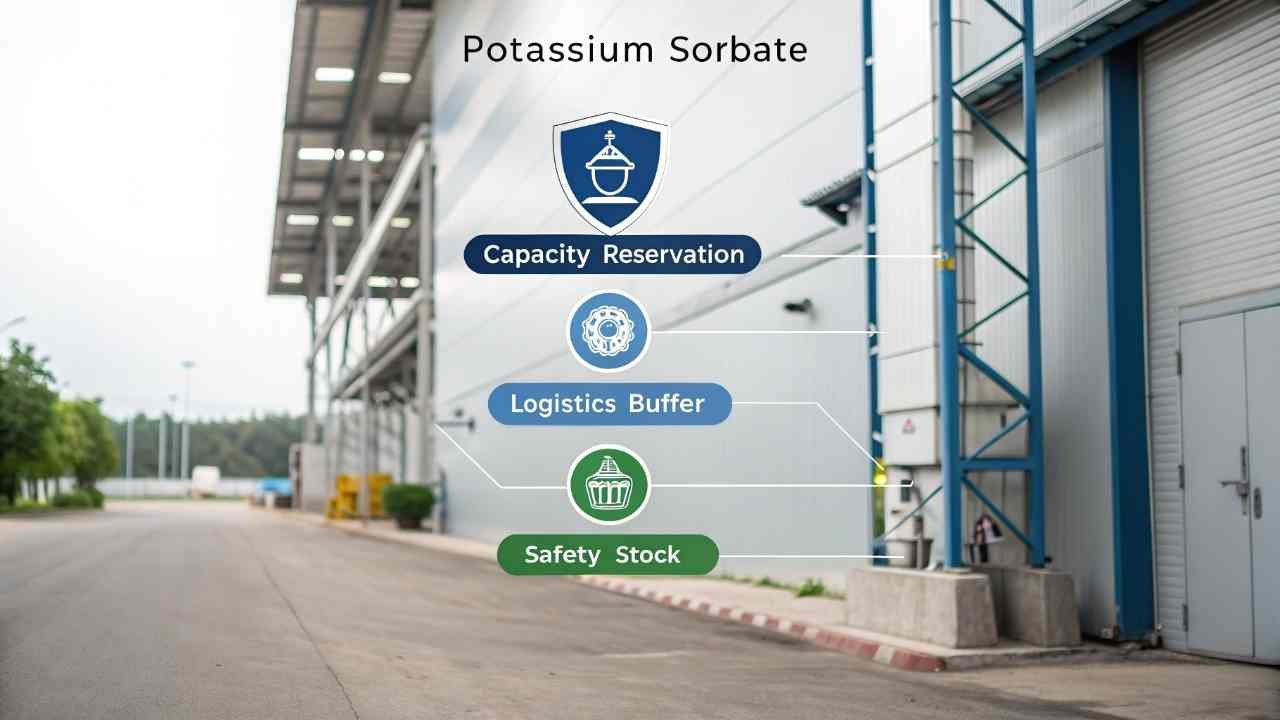
A professional planner builds a resilient "just-in-case" supply chain by creating three types of buffers. The first is capacity reservation, achieved by giving your supplier a forecast. The second is a time buffer, created by ordering 10-12 weeks in advance to absorb any logistics delays. The third and most powerful is a physical safety stock in your warehouse. These layers of protection work together to make a supply gap almost impossible.
"Just-in-Time" vs. "Planned Buffer" Approach:
| Element | "Just-in-Time" (High Risk) | "Planned Buffer" (Low Risk) |
|---|---|---|
| Supplier | Hopes capacity is available when the order is placed. | Has capacity reserved based on a forecast. |
| Lead Time | Assumes a "best case" scenario with no delays. | Includes 1-2 weeks of buffer time for contingencies. |
| Inventory | Carries minimal to no safety stock. | Maintains a strategic 4-6 week safety stock. |
| Result | Fragile. Any small delay causes a crisis. | Resilient. Can absorb most common disruptions. |
What Planning Errors Increase Potassium Sorbate Costs?
Do you feel like your final landed cost is always higher than you expected? Hidden costs from poor planning can destroy your budget and your profit margins.
The biggest planning errors are ignoring the total lead time, which forces expensive urgent shipping, buying only in the peak season when prices are highest, and making frequent small LCL shipments instead of planned bulk FCL shipments. These mistakes dramatically increase total costs.
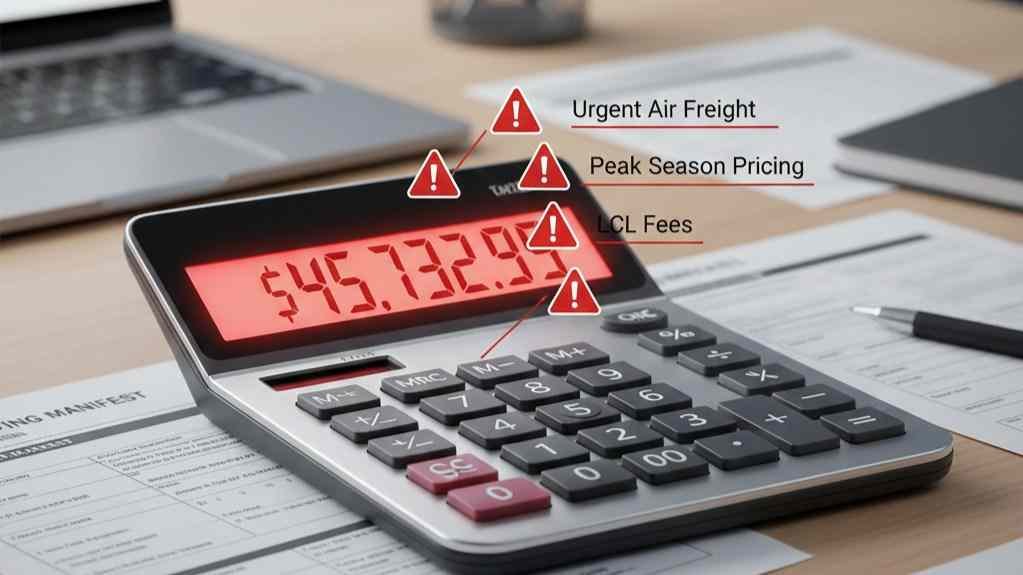
Poor planning directly increases your costs. The cost of urgency5 is the most common error: underestimating the lead time forces you to pay for expensive air freight. The cost of bad timing6 comes from buying only during the peak Q4 season when product and freight prices are highest. The cost of inefficiency comes from making many small LCL shipments instead of leveraging the economies of scale of a larger, well-planned FCL shipment.
Cost Impact of Poor vs. Good Planning:
| Planning Behavior | Poor Planning (Reactive) | Good Planning (Proactive) |
|---|---|---|
| Timing | Buys small amounts whenever needed. | Leverages economies of scale with bulk orders. |
| Seasonality | Often forced to buy during peak Q4. | Can shift some purchasing to the off-season (Q2). |
| Shipping Method | Forced to use expensive LCL or air freight. | Uses cost-effective FCL sea freight. |
| Total Landed Cost | High | Low / Optimized |
Conclusion
Improving purchase planning is the most powerful way to control costs and reduce risk. Proactive forecasting and a strong supplier partnership create a stable and resilient supply chain.
-
Exploring inventory optimization strategies can significantly enhance your cash flow and reduce costs. ↩
-
Exploring sea transit time can help you optimize shipping schedules and improve delivery efficiency. ↩
-
Understanding total lead time is crucial for effective supply chain management and avoiding planning errors. ↩
-
Understanding historical sales data is crucial for making informed decisions and forecasting future trends. ↩
-
Understanding the cost of urgency can help businesses avoid expensive air freight and improve planning. ↩
-
Exploring the cost of bad timing can reveal strategies to optimize purchasing and reduce expenses during peak seasons. ↩