

Unreliable delivery stops your production and empties your warehouse. These gaps result in lost sales and angry customers. I show you how to secure a stable supply chain today.
Suppliers ensure reliable delivery through standardized 14-day production lead times, moisture-proof multi-layer packaging, and optimized shipping routes. By using priority production slots and strict palletization, manufacturers prevent transit damage and customs delays. Proper documentation and real-time tracking further guarantee on-time arrival for global wholesale orders.
I manage factory selection and oversee production for my B2B clients at FINETECH. I visit Chinese plants to audit their logistics because your brand safety depends on technical accuracy. I want to share the technical facts about Isolated Soy Protein (ISP) delivery so you can secure your supply chain and protect your profit margins.
What is the standard lead time for Isolated soy protein export orders?
Slow production forces you to pay for expensive air freight. These delays drain your budget and disrupt your local market. I explain the technical timeline for a professional export order.
The standard lead time for Isolated Soy Protein is usually 10 to 14 days for production. After production, the CIQ (Customs Inspection) and laboratory testing take an additional 3 to 5 days. Total preparation time is approximately 15 to 20 days before the cargo leaves the port.

Dive Deeper into Export Timelines
I see that "Lead Time1" is more than just a date on a contract. It represents the factory's efficiency. In China, most ISP plants are in Shandong or Henan. Once you place an order, the factory must schedule a "Production Run." ISP is a high-volume product, so factories do not keep large stocks of every grade. I act as your strategic office to ensure your order gets a priority slot. If the factory is busy, I push for your batch to be made first. This 10-to-14-day window includes the spray-drying process2 and the final milling. I visit the factories to check their production logs and ensure they do not take shortcuts to meet a deadline.
After the powder is packed, we must wait for the government inspection (CIQ). This is a mandatory step for food additives leaving China. It takes about 3 to 5 days for the officers to check the batch and issue the Health Certificate. I oversee this document process to avoid any spelling errors that cause port delays. You must also consider the "Transit Time." For my clients in Southeast Asia, the ship takes 7 to 15 days. For the Middle East, it takes 20 to 30 days. For Europe, it can take 35 to 45 days. I help you calculate your "Re-order Point" by adding these days together. This technical planning ensures you never have a gap in your warehouse.
Standard Export Timeline Breakdown
| Phase | Activity | Duration | FINETECH's Quality Check |
|---|---|---|---|
| Order Entry | Raw material prep | 2 - 3 Days | Verify soy meal source |
| Production | Extraction/Drying | 7 - 10 Days | Audit spray-drying logs |
| Lab Testing | Internal QC/Assay | 1 - 2 Days | Check protein >90% |
| Customs (CIQ) | Gov inspection | 3 - 5 Days | Verify health certificates |
| Port Move | Trucking to port | 1 - 2 Days | Inspect container hygiene |
| Loading | Vessel departure | 1 - 2 Days | Confirm security seal no. |
Which packaging methods best protect Isolated soy protein during shipping?
Torn bags and moisture turn your premium protein into a moldy waste. This damage destroys your investment and halts your production. I show you the technical packaging standards that prevent loss.
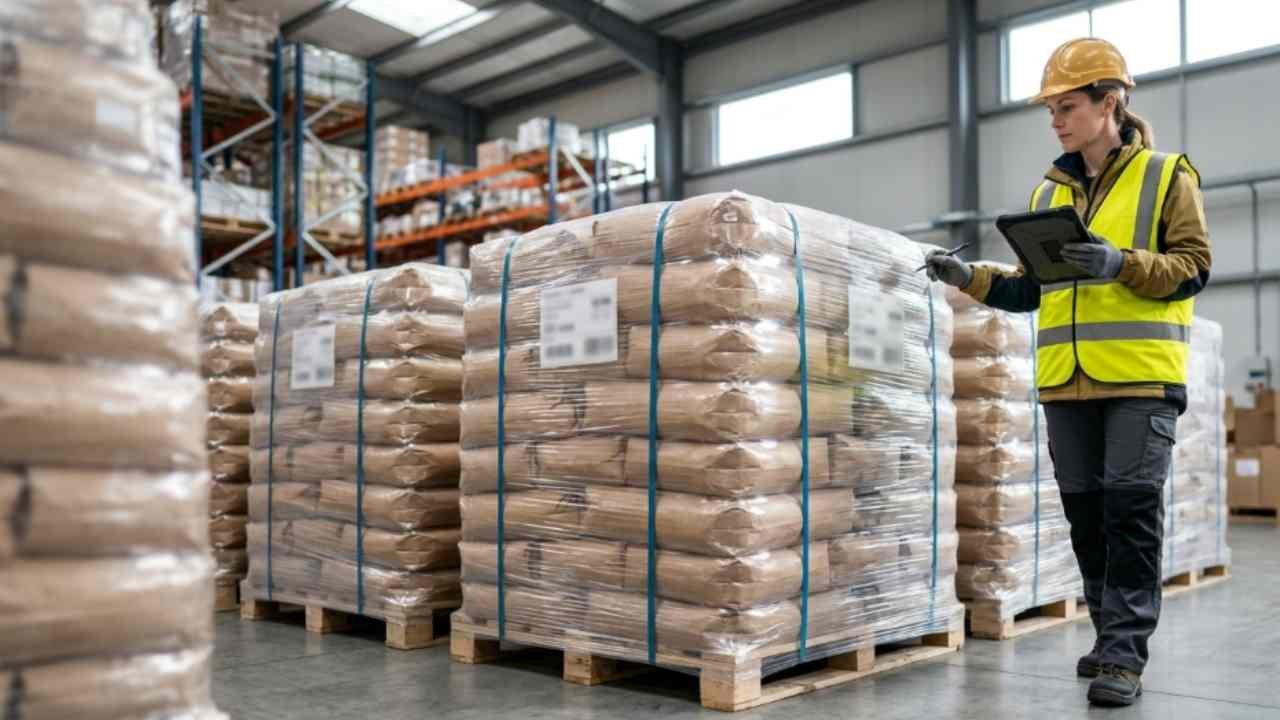
The best protection is 20kg or 25kg multi-wall Kraft paper bags with an inner PE (polyethylene) liner. For export, pallets must be heat-treated, shrink-wrapped, and fitted with cardboard corner protectors. This system prevents moisture ingress and physical tearing during long-distance sea or rail transit.
Dive Deeper into Packaging Science
I see that "Moisture" is the biggest threat to Isolated Soy Protein. Protein powder is "hygroscopic." This means it sucks water out of the humid sea air. If the bag is not sealed well, the protein will form hard lumps. This ruins the solubility of the product. I act as your technical eyes to check the inner PE liner thickness. It must be at least 0.05mm thick. I visit the packing lines to ensure the workers use heat-sealing or high-strength sewing. If a bag leaks, it can contaminate the whole pallet. I prioritize factories that use a "Clean-Room" packing environment to keep the bags free from dust.
Physical strength is the second part of the protection. A 20-ton container has 800 to 1,000 bags. They are stacked high. I oversee the "Palletization" process. We use 1.1m x 1.1m pallets. Every pallet must have an IPPC stamp3 to prove it was heat-treated. We use multiple layers of shrink wrap to tie the bags together. I also insist on using cardboard corner protectors. These prevent the straps from cutting into the bags. I visit the loading area to check the container floor. It must be dry and have no odors. If the container is wet, the bottom bags will rot. I use these technical checks to make sure your ISP arrives in "Top Quality" condition every time.
| Packaging Component | Standard Requirement | FINETECH's Observation | Purpose |
|---|---|---|---|
| Inner Liner | Food-grade PE bag | 50+ Microns thick | Moisture barrier |
| Outer Bag | 3-layer Kraft Paper | Audit burst strength | Prevents physical tears |
| Pallet | Plastic or Heat-Treated | Look for IPPC stamp | Compliance and stability |
| Wrap | 5-layer Shrink Film | Check wrap tension | Holds bags together |
| Corners | L-shape Cardboard | Inspect placement | Prevents strap damage |
| Container Seal | Bolt Security Seal | Record seal number | Prevents theft/tampering |
How do suppliers handle urgent Isolated soy protein delivery requests?
Stockouts destroy your market share and give your competitors an advantage. Waiting weeks for a new batch is not an option during a crisis. I explain how we speed up the supply chain for emergencies.
Suppliers handle urgent requests by maintaining "Buffer Stock" of standard grades and using air freight for small volumes. For bulk orders, we can move the request to a priority production line and use "Express" sea routes. Choosing "Ready-to-Ship" inventory from the warehouse reduces lead time to 3-5 days.

Dive Deeper into Emergency Logistics
I see that "Speed" requires a strategic plan before the crisis happens. I always suggest my clients keep a "Safety Stock" in China. I act as your strategic office to manage this inventory. We keep 5 to 10 tons of your specific grade in a clean, dry warehouse. When you have an emergency, we can truck it to the port in 24 hours. This bypasses the 14-day production time. I visit these warehouses to ensure the stock stays fresh. I check the production dates to follow the "First-In, First-Out (FIFO)4" rule. This ensures you never get old stock even when you are in a rush.
If the volume is small, we use "Air Freight." This is expensive, but it takes only 3 to 7 days to reach any port in the world. I coordinate with couriers like DHL or UPS for sample-sized needs. For larger urgent orders, I look for "Express Sea Routes." Some shipping lines are 10 days faster than others. I visit the logistics agents to find these "Fast Vessels." I also suggest using "LCL" (Less than Container Load) shipping. This allows us to ship 1 or 2 tons immediately without waiting for a full container. I oversee the document preparation to ensure "Express Clearance" at the destination. By having these technical options ready, I help you stay ahead of your market demand.
| Urgent Solution | Lead Time | Cost Impact | Best For |
|---|---|---|---|
| Warehouse Stock | 3 - 5 Days | Low | Standard bulk orders |
| Air Freight | 3 - 7 Days | Very High | Urgent samples / Small gaps |
| Priority Production | 7 - 10 Days | Moderate | Large volume shortages |
| LCL Shipping | 10 - 15 Days | Moderate | Mid-size urgent orders |
| Fast Sea Route | 15 - 25 Days | Low | Middle East / EU orders |
| Trucking (Rail) | 12 - 18 Days | Moderate | Russia and Central Asia |
What transportation methods are most efficient for bulk Isolated soy protein exports?
High shipping costs eat your profit and make your product too expensive. Choosing the wrong route leads to delays and moisture damage. I identify the most efficient ways to move your bulk protein.
Sea freight (FCL) is the most efficient method for global bulk ISP exports due to its low cost per ton. For Russia and Central Asia, rail transport (China-Europe Express) is faster than sea. Road transport is used for Southeast Asian neighbors like Vietnam and Malaysia to ensure door-to-door delivery speed.

Dive Deeper into Transportation Efficiency
I see that "Efficiency" is a balance of cost and speed. Sea freight in 20ft containers is the industry standard. One container holds about 20 tons of ISP without pallets, or 10 to 12 tons on pallets. I act as your logistics advisor to choose the best loading method. If you want the lowest price, we "Hand Load" the bags. This uses every centimeter of space. If you want fast unloading at your factory, we use pallets. I visit the Qingdao or Tianjin ports to check the container availability. These are the main exit points for Chinese soy protein. I ensure the container is "Food-Grade" and has no rust or holes.
For my clients in Russia and Germany, the "Rail Express" is a technical win. It takes about 15 to 20 days. This is much faster than the 45 days by sea. I oversee the loading for rail cargo differently. The vibrations on a train are stronger than a ship. We use extra "Dunnage Bags" (air bags) to fill the gaps between pallets. This prevents the bags from shifting and breaking. For Southeast Asia, I often suggest "Door-to-Door" trucking for nearby countries. This reduces the number of times the cargo is handled. Every time a worker touches the bag, there is a risk of a tear. I use these technical choices to lower your "Total Cost of Ownership."
| Method | Avg. Cost | Avg. Speed | FINETECH's Technical View |
|---|---|---|---|
| Sea (FCL) | Lowest | 20 - 45 Days | Best for large wholesale stock |
| Rail (Express) | Moderate | 15 - 20 Days | Best for Russia and EU land routes |
| Road (Truck) | Moderate | 5 - 10 Days | Best for SE Asian neighbors |
| Sea (LCL) | Moderate | 25 - 50 Days | Best for small distributors |
| Air Freight | High | 3 - 7 Days | Only for laboratory or urgent needs |
| Multi-modal | Moderate | 20 - 30 Days | Best for remote inland locations |
How can buyers reduce logistics risks when importing Isolated soy protein?
Port strikes and document errors can block your cargo for months. These legal and physical risks cause massive financial losses. I show you the technical steps to protect your investment.
Buyers reduce logistics risks by using CIF (Cost, Insurance, and Freight) terms and providing accurate HS codes (3504.00.90). Pre-verifying documents with a local customs broker and requiring pre-shipment inspections from SGS ensure that the cargo matches the paperwork and meets local food safety laws.

Dive Deeper into Risk Mitigation
I see that "Risk Management" is about preventing the problem before it starts. The first step is "Document Verification." I act as your technical coordinator to check the COA, Invoice, and Packing List. They must match exactly. If the batch number on the bag is different from the paper, customs will seize the cargo. I visit the factories to check these labels. The second step is "Cargo Insurance." I always suggest CIF terms for new clients. This means the factory pays for insurance. If the ship has an accident, you are covered. I check the insurance policy to ensure it is an "All Risks" policy.
Another technical risk is "HS Code5" errors. For Isolated Soy Protein, the global code is 3504.00.90. If your broker uses a different code, you might pay a 20% tax instead of 5%. I oversee this coding to ensure you pay the correct rate. I also suggest using "Third-Party Inspection" from SGS or Intertek. They go to the factory after the cargo is loaded. They put a "Security Seal" on the door. This seal ensures no one opens the container during the trip. I record this seal number on the Bill of Lading. I also check the weather forecasts for the shipping route. If there is a typhoon, we delay the loading to avoid moisture damage at the port. By following these technical steps, I ensure your ISP arrives safely and legally.
| Logistics Risk | Technical Solution | FINETECH's Added Value |
|---|---|---|
| Cargo Damage | CIF Insurance / Pallets | Verify insurance policy details |
| Customs Block | Pre-verify HS codes | Check local import regulations |
| Document Error | Triple-check CIQ papers | Liaison with factory doc team |
| Batch Mix-up | Batch-matching audit | Physical check at warehouse |
| Port Delays | Direct sea routes | Monitor vessel AIS data daily |
| Contamination | Container hygiene check | Inspect for odors/rust in box |
Conclusion
Reliable international delivery of Isolated Soy Protein requires strict lead-time management, moisture-proof packaging, and proactive risk mitigation. I manage these technical logistics at FINETECH to ensure your supply chain remains stable, safe, and efficient.
-
Investopedia – Explanation of lead time as the latency between the initiation and completion of a process in manufacturing. ↩
-
ScienceDirect – Comprehensive overview of the engineering and industrial applications of spray drying in food ingredient production. ↩
-
IPPC Standards – International Plant Protection Convention guidelines for ISPM 15, which regulates wood packaging materials in international trade. ↩
-
Investopedia – Overview of the FIFO inventory management method for rotating goods based on their production or entry dates. ↩
-
World Customs Organization – Official resource describing the Harmonized System (HS) codes used globally to classify and tax traded products. ↩