
Poor raw material quality control leads to costly finished product failures. Active molecules like Vitamin A degrade quickly when manufacturing standards lack precision. Implementing strict quality audits ensures product safety.
Quality control in the Vitamin A series is managed through rigorous high-performance liquid chromatography (HPLC) purity testing, microencapsulation technologies for oxidation protection, strict compliance with USP or EP monograph standards, and accredited certifications such as FSSC 22000, ISO, and GMP.
Industrial manufacturing operations depend on analytical accuracy and raw material stability. Strategic sourcing operations require thorough factory auditing and consistent quality verification. Sourcing partners like FINETECH streamline this process for B2B buyers by selecting verified factories, overseeing production, and managing rigorous quality controls. This detailed analysis examines the quality systems that guarantee reliable Vitamin A shipments.
What Are the Key Quality Standards for Vitamin A Series?
Mismatched product specifications lead to customs rejections and inconsistent processing behavior. Sourcing Vitamin A without clear monograph standards risks regulatory non-compliance. Verifying international quality benchmarks protects your chemical procurement pipeline.
The key quality standards for the Vitamin A series are defined by international pharmacopeias including the United States Pharmacopeia (USP), European Pharmacopoeia (EP), and the Food Chemicals Codex (FCC). These monographs specify exact criteria for assay limits, related substances, and heavy metals.

Dive Deeper into Global Pharmacopeia Monograph Requirements
To ensure consistent performance in food, feed, and pharmaceutical applications, Vitamin A series ingredients must strictly adhere to recognized international pharmacopeia monographs. The primary standards used in global trade are the United States Pharmacopeia1 (USP) and the European Pharmacopoeia (EP). These official documents establish the minimum chemical criteria that a batch must meet to be deemed acceptable. They define parameters such as active isomer composition, limiting the presence of inactive or degraded isomers like 13-cis-retinol, while maximizing the presence of active all-trans isomers.
For food-grade applications, the Food Chemicals Codex2 (FCC) offers specialized guidelines tailored to food fortification. In China, the national GB standards govern both food and feed-grade Vitamin A production. When buyers evaluate a manufacturer, they must request a comprehensive Certificate of Analysis (COA) that lists these specific reference standards. Testing methods must be validated against these pharmacopeias to prevent discrepancies during importing port inspections. Independent third-party lab testing, such as SGS or Eurofins audits, helps confirm that Chinese or European manufacturing facilities consistently achieve these high standards. Standardizing these requirements ensures seamless clearance in regions like Europe, the Middle East, and Southeast Asia.
| Standard Body | Main Focus | Critical Parameter | Sourcing Verification Action |
|---|---|---|---|
| USP (United States Pharmacopeia) | Pharmaceutical & Supplement | All-trans-retinyl ester ratio | Verify chromatographic resolution criteria |
| EP (European Pharmacopoeia) | Pharmaceutical & Feed | Limit of related substances | Audit UV absorption ratio tests |
| FCC (Food Chemicals Codex) | Food Additives & Fortification | Heavy metal and arsenic limits | Request ICP-MS test logs from laboratory |
| GB (China National Standard) | Domestic & Feed-grade production | Acid value and peroxide limits | Cross-reference with import country customs |
How Is Purity Tested in Vitamin A Series Manufacturing?
Standard chemical assays can hide batch-to-batch impurities that compromise your final product formulation. Unchecked molecular degradation leads to rapid potency loss in storage. Deploying advanced analytical methods guarantees actual ingredient concentration.
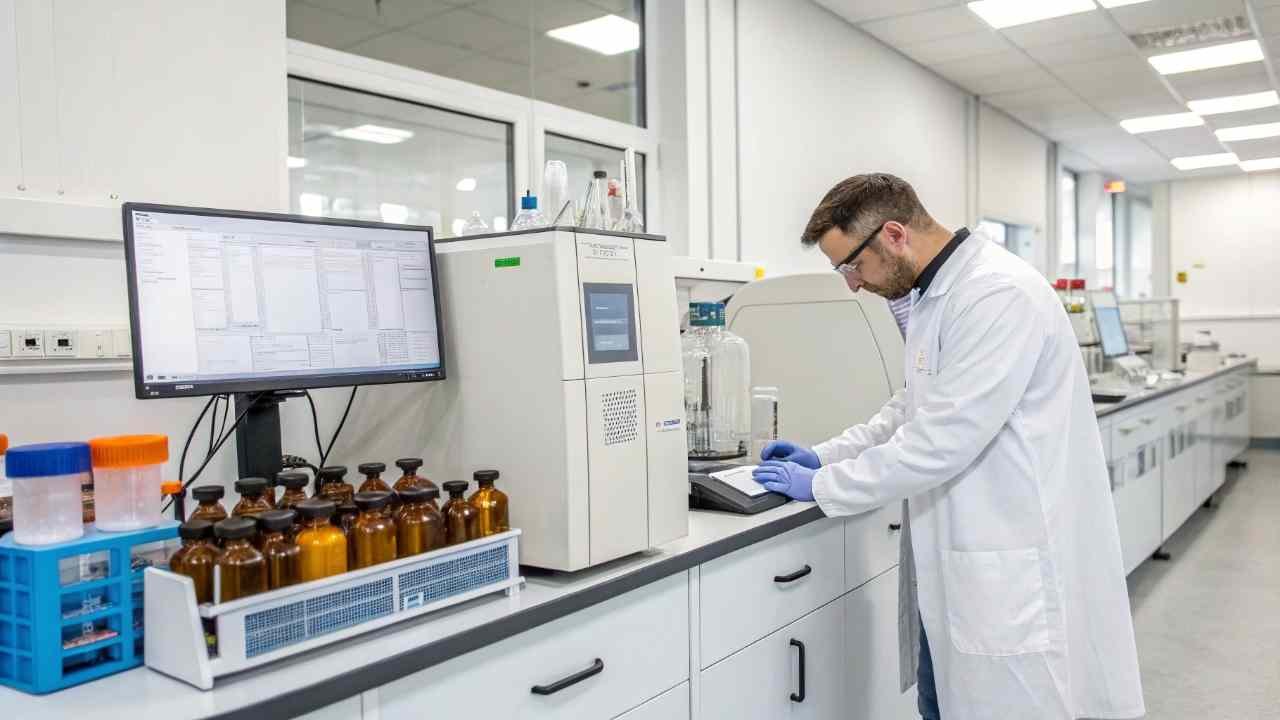
Purity testing for the Vitamin A series is primarily conducted using High-Performance Liquid Chromatography (HPLC) coupled with Ultraviolet (UV) or Diode Array Detectors (DAD). This method accurately separates active all-trans isomers from degraded related substances to determine exact potency.
Dive Deeper into Analytical Chromatographic Methods
HPLC3 is the gold standard for verifying the chemical purity and isomer composition of the Vitamin A series. Because Vitamin A is highly sensitive to light and air, testing laboratories must run these assays rapidly under yellow safety light to prevent artificial sample degradation during preparation. The HPLC column, typically a reverse-phase C18 or C30 column, separates the active all-trans-retinyl acetate or palmitate from degraded isomers and residual synthesis solvents. UV detection is performed at a specific absorption wavelength, usually 325 nm, where retinyl esters exhibit maximum absorption.
In addition to HPLC, ultraviolet-visible spectrophotometry (UV-Vis) is used as a rapid screening tool. For example, EP Method A calculates the ratios of absorption at different wavelengths (such as 300 nm, 326 nm, and 350 nm) to confirm the identity and check for contamination. If the absorption ratios exceed the monograph limits, the batch must undergo more detailed chromatographic separation. Manufacturers must also test for residual solvents used in synthesis, such as cyclohexane or methanol, using Gas Chromatography (GC) with flame ionization detection. Accurate calibration of these instruments ensures that the active concentration listed on the label is completely reliable.
| Analytical Instrument | Target Analyte | Testing Objective | Quality Safeguard |
|---|---|---|---|
| HPLC-UV (325 nm) | All-trans-retinyl esters | Quantify active potency and isomers | Exclude inactive 13-cis isomer volume |
| UV-Vis Spectrophotometer | Retinol absorption spectrum | Rapid identity and purity screening | Verify absorption peak is between 325-327 nm |
| Gas Chromatography (GC) | Residual synthesis solvents | Detect volatile chemical traces | Ensure solvent levels are below ppm thresholds |
| ICP-MS | Heavy metals (Pb, As, Cd, Hg) | Quantify trace inorganic toxins | Guarantee food-grade safety compliance |
What Are Common Quality Risks in Vitamin A Series?
Hidden contaminants and unstable isomers can ruin entire batches of your final food or feed products. Unexpected chemical oxidation depletes potency before the product even reaches the consumer. Identifying common manufacturing risks prevents costly waste.
The most common quality risks in the Vitamin A series are oxidative degradation, isomer degradation (loss of all-trans activity), residual solvent contamination, and heavy metal accumulation. Exposure to oxygen, light, heat, or metallic catalysts accelerates these risks.

Dive Deeper into Chemical and Physical Risks
Vitamin A is chemically unstable due to the presence of multiple conjugated double bonds in its molecular structure. This specific chemical configuration makes it highly vulnerable to oxidation4 by atmospheric oxygen. Once oxidized, the molecule loses its biological activity, rendering it useless for nutritional supplementation. Another major risk is isomer conversion. Under thermal or photochemical stress, the active all-trans configuration can convert into cis-isomers, which possess significantly lower bioactivity. This transformation reduces the overall effectiveness of the raw material even if the total retinoid content seems unchanged.
Physical quality risks also include the formation of peroxides and free acids. High peroxide values indicate that oxidation has already begun, which will rapidly accelerate during storage. Furthermore, in powder formulations, such as spray-dried beadlets, physical stability risks like caking or poor water solubility can occur. Caking prevents uniform mixing in dry feed or food premixes, leading to uneven distribution of the active nutrient. Sourcing managers must evaluate the production conditions of chemical plants. Factories must use nitrogen blankets during packaging and utilize proper protective wall materials to minimize these quality risks.
| Identified Quality Risk | Primary Cause | Final Impact | Prevention Strategy |
|---|---|---|---|
| Oxidative Degradation | Air and light exposure | Rapid loss of nutritional potency | Use nitrogen packaging and UV protection |
| Isomer Conversion | Thermal and light stress | Reduced biological activity | Maintain strict cold chain transportation |
| Caking (Powder Grades) | Humidity and heat storage | Poor mixing and flowability | Optimize microencapsulation wall materials |
| Residual Heavy Metals | Unfiltered raw materials | Toxicological non-compliance | Implement multi-stage filtration in production |
How Do Manufacturers Ensure Stability of Vitamin A Series?
Rapid degradation of active ingredients under normal storage conditions cuts shelf life short and drives up costs. Standard packaging is not enough to protect delicate fat-soluble vitamins. Implementing robust stability solutions extends product lifespan.
Manufacturers ensure the stability of the Vitamin A series by utilizing microencapsulation (spray-drying retinyl esters within protective starch or gelatin matrices), adding food-grade antioxidants such as BHT, BHA, or natural tocopherols, and utilizing vacuum nitrogen-flushed packaging.

Dive Deeper into Microencapsulation and Antioxidant Stabilization
To overcome the natural instability of Vitamin A, manufacturers utilize advanced physical and chemical stabilization techniques. The primary physical method is microencapsulation, which involves converting oil-soluble retinyl esters into water-dispersible beadlets. Using spray-drying or spray-cooling technologies, manufacturers trap microscopic droplets of Vitamin A oil inside a protective matrix. This matrix is typically composed of food-grade starch, gelatin, or gum arabic. The surrounding wall material acts as a physical barrier that prevents oxygen, moisture, and light from directly contacting the active vitamin molecules.
Chemically, manufacturers add lipid-soluble antioxidants to the oil phase before encapsulation. Butylated hydroxytoluene (BHT) and butylated hydroxyanisole (BHA) are highly effective synthetic antioxidants used in feed-grade formulations. For food-grade and organic-compliant products, natural mixed tocopherols (Vitamin E) or ascorbyl palmitate are used as safer alternatives. These antioxidants scavenge free radicals and prevent the initiation of oxidative chain reactions. Sourcing teams like FINETECH verify that factories optimize both the matrix thickness and antioxidant ratios, ensuring that the Vitamin A powder remains stable even when subjected to high temperatures during feed pelleting or food extrusion.
| Stabilization Method | Applied Mechanism | Target Formulation | Operational Benefit |
|---|---|---|---|
| Starch Microencapsulation | Physical barrier wall | Water-dispersible powders | Prevents heat and moisture degradation |
| BHT Addition | Synthetic antioxidant | Feed-grade oils and powders | Highly cost-effective oxidation prevention |
| Mixed Tocopherols | Natural antioxidant | Food & cosmetic applications | Meets clean-label marketing demands |
| Nitrogen Flushing | Oxygen displacement | Bulk liquid and oil drums | Preserves quality during long sea shipping |
What Certifications Are Required for Vitamin A Series Export?
Missing or invalid shipping certificates cause custom holds that delay your production schedules. Navigating complex international food safety laws without proper documentation risks high port demurrage fees. Verifying proper certifications ensures smooth border clearance.
Exporting the Vitamin A series requires key international certifications, including FSSC 22000 or ISO 22000 for food safety management, GMP for pharmaceutical grades, and Halal and Kosher certifications to meet cultural and dietary market compliance.

Dive Deeper into Regulatory Compliance
International trade of chemical food additives and animal feed ingredients requires strict adherence to regulatory documentation. Different importing countries maintain specific entry requirements that a supplier must satisfy. For shipments destined for the European Union, compliance with REACH regulations5 is necessary for chemical substances, while food-grade materials must come from facilities registered under FSSC 22000 or ISO 22000. These internationally recognized food safety management systems prove that the manufacturing plant maintains rigorous hazard analysis critical control point (HACCP) programs.
In the Middle East, particularly in countries like Saudi Arabia and the UAE, verified Halal certification6 is mandatory for food and beverage formulations. This certificate must be issued by an accredited Islamic body recognized by local standards authorities, such as SFDA or ESMA. Similarly, Kosher certification is necessary for entry into Jewish dietary markets. For pharmaceutical or high-end veterinary grades, a Good Manufacturing Practice (GMP) certificate is essential to prove that the batch-to-batch quality meets strict medical standards. Sourcing partners like FINETECH manage this regulatory verification by compiling complete technical dossiers, including allergen statements, GMO-free declarations, and BSE/TSE-free certificates. This diligent documentation guarantees hassle-free import clearance for wholesale buyers globally.
| Certification Name | Target Regulatory Market | Sourcing Significance | Audit Verification |
|---|---|---|---|
| FSSC 22000 / ISO 22000 | Global Food & Feed safety | Proves comprehensive HACCP systems | Verify GFSI-approved registry status |
| Halal / Kosher | Middle East & Jewish markets | Ensures compliance with cultural dietary laws | Confirm issuing body accreditation |
| GMP (Good Manufacturing) | Pharmaceutical & High-end Feed | Confirms strict batch-to-batch consistency | Inspect drug manufacturing licenses |
| REACH / CEP | European Union | Mandatory for chemical import clearance | Request valid registration numbers |
Conclusion
Vitamin A quality control relies on strict HPLC testing, precise microencapsulation, and compliant certifications. Partnering with a reliable sourcing team keeps your ingredient supply-chain safe, compliant, and highly stable.
-
United States Pharmacopeia (USP) – Official organization page establishing public quality standards for medicines, dietary supplements, and food ingredients globally. ↩
-
Food Chemicals Codex (FCC) – Official registry providing international guidelines, monographs, and identity benchmarks to verify the purity and quality of food ingredients. ↩
-
Shimadzu – Technical learning resources explaining the fundamental principles, components, and practical usage of High-Performance Liquid Chromatography (HPLC). ↩
-
MDPI – Peer-reviewed review detailing analytical methods and mechanisms of lipid oxidation and antioxidant activity in high-fat food and nutritional systems. ↩
-
European Chemicals Agency (ECHA) – Regulatory portal detailing the registration, evaluation, authorization, and restriction requirements under REACH for EU chemical exports. ↩
-
Saudi Food and Drug Authority (SFDA) – Official Saudi Halal Center regulations, detailing the compliance and issuing requirements for Halal certification bodies. ↩