Supply chain breaks kill your production schedule. Unreliable sources cause missed deadlines and heavy financial losses. I show you why China is the backbone of global Stevia stability and safety.
Yes, China is the most reliable source for Stevia, producing over 80% of the world's supply. Chinese suppliers offer vertical integration from farming to extraction. This ensures price stability, high-purity grades like Reb M, and full compliance with international food safety standards for wholesale buyers.
I manage factory selection and oversee production for my B2B clients at FINETECH. I want to share the technical facts about the Chinese Stevia market so you can secure your supply and grow your business.
What advantages do Chinese Stevia manufacturers offer to global buyers?
High ingredient costs hurt your retail price and margins. Buying from small, fragmented markets increases your supply risk. I explain how the scale of Chinese Stevia provides a massive competitive advantage.
Chinese manufacturers provide a 20% to 30% cost advantage due to large-scale farming in provinces like Anhui and Gansu. They offer vertical integration, advanced extraction technology for Reb A and Reb M, and highly efficient logistics for large-scale global wholesale orders.
Scale, Integration, and Technological Leadership
I see that scale is the first big advantage. China has the largest planting area for Stevia in the world. Farmers in provinces like Anhui and Jiangsu have grown Stevia for decades. This creates a "Vertical Integration1" model. The factory owns the land or has long-term contracts with the farmers. This means the factory controls the quality of the leaves from the start. They do not rely on middleman traders. I visit these farms to ensure the soil is clean and free from harmful chemicals. This integration keeps the raw material price stable even when global markets are volatile. I act as your strategic partner to access these primary sources.
Technology is the second major advantage. Chinese factories have moved beyond basic Reb A 60% or 95%. They now lead in "Enzymatic Conversion" and high-purity Reb M production. Reb M is the best-tasting part of the leaf, but it is rare. Chinese scientists have developed ways to produce it at a lower cost. This allows my B2B clients to make "Sugar-Free" drinks that taste exactly like sugar. I prioritize factories that use modern crystallization and filtration systems. These systems ensure the powder is white and dissolves instantly. I also check the logistics infrastructure. Most major plants are near high-speed rail or ports like Shanghai. This ensures your order moves from the warehouse to the ship in 48 hours.
Comparison of Stevia Sourcing Regions
| Feature | China (Mainland) | South America | SE Asia (Local) |
|---|---|---|---|
| Global Market Share | Over 80% | Less than 5% | Less than 10% |
| Supply Stability | Very High | Moderate | Low (Seasonal) |
| Purity Options | Full (RA, RB, RD, RM) | Limited | Mostly Raw Extract |
| Price Level | Most Competitive | High | Moderate |
| Logistics Speed | Fast (Direct ships) | Slow | Moderate |
| Vertical Integration | High | Low | Low |
How do Chinese Stevia suppliers ensure consistent export quality?
One bad batch of Stevia can ruin thousands of liters of soda. Bitter aftertastes from low-purity extracts lead to customer complaints. I show you the technical steps Chinese labs take to guarantee consistent purity.
Suppliers ensure quality through HPLC testing to verify glycoside content and purity. They follow strict protocols for pesticide residue control and heavy metal testing. Leading factories use automated extraction lines and batch-tracking systems to maintain consistency and meet international FCC and USP standards.
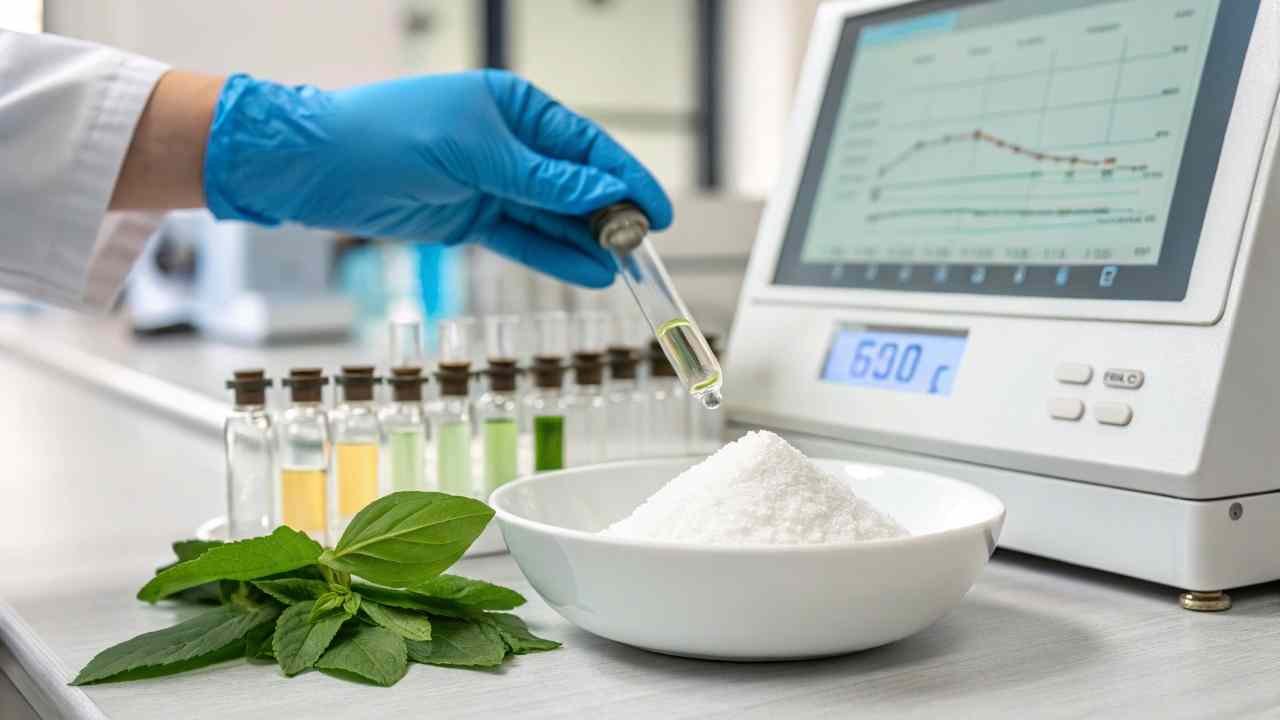
Advanced Lab Testing and Process Control
I see that consistency is the result of strict lab work. Every batch of Stevia powder goes through a machine called an HPLC (High-Performance Liquid Chromatography). This machine measures the exact percentage of Rebaudioside A or M. I check these lab reports for every client order. A good factory in China will provide a "Batch-Specific COA." This means the report is for the actual drum you receive, not a generic copy. I also look for "Impurity Profiling." We check for ash content and moisture levels. If the moisture is too high, the powder will cake during shipping. I ensure the moisture is always below 5% for long-distance export.
Pesticide control2 is another technical focus. China has very strict laws about pesticide use on export crops. Leading factories test the leaves before they enter the extraction line. I verify these tests to ensure the product meets EU and US safety laws. The extraction process itself uses water or food-grade ethanol. I visit the plants to ensure no harmful chemicals like methanol are used in the solvent stage. We also check the "Heavy Metal" logs. Lead and Arsenic must be extremely low, often below 1 ppm. I act as your technical gatekeeper by auditing the factory's internal QC department. This oversight ensures that your Stevia is not just sweet, but also 100% safe for human consumption.
Technical Quality Benchmarks
| Parameter | Standard Level | FINETECH's High-Quality Target |
|---|---|---|
| Total Glycosides | 95.0% Min | 98.0% Min |
| Rebaudioside A | 95.0% Min | 97.0% - 99.0% |
| Loss on Drying | 6.0% Max | 4.0% Max |
| Ash Content | 1.0% Max | 0.2% Max |
| Lead (Pb) | 1 ppm Max | 0.5 ppm Max |
| Arsenic (As) | 1 ppm Max | 0.5 ppm Max |
What certifications are required for Stevia exports from China?
Customs rejections at the port cause massive delays and costs. Missing or fake certificates stop you from entering premium markets. I identify the mandatory documents and certifications for a safe Stevia import process.
Required certifications include FSSC 22000 or ISO 22000 for food safety, plus HALAL and KOSHER for religious markets. For the US and Europe, USDA Organic, EU Organic, and Non-GMO Project Verified certifications are essential for high-end food and beverage applications.
The "Trust Layer" of Global Documentation
I see that certifications are the language of trust in the B2B chemical market. ISO 22000 is the baseline. It proves the factory has a management system for food safety. But for my clients in the Middle East, a "Halal Certificate" is mandatory. I check that the Halal body is recognized by the local government in your country, like JAKIM or MUI. This prevents your cargo from being stuck at the border. I also manage Kosher certificates for our partners in Europe and the Americas. I act as your strategic partner to verify that these certificates are active and valid for the specific year of production.
For the health-food sector, "Organic" and "Non-GMO3" labels are the key to high margins. China has many farms that follow USDA and EU organic rules. These farms use zero synthetic fertilizers. I visit these organic zones to ensure the separation between organic and conventional fields is real. We also provide "Non-GMO Project Verified" documents. Stevia is a natural plant, but buyers want proof that no genetic engineering was used in the extraction. I also collect the "Health Certificate" and "Certificate of Free Sale" from the Chinese government (CIQ). These papers prove the product is legally sold in China. Having this full "Document Pack" makes the customs process in Russia, Germany, or the UAE much smoother.
Mandatory Documentation Checklist
| Document Name | Technical Purpose | Markets Required |
|---|---|---|
| ISO / FSSC 22000 | Food safety system | Global |
| COA (Batch Specific) | Purity and metals check | Global |
| HALAL Certificate | Religious compliance | Middle East / SE Asia |
| KOSHER Certificate | Religious compliance | Europe / USA |
| Organic (USDA/EU) | Chemical-free farming | High-end Retail |
| Non-GMO Statement | No genetic engineering | Europe / USA |
| SDS (GHS Version) | Safety and handling | Logistics / Port |
How do Chinese factories handle bulk Stevia production orders?
Scaling your production is impossible with tiny or slow suppliers. Long lead times prevent you from grabbing new market trends. I explain how large-scale Chinese factories manage high-volume B2B orders with speed and precision.
Chinese factories handle bulk orders by maintaining large raw material reserves and using continuous extraction lines. They offer flexible MOQs, from 100kg to full containers. They also provide customized blending, granulation, and private label packaging to suit the specific needs of food wholesalers and distributors.
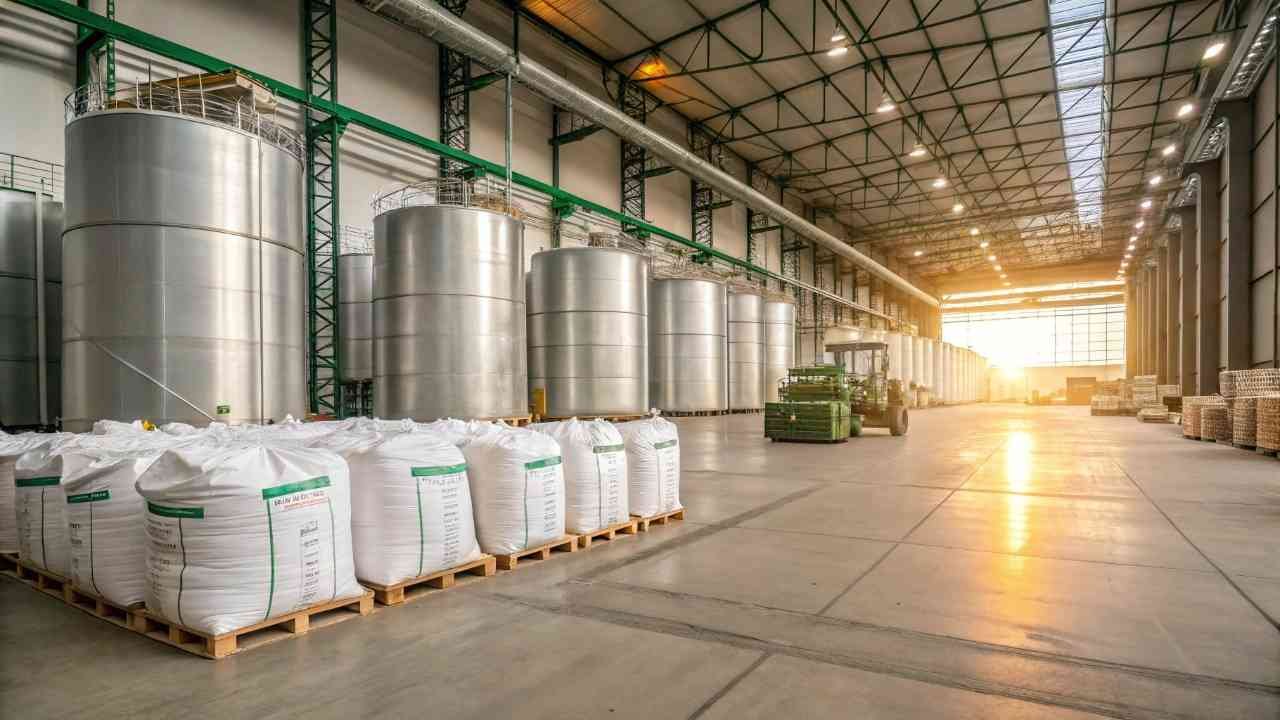
Capacity, Customization, and Logistics Speed
I see that "Throughput" is what matters for big buyers. A top-tier factory in China can produce several tons of high-purity Stevia powder every day. They use "Continuous Extraction" lines that never stop. This efficiency lowers the cost and ensures a steady supply. I help my clients plan their "Annual Volume" with these factories. By committing to a yearly volume, I secure a fixed price and a reserved production slot. This is vital during the harvest season when everyone wants to buy. I act as your production manager in China to keep your order at the front of the line. This ensures you never face a "Stock Out" situation in your local warehouse.
Customization is the second part of bulk handling. Not every factory needs the same format. Some of my clients need "Granulated Stevia" for table-top sachets. This format does not create dust and flows easily. Others need "Stevia Blends" with Erythritol4 or Monk Fruit to match a specific sugar profile. I oversee the blending process at the factory to ensure the mix is uniform. If the blend is not mixed perfectly, one bag will be sweeter than the other. I also manage the packaging. We use double-layered PE bags inside high-strength fiber drums. This packaging protects the powder from moisture and damage during long-distance ocean freight to places like Korea or Vietnam.
| Service Type | Technical Detail | FINETECH's Advantage |
|---|---|---|
| Bulk Capacity | 1000+ Tons per year | Priority production access |
| Custom Blending | Stevia + Erythritol/Xylitol | Precise sweetness ratios |
| Granulation | 20-80 mesh sizes | Dust-free manufacturing |
| Private Label | OEM drum / carton marking | Ready-for-sale packaging |
| Low MOQ | Starting from 100kg | Low risk for new trials |
| Fast Delivery | 7-14 day lead time | Quick market response |
How can importers evaluate reliable Stevia suppliers in China?
Choosing the wrong partner leads to lost deposits and fake lab reports. You cannot risk your company's capital on unverified online claims. I reveal the technical evaluation process I use to find the best factories for my clients.
Evaluate suppliers by reviewing their export history, checking their Sinosure credit rating, and requesting lab-tested samples. A reliable supplier should offer on-site or video audits and provide transparent data on their extraction methods. Always verify their certifications against official government and third-party databases.
The Verification Loop and Financial Health
I see that many buyers only look at the Alibaba price. This is dangerous. I use a "Three-Step Verification" loop. First, I check the factory's financial health using Sinosure (China Export & Credit Insurance Corporation)5. A factory with a high Sinosure rating is stable and unlikely to go bankrupt. Second, I look at their "Export Track Record." I want to see that they have shipped to strict markets like the US or Europe before. If they have passed European customs many times, their quality is likely high. I act as your auditor to gather this data. This research prevents you from sending money to a "trading company" that has no factory and no quality control.
Third, I conduct on-site or video audits. I look at the "Mother Liquor" and the crystallization area. If the factory is dirty, the Stevia will be dirty. I also check their lab equipment. If they do not have their own HPLC machine, they cannot guarantee every batch. I also request a "Golden Sample" from a recent production run. I help you compare this sample to your current supply. We look at the "Taste Profile" for bitterness and the "Dissolving Speed." By following this technical evaluation, we remove the guesswork. You get a partner who supports your growth, not just a seller who wants your money. This professional vetting is the foundation of a safe and profitable wholesale business.
| Evaluation Step | What to Check | Why it Matters |
|---|---|---|
| Financial Check | Sinosure credit rating | Prevents financial loss |
| Export History | Customs data / BL copies | Proves market experience |
| Lab Audit | HPLC equipment / QC staff | Ensures batch consistency |
| Site Visit | Hygiene / Storage conditions | Prevents contamination |
| Sample Test | Purity / Aftertaste / Mesh | Verify technical specs |
| Cert Verification | Database cross-check | Ensures legal compliance |
Conclusion
China is a highly reliable source for Stevia due to its vertical integration, advanced extraction technology, and strict quality certifications. I manage these technical details at FINETECH to ensure your global procurement is safe, consistent, and cost-effective.
-
Investopedia – A guide to how vertical integration helps companies control supply chains and reduce costs. ↩
-
FAO – Global standards and guidelines for the safe management and regulation of pesticides in agriculture. ↩
-
Non-GMO Project – Details on the verification process to ensure products are produced without genetic engineering. ↩
-
Healthline – A nutritional review of erythritol and its common applications as a bulk sweetener in sugar-free products. ↩
-
Sinosure Official – The primary credit insurance provider in China assisting in the risk management of international trade. ↩