

Sourcing inconsistent Acesulfame-K grades without analyzing physical particle behavior, chemical purity fluctuations, and processing thermal profiles causes formulation segregation, off-flavors, and rapid product sweetness decay.
Evaluating quality factors of Acesulfame-K requires analyzing chemical purity limits to prevent metallic off-tastes, choosing appropriate particle mesh sizes for mixing, monitoring stability across acidic and thermal processing boundaries, and standardizing supplier batch quality.
Successfully manufacturing premium sugar-free foods and beverages requires a disciplined approach to evaluating raw material properties. Sourcing managers must examine physical dissolving profiles and chemical stability parameters to protect their formulations from active potency losses and off-flavor defects. Sourcing partners like FINETECH simplify factory checks, verify production compliance, and secure competitive pricing directly in China to guarantee bulk deliveries. This guide explains what quality factors affect the performance of Acesulfame-K in food applications.
How Does Acesulfame-K Purity Influence Sweetness Performance?
Allowing trace synthesis byproducts into sweetener batches degrades the clean sensory profile of sugar-free formulations. Unchecked chemical contaminants introduce persistent bitter off-notes.
Acesulfame-K purity directly dictates sweetness performance, as active assays below ninety-nine percent or elevated levels of organic synthesis byproducts like acetoacetamide introduce unpleasant metallic and bitter off-flavors.

Dive Deeper into Active Assays, Organic Intermediates, and Flavor Integrity
The chemical purity of Acesulfame-K is the primary factor that determines its sweetness performance and overall sensory quality in food and beverage products. According to international pharmaceutical and food-grade standards, such as the United States Pharmacopeia (USP) and Food Chemicals Codex (FCC), high-quality Acesulfame-K must maintain an active substance assay between ninety-nine percent and one hundred and one percent. When the purity falls below this range, even by a fraction of a percent, the sweetness intensity is compromised. This drop in purity often signals the presence of unreacted synthesis intermediates or moisture, which alter the expected sweetness profile of the finished product.
Furthermore, trace organic impurities from the manufacturing process, specifically acetoacetamide and acetoacetamide-N-sulfonic acid, can introduce a persistent metallic or bitter taste that ruins the sweet flavor. Even at parts-per-million levels, these chemical byproducts interfere with the taste receptors, necessitating the use of expensive flavor-masking agents. Standardizing on high-purity raw materials ensures that the sweetener remains clean, crisp, and predictable. Sourcing partners like FINETECH assist food brands by auditing raw material batches, verifying that organic impurities1 are suppressed well below regulatory limits through high-efficiency recrystallization, preserving taste integrity.
| Purity Parameter | Standard Specification | Sweetness Impact | Sourcing Control Method |
|---|---|---|---|
| Active Assay | 99.0% to 101.0% | Core sweetening potency | High-Performance Liquid Chromatography |
| Acetoacetamide | Maximum 0.12% | Bitter and metallic off-notes | Multi-stage recrystallization |
| Loss on Drying | Maximum 1.0% | Dilutes sweetness concentration | Vacuum heat drying |
| Heavy Metals | Below USP monographs | Safety compliance only | Pre-shipment laboratory assays |
Why Is Particle Size Important for Acesulfame-K Processing?
Mixing mismatched powder sizes causes heavy ingredient separation and inconsistent sweet spots in dry performance drink blends. Coordinated physical dimensions ensure uniform distribution.
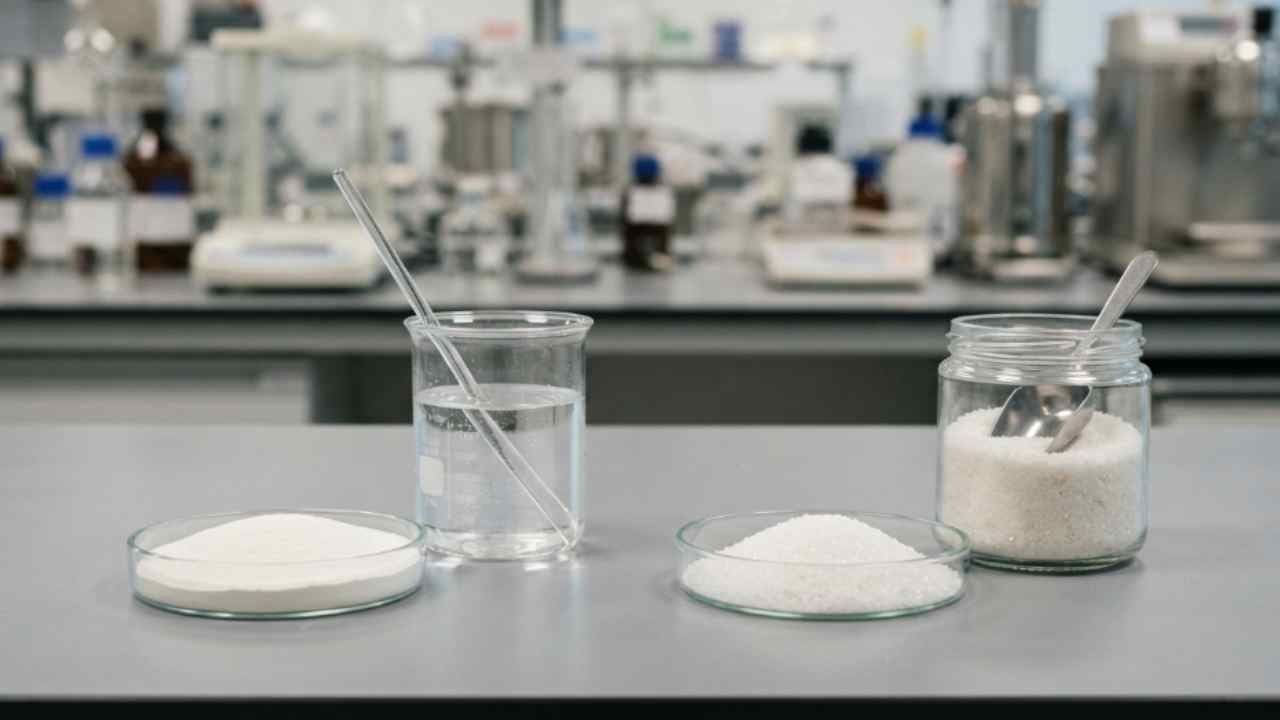
Particle size dictates processing efficiency, with fine powders optimizing rapid cold-liquid dissolution in ready-to-drink beverages, while coarser granules prevent gravitational segregation and improve powder flow in dry mixes.
Dive Deeper into Dissolution Rates, Dry Powder Segregation, and Flowability Controls
Beyond chemical purity, the physical particle size of Acesulfame-K plays a critical role in determining its performance and ease of processing during food manufacturing. Crystalline Acesulfame-K is typically available in several physical formats, ranging from fine powders to coarser granules. The selection of the appropriate particle size must align with the specific processing setup of the manufacturing facility. For liquid applications, such as ready-to-drink (RTD) soft drinks, juices, and flavored waters, fine powder formats are highly preferred. The increased surface area of the fine powder promotes rapid dissolution kinetics in cold water, preventing un-dissolved crystal sedimentation in the blending tanks.
Conversely, for dry powder formulations, such as protein shakes, meal replacements, and tabletop sweetening packets, coarser granules are superior. If fine powder is used in a dry-mix system, differences in bulk density can cause the ingredients to separate under gravity during transport, resulting in inconsistent sweetness across different packages. Coarser granules also exhibit superior physical flowability, reducing the risk of powder caking2 in humid storage environments and preventing mechanical jams in packaging hoppers. Sourcing partners like FINETECH help buyers navigate these physical parameters by matching their machinery setups with the ideal mesh size.
| Crystalline Format | Common Mesh Size | Processing Advantage | Target Application |
|---|---|---|---|
| Fine Powder | 80 to 120 mesh | Extremely rapid dissolution | Liquid RTD beverages, syrups |
| Micro-Granules | 30 to 80 mesh | Good flowability, low caking | Tabletop sugar alternatives |
| Coarse Granules | 10 to 30 mesh | Prevents powder segregation | Dry-mix protein shakes |
| Custom Granulation | Tailored mesh | Optimized for automated lines | High-speed packaging systems |
How Does Acesulfame-K Perform Under Different pH Conditions?
Utilizing highly sensitive sweeteners in acidic carbonated beverages leads to rapid sweetness loss and poor shelf storage. Structuring formulas with acid-tolerant compounds preserves quality.
Acesulfame-K performs exceptionally well across a wide pH range, maintaining its chemical integrity and sweetness profile in highly acidic carbonated soft drinks as well as neutral dairy products.

Dive Deeper into Acidic Soft Drinks, Neutral Dairy Systems, and Hydrolytic Resistance
One of the most valuable performance characteristics of Acesulfame-K is its outstanding chemical resilience under different pH conditions, making it an incredibly versatile sweetener for diverse food formulations. In the soft drink industry, beverages are highly acidic, often exhibiting pH values between two point five and three point five. Many high-intensity sweeteners, such as aspartame3, are unstable in these acidic environments and undergo hydrolytic degradation over time, causing the beverage to lose its sweetness as it sits on retail shelves.
Acesulfame-K, however, possesses a highly stable cyclic structure that resists hydrolysis. It maintains its chemical integrity and sweetening power across a broad pH spectrum, from highly acidic sodas to neutral dairy applications like yogurts and flavored milks (pH 6.5 to 7.0). This stability ensures that the finished product retains its intended sweetness throughout its entire commercial shelf life, regardless of storage conditions. Sourcing partners like FINETECH assist product developers by providing stability test data and technical support, verifying that the procured Acesulfame-K maintains consistent active assays in both low-pH and neutral formulas, ensuring reliable long-term flavor profiles for consumer goods.
| Formulation Category | pH Range | Acesulfame-K Performance | Comparative Sweetener Risk |
|---|---|---|---|
| Carbonated Soft Drinks | pH 2.5 to 3.5 | Resists acid-induced hydrolysis | Aspartame decays in storage |
| Fruit Juices | pH 3.0 to 4.0 | Maintains active sweetness profile | Sweetness fades under high heat |
| Flavored Yogurts | pH 4.0 to 4.5 | Stable during fermentation phase | Degradation by biological acids |
| Liquid Dairy Milk | pH 6.5 to 7.0 | Stable in neutral environment | Complex proteins reduce stability |
What Factors Affect Acesulfame-K Stability During Food Processing?
Exposing fragile sugar alternatives to intense commercial pasteurization or baking heat causes severe active ingredient degradation. Heat-resistant osmolytes and sweeteners bypass thermal breakdown.
Processing stability is primarily preserved due to Acesulfame-K’s high thermal resistance up to two hundred and twenty-five degrees Celsius and its complete immunity to Maillard browning reactions.

Dive Deeper into High-Heat Resistance, Maillard Browning Immunity, and Ingredient Synergy
In food processing, raw ingredients must withstand various physical and thermal stresses without degrading or causing quality defects. Acesulfame-K is highly favored by food manufacturers due to its exceptional thermal stability. During commercial processing, food products are often subjected to high temperatures, such as ultra-high temperature (UHT) sterilization in dairy lines, high-temperature short-time (HTST) pasteurization4 in juices, or high-heat baking in confectionery lines. While other sweeteners break down under heat, Acesulfame-K remains stable at temperatures up to two hundred and twenty-five degrees Celsius.
Additionally, Acesulfame-K is immune to the Maillard browning reaction5. Because it is not a carbohydrate and lacks free amino groups, it does not react with reducing sugars or proteins under heat, preventing unwanted color changes or caramelized off-odors in baked goods. It also exhibits excellent compatibility with other sweetening agents, such as sucralose or aspartame, where it works synergistically to mask aftertastes and create a rounded flavor profile. Sourcing partners like FINETECH verify these processing tolerances by auditing manufacturer quality control processes, ensuring that the raw material is free-flowing, low-moisture, and capable of withstanding intense thermal processing without losing sweetening potency.
| Processing stress | Manufacturing Parameter | Acesulfame-K Behavior | Technical Production Benefit |
|---|---|---|---|
| HTST Pasteurization | 72°C to 75°C for 15 seconds | Retains complete structure | Zero loss of sweetness potency |
| UHT Sterilization | 135°C to 140°C for 4 seconds | Retains complete structure | Safe for long-life milk products |
| Commercial Baking | Up to 225°C thermal heat | Resists molecular degradation | Ideal for sugar-free pastries |
| Maillard Browning | High heat + reducing sugars | Zero chemical reaction | Prevents off-color developments |
How Can Manufacturers Ensure Consistent Acesulfame-K Performance in Formulas?
Dealing with unpredictable batch-to-batch raw material variations results in manufacturing inconsistencies and unreliable finished products. Establishing structured sourcing verification secures production output.
Manufacturers ensure consistent performance by standardizing raw material specifications, executing batch-to-batch HPLC purity tests, calibrating optimal mesh sizes, and utilizing on-the-ground supplier quality audits.

Dive Deeper into Monographic Standardization, HPLC Assays, and Sourcing Audits
Ensuring consistent sweetness and processing performance in food and beverage formulas requires food manufacturers to establish a strict, standardized quality control program for raw materials. Relying solely on basic supplier declarations can lead to batch-to-batch variations in purity, moisture, and particle size, which ultimately compromises the quality of the finished consumer product. To prevent these processing failures, manufacturers must implement rigorous testing protocols for every incoming lot of Acesulfame-K.
A key step in this process is standardizing the raw material specifications. Every incoming batch must be verified through High-Performance Liquid Chromatography (HPLC) to confirm the active assay complies with USP or FCC monographs. Sieve analyses should be performed to verify particle size consistency, and loss-on-drying tests must confirm that moisture levels remain below zero point five percent. Sourcing partners like FINETECH protect buyers by executing these critical checks directly on the ground in China. They physically audit manufacturing plants to ensure compliance with FSSC 22000 hygiene standards, coordinate pre-shipment laboratory analysis to verify low-odor and low-moisture criteria, and manage transport logistics to ensure the cargo arrives in a pristine, free-flowing, and ready-to-process condition.
| Sourcing Verification Step | Technical Action in China | Manufacturing Benefit | Finished Product Outcome |
|---|---|---|---|
| Purity Assay Check | Run HPLC testing per lot | Verifies sweetening potency | Prevents under-sweetened batches |
| Sieve Calibration | Verify particle distribution | Prevents powder separation | Ensures even product flavor |
| Moisture Audit | Execute loss-on-drying test | Stops mechanical hopper caking | Ensures smooth factory throughput |
| Factory Inspections | Audit cleanroom FSSC files | Guarantees hygiene compliance | Bypasses regulatory delays |
Conclusion
Acesulfame-K performance in food applications is dictated by chemical purity limits that suppress bitter acetoacetamide byproducts, selection of application-specific mesh sizes for liquid dissolving or dry mixing, outstanding hydrolytic resilience under low and neutral pH ranges, thermal stability up to two hundred and twenty-five degrees Celsius, and standardized supplier sourcing audits.
-
ISA statement on EFSA's comprehensive safety re-evaluation of Acesulfame-K, highlighting the safety profiles of active substances and organic impurities. ↩
-
BAKERpedia guide to anti-caking agent mechanisms, powder flows, and prevention of agglomeration or powder caking in crystalline ingredients. ↩
-
Official US FDA resource detailing the safety, history, and approval conditions of aspartame and other high-intensity sweeteners in food. ↩
-
BAKERpedia food science overview explaining pasteurization kinetics, thermal microbial control, and processing conditions for liquid foods. ↩
-
Ragus Sugars article explaining the scientific mechanics and food formulation impacts of the non-enzymatic Maillard browning reaction. ↩