Poor quality Vitamin B3 leads to product recalls and health risks. This uncertainty stops your business growth. I provide the technical standards to ensure your food production stays safe and compliant.
Food-grade Vitamin B3 (Niacin) must meet FCC, USP, or BP standards. It requires a minimum purity of 99%, low heavy metal content (Lead < 2mg/kg), and zero harmful microbial contamination. Compliance with ISO 22000 and HACCP ensures it is safe for human consumption globally.
I manage factory selection and quality oversight for my B2B clients at FINETECH. I want to explain the technical rules for Vitamin B3 to ensure your shipments meet every safety requirement.
What Are the Key Specifications of Vitamin B3 (Niacin)?
Using incorrect specifications causes mixing failures and nutritional gaps. This waste costs you money and time. I explain the critical data points to protect your manufacturing process and product quality.
Key specs for Vitamin B3 include an assay level of 99.0%–101.0%, a melting range of 234°C–238°C, and loss on drying under 1.0%. It must be a white crystalline powder with specific limits on chloride, sulfate, and heavy metals to meet international food safety laws.

Understanding the Chemical Profile
I see that many buyers focus only on the purity percentage. But the technical profile is deeper than just one number. Vitamin B3 exists mainly as Nicotinic Acid or Niacinamide. For food use, Nicotinic Acid must have a very sharp melting point. If the melting point1 is too wide, it means there are impurities in the crystals. I check the lab reports for a melting range of 234°C to 238°C. Also, the "Loss on Drying" is a critical factor. It must be below 1.0%. If the powder is too wet, it will clump in your machines. This makes it hard to dose correctly in large food batches.
The mesh size is another technical detail I manage. Most food manufacturers2 want a fine powder that dissolves quickly. I ensure the particle size is consistent across every drum. This consistency prevents "hot spots" of vitamins in your final product. We also look at the residue on ignition. This should be less than 0.1%. This test tells us if there are inorganic minerals left over from the factory process. By checking these details, I ensure the Niacin fits your recipe perfectly. I only select factories in China that can prove these numbers in every batch.
International Specification Comparison
| Specification Item | USP Standard | BP Standard | FCC Standard |
|---|---|---|---|
| Assay (Purity) | 99.0% - 101.0% | 99.5% - 100.5% | 99.0% - 101.0% |
| Melting Range | 234°C - 238°C | 234°C - 237°C | 234°C - 238°C |
| Loss on Drying | Max 1.0% | Max 0.5% | Max 1.0% |
| Residue on Ignition | Max 0.1% | Max 0.1% | Max 0.1% |
| Heavy Metals (Pb) | < 10 ppm | < 20 ppm | < 2 ppm |
How Is Purity Tested for Vitamin B3 (Niacin)?
Blindly trusting a label leads to manufacturing disasters. One impure batch ruins your reputation. I describe the testing methods we use to guarantee the chemical integrity of every shipment before it leaves China.
Purity is primarily tested using High-Performance Liquid Chromatography (HPLC) or titration. HPLC provides the exact assay percentage and identifies impurities. We also use atomic absorption for heavy metals and standard plate counts for microbial safety to ensure 100% compliance with food safety rules.

Advanced Laboratory Verification
I want you to know how we verify the quality. The primary tool is HPLC3. This machine separates the Vitamin B3 from any other molecules. It gives us a very accurate purity reading. I review the HPLC chromatograms from the factory lab. If I see extra "peaks" on the graph, I know the product is not clean. For Nicotinic Acid, titration is also a common and reliable method. It uses a chemical reaction to measure the concentration. It is a standard method in both the USP and BP manuals. I ensure the factory uses calibrated equipment for these tests.
Identity testing is also vital. We use Fourier-Transform Infrared Spectroscopy (FTIR). This test creates a "fingerprint" of the molecule. It proves that the white powder is actually Vitamin B3 and not another chemical. I also oversee the heavy metal testing. We use Inductively Coupled Plasma (ICP) to find tiny traces of Lead or Arsenic. In the food industry, these must be almost zero. Lead must stay below 2 mg/kg for most food uses. I also check the microbiology. We test for Salmonella and E. coli4. For my buyers in Europe and the Middle East, a negative result for these is mandatory. My oversight ensures no unsafe material reaches your warehouse.
Common Quality Tests for Vitamin B3
| Test Name | Method | Purpose |
|---|---|---|
| Assay | HPLC / Titration | Measures exact purity |
| Identification | FTIR / UV | Confirms chemical identity |
| Heavy Metals | ICP-MS / AA | Checks for Lead and Arsenic |
| Mesh Size | Sieve Analysis | Checks powder fineness |
| Microbiology | Plate Count | Ensures no harmful bacteria |
| Appearance | Visual Check | Confirms white color and no dirt |
What Is the Difference Between Food-Grade and Feed-Grade Vitamin B3 (Niacin)?
Using feed-grade in food products results in legal bans and health hazards. These errors destroy companies and brand trust. I clarify the technical differences so you never make this costly mistake in your procurement.
Food-grade Vitamin B3 has 99%+ purity and strict heavy metal limits (Lead < 2ppm). Feed-grade has lower purity requirements and higher allowed impurities. Food-grade production requires HACCP and ISO 22000 certifications, while feed-grade follows less stringent hygiene and document protocols.

Purity and Safety Gaps
I see that some traders try to sell feed-grade as food-grade because it is cheaper. This is a huge risk. Feed-grade Niacin often has a purity of only 98% or lower. The remaining 2% can contain residual solvents or fermentation byproducts. These are not safe for humans. Food-grade material is much cleaner. It goes through more purification steps in the factory. Also, the heavy metal limits are much tighter. In feed-grade, Lead might be allowed at 10 or 20 ppm. In food-grade, it must be under 2 ppm. I manage the selection of factories that have separate lines for food-grade production. This prevents cross-contamination5.
The documentation is also very different. Food-grade B3 comes with a full set of safety certificates. This includes ISO 22000 and HACCP6. These prove the factory has a food safety management system. Feed-grade usually only has a basic COA. For my clients in the Middle East and Southeast Asia, food-grade also requires HALAL and KOSHER certificates. Feed-grade material rarely has these. Also, the physical appearance can differ. Food-grade is a bright, pure white. Feed-grade can be slightly off-white or yellowish. I check every shipment to ensure the color and documents match the high standards of food manufacturing.
Comparison Table: Food Grade vs. Feed Grade
| Feature | Food-Grade B3 | Feed-Grade B3 |
|---|---|---|
| Purity (Assay) | 99.0% - 101.0% | 98.0% - 99.0% |
| Lead (Pb) Limit | < 2 mg/kg | < 10-20 mg/kg |
| Production Standard | HACCP / GMP | Basic Feed License |
| Certifications | HALAL / KOSHER / ISO | None / Basic |
| Appearance | Pure White | Off-white / Yellowish |
| End Use | Human Food / Pharma | Livestock / Poultry |
How Is Batch Consistency Ensured for Vitamin B3 (Niacin)?
Inconsistent batches cause irregular food colors and varying nutritional levels. This lack of uniformity loses customer trust. I oversee the production steps in China to ensure every drum matches the previous one in your supply chain.
Batch consistency is ensured through automated production controls and standardized raw material sourcing. Factories use "Retainer Samples" from every batch for two years. Regular HPLC testing during production and final pre-shipment inspections at FINETECH guarantee that every shipment is uniform and reliable.
Standardized Manufacturing Processes
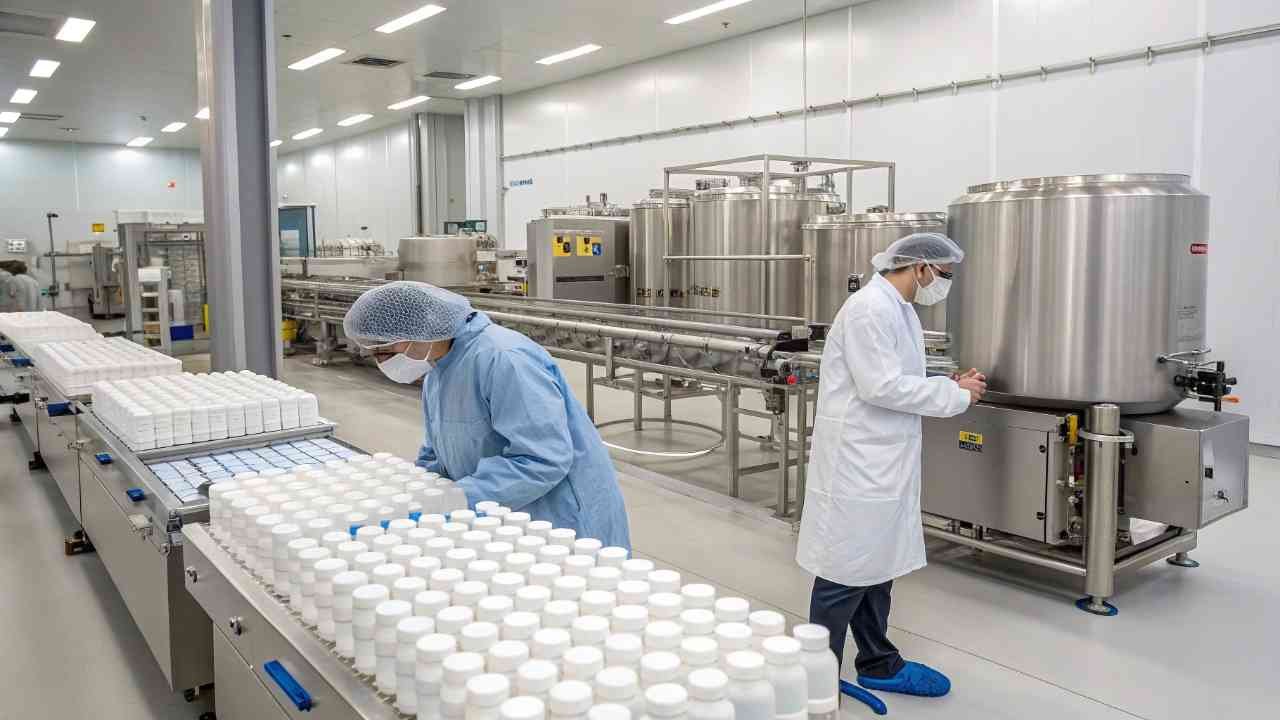
I observe that consistency starts with raw materials. The factories I choose use the same high-quality picoline for every run. They use automated systems to control temperature and pressure during the chemical synthesis. This automation removes human error. If the temperature changes even a little, the crystal size might change. I visit the factories to check their control rooms. A stable process means the assay level will be the same in January and in June. This is vital for my wholesale buyers who need a reliable product for their own customers. I focus on factories that prioritize long-term stability over short-term speed.
I also insist on a strict sampling plan. The lab must take samples from the top, middle, and bottom of the blender. This proves the whole batch is the same. We also keep a "retainer sample" from every batch for at least two years. If you ever have a problem, we can test that sample again. It provides a technical history of the product. My pre-shipment inspection includes checking the batch numbers on every drum. I ensure they match the COA exactly. This traceability7 is a requirement for modern food safety. By managing these details, I ensure your production line never has to stop because of a weird batch.
Steps to Ensure Batch Uniformity
| Step | Action | Benefit |
|---|---|---|
| Raw Material Check | Verify picoline purity | Consistent starting point |
| Automation | Digital sensors for synthesis | No human error |
| Multi-Point Sampling | Test top/middle/bottom | Uniform batch quality |
| Retainer Samples | Store samples for 2 years | Long-term traceability |
| Final Inspection | Match drum codes to COA | 100% correct delivery |
| Retesting | Re-check old stock | Ensures potency over time |
What Quality Documents Are Required for Vitamin B3 (Niacin)?
Missing documents stop your cargo at customs for weeks. These delays lead to high storage fees and lost sales. I provide a complete technical file with every shipment to ensure smooth clearance and compliance for your business.
Essential documents include a Certificate of Analysis (COA), MSDS, and a Health Certificate. Food buyers also require ISO 22000, HACCP, HALAL, and KOSHER certificates. A Non-GMO statement and an Allergen report are also standard requirements for modern international food manufacturing and trade.
Building a Complete Technical File
I see that customs officers are very strict about food additives. You must have a perfect COA. It must list all the tests we discussed, like assay and heavy metals. It must also have a clear batch number and production date. I check every COA before the ship leaves the port. I also provide the MSDS (Material Safety Data Sheet). This document is needed for shipping and warehouse safety. It tells people how to handle the powder and what to do in an emergency. For my buyers in the Middle East, a Health Certificate from the Chinese government is mandatory. It proves the product is fit for human consumption.
I also manage the religious and lifestyle certificates. For Indonesia, Malaysia, and Saudi Arabia, a HALAL certificate is a legal requirement. I ensure it comes from a recognized body. KOSHER is also important for the European market. Modern food buyers also ask for "Statement" documents. These include a Non-GMO statement and an Allergen statement. Even though Vitamin B3 is a chemical, buyers want to know if it touched soy or wheat in the factory. I provide these papers to help you pass audits from large food companies. My goal is to make your procurement easy by handling all the technical paperwork for you.
Document Checklist for B2B Buyers
| Document Name | Purpose | Importance |
|---|---|---|
| Certificate of Analysis (COA) | Proves batch quality | Mandatory |
| MSDS | Safety and logistics info | Mandatory |
| Health Certificate | Government safety proof | Mandatory for Food |
| ISO 22000 / HACCP | Factory safety standard | Mandatory for Food |
| HALAL / KOSHER | Religious compliance | Market Dependent |
| Non-GMO / Allergen | Consumer safety proof | High (for Food) |
| Packing List / Invoice | Customs clearance | Mandatory |
Conclusion
Quality standards for Vitamin B3 ensure purity, safety, and consistency for food production. I manage these technical specs and documents at FINETECH to protect your business and ensure smooth international trade.
-
ScienceDirect – Engineering reference explaining how the melting point verifies the purity and crystalline integrity of chemical additives. ↩
-
Food Processing – An industry hub for food enterprises and manufacturers to stay updated on production technology and market trends. ↩
-
Waters Corp – Technical application notes for laboratory personnel on using HPLC for precise vitamin and additive testing. ↩
-
Food Safety Magazine – A leading resource for technical staff focused on pathogen control and safety standards in food production. ↩
-
U.S. FDA – Official guidelines on HACCP principles used to manage and prevent biological and chemical cross-contamination. ↩
-
ISO – The international official site for the ISO 22000 standard, defining global food safety management requirements. ↩
-
GS1 Traceability – A technical standard for trade orientation that ensures end-to-end visibility and safety in the supply chain. ↩