
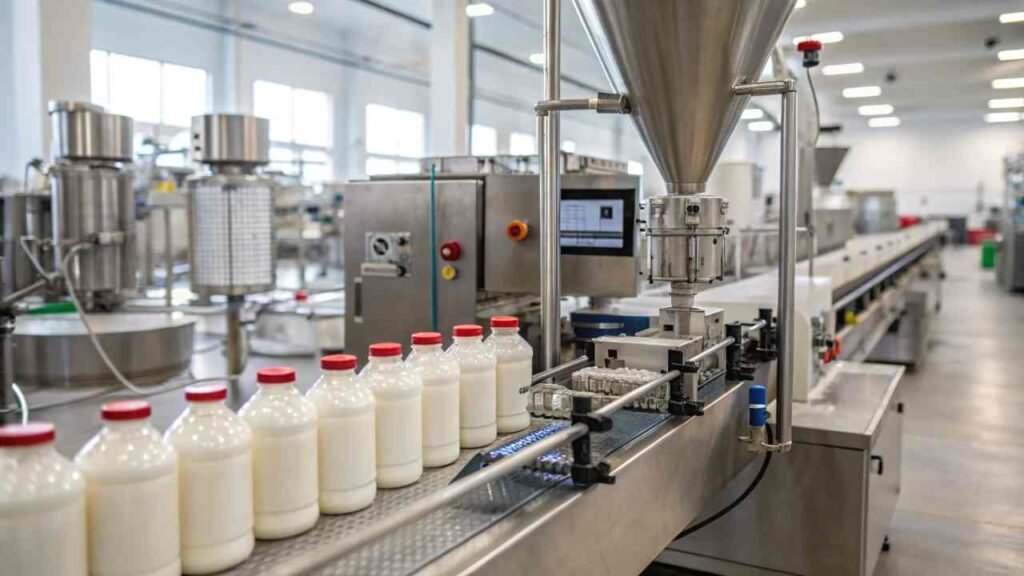
Selecting the incorrect concentration of Vitamin H leads to severe dosing errors, uneven mixture distribution, and wasted active ingredients. Incompatible formats ruin batches. Evaluating application specifications prevents production failures.
Choosing the best Vitamin H form depends on the processing setup. Pure D-Biotin (98%+) suits high-precision liquid blending, supplements, and cosmetics, while diluted 1% food-grade or 2% feed-grade powders are optimized for dry food fortification and bulk livestock feed premixes.
Successful product formulation requires matching the physical and chemical properties of a raw material with the target manufacturing line. Industrial buyers must evaluate concentration, density, and flowability parameters to prevent dosing errors. Sourcing partners like FINETECH simplify factory checks, verify production compliance, and secure competitive pricing directly in China to guarantee bulk deliveries. This guide details how to select the right Vitamin H series form.
What Are the Differences Between Pure and Diluted Vitamin H Series?
Adding highly concentrated vitamins to large dry mixtures without pre-dilution creates localized hotspots and failed nutritional assays. Inconsistent dispersion wastes active molecules. Distinguishing pure and diluted forms solves this.
Pure Vitamin H (98%+) is a highly concentrated crystalline powder used for liquid supplements, cosmetics, and pharmaceutical synthesis. Diluted forms (1% or 2%) are blended with carrier excipients to ensure uniform powder distribution in food and feed production.
Dive Deeper into Concentration Gradients and Industrial Roles
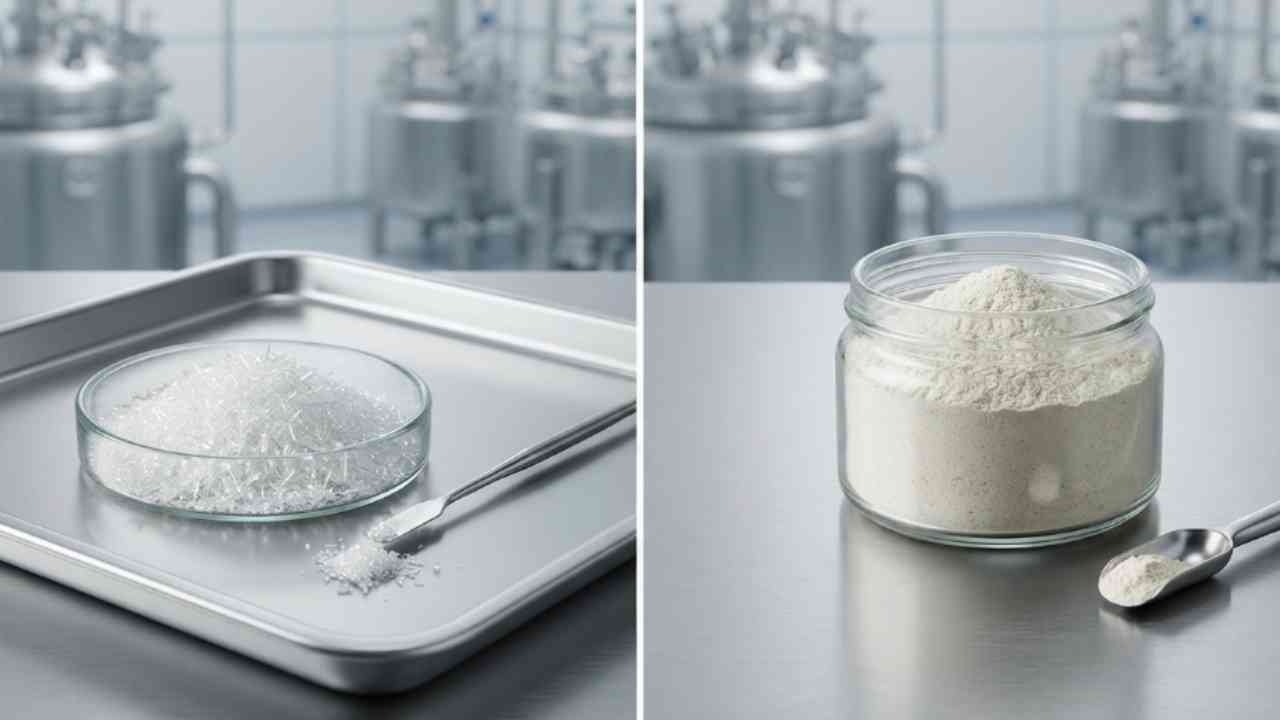
Evaluating the technical differences between pure and diluted Vitamin H is essential to ensure stable dosing and cost-efficient processing. Pure D-Biotin1 (typically ninety-eight percent or higher) is a highly concentrated, white crystalline powder. In this pure state, the molecule exhibits strong hydrophobic properties, electrostatic charge, and a tendency to clump. Because the human body only requires microgram-level amounts of Biotin daily, handling pure crystals is highly challenging for standard mixing plants. Consequently, pure D-Biotin is reserved for specialized pharmaceutical APIs, liquid cosmetics, softgel supplements, or advanced laboratories equipped with ultra-precision weighing scales and high-shear liquid mixers.
In contrast, diluted Vitamin H formulations are engineered specifically for dry blending lines. Manufacturers disperse pure D-Biotin crystals into carrier excipients like starch, maltodextrin, or calcium carbonate to create standardized one percent or two percent powders. These diluted forms drastically reduce the risks of localized dosing hotspots and active particle segregation. They are cheaper per kilogram, generate less static charge, and pour easily, making them the industry standard for bulk dry food, beverages, and livestock nutrition. Sourcing partners like FINETECH assist buyers by evaluating these distinct physical grades in China, ensuring that imported raw materials match the exact mechanical capabilities of their production lines.
| Quality Parameter | Pure D-Biotin (98%+) | Diluted D-Biotin (1% or 2%) | Sourcing Consideration |
|---|---|---|---|
| Active Concentration | 980,000 mcg per gram | 10,000 to 20,000 mcg per gram | Pure requires high-precision scales |
| Physical Behavior | Highly static, clumps easily | Free-flowing, low dust | Diluted is easier to handle in bulk |
| Primary Carriers | None (pure API crystals) | Maltodextrin, starch, minerals | Carriers must match dietary rules |
| Standard Packaging | 1 kg to 5 kg vacuum bags | 25 kg fiber drums | Diluted is optimized for bulk storage |
Why Is Vitamin H Series Available in Different Concentrations?
Attempting to weigh microgram-level active ingredients on standard industrial scales causes massive dosing variances and failed batch tests. Scale-incompatible measurements ruin quality. Offering diverse concentrations prevents dosing errors.
Vitamin H is available in various concentrations because different industries possess varying mixing capacities. While advanced pharmaceutical plants can handle highly potent pure crystals, standard feed mills require pre-diluted powders to ensure uniform distribution in bulk mixers.

Dive Deeper into Scale Accuracy and Industrial Blending Capacity
The availability of the Vitamin H series in multiple concentrations is a practical solution to the diverse mixing capabilities found across global industries. In manufacturing plants, the accuracy of weighing machinery varies significantly depending on the production scale. A state-of-the-art pharmaceutical cleanroom can measure milligrams of raw materials with absolute precision. However, a bulk feed mill or a standard food processing facility operates massive mixers where the smallest weighable increment might be several grams. If these large-scale facilities attempted to use pure D-Biotin, the unavoidable weighing errors would lead to severe dosing deviations and failed quality audits.
By providing Vitamin H in various pre-diluted concentrations, chemical manufacturers eliminate this operational risk. Feed mills can purchase two percent D-Biotin, which easily disperses through agricultural grain mixes. Food processors can utilize one percent or ten percent starch-coated powders that are optimized for infant formula2 or dietary drink mixes. This variety allows processing plants to bypass the complex pre-blending steps, saving manufacturing time and reducing cleanroom overheads. Sourcing partners like FINETECH help B2B buyers select the correct concentration format in China, matching the supplier's output to the buyer's localized production machinery and regulatory standards.
| Active Concentration | Common Application | Blending Machinery Requirement | Sourcing Benefit |
|---|---|---|---|
| Pure D-Biotin (98%+) | Supplements, liquid cosmetics | High-precision micro-scale mixers | Maximizes active ingredient density |
| 10% Dilution Powder | Food premixes, tablets | Multi-stage powder blenders | Reduces factory pre-blending steps |
| 2% Feed Grade | Livestock feed, premixes | Standard feed mill paddle mixers | Prevents micro-ingredient hotspots |
| 1% Food Grade | Beverages, baby formula | Cold-water spray-dry systems | Disperses clearly in liquid systems |
Which Vitamin H Series Forms Are Best for Premixes?
Mixing incompatible carriers into nutritional premixes causes particle separation, active clumping, and failed batch assays. Segregating ingredients ruins quality. Selecting premix-compatible forms ensures formulation uniformity.
For feed premixes, D-Biotin 2% powder with mineral carriers like dicalcium phosphate is best due to its density. For food and supplement premixes, allergen-free 1% or 10% D-Biotin on starch or maltodextrin carriers is preferred for clean labels.
Dive Deeper into Carrier Compatibility and Density Matching
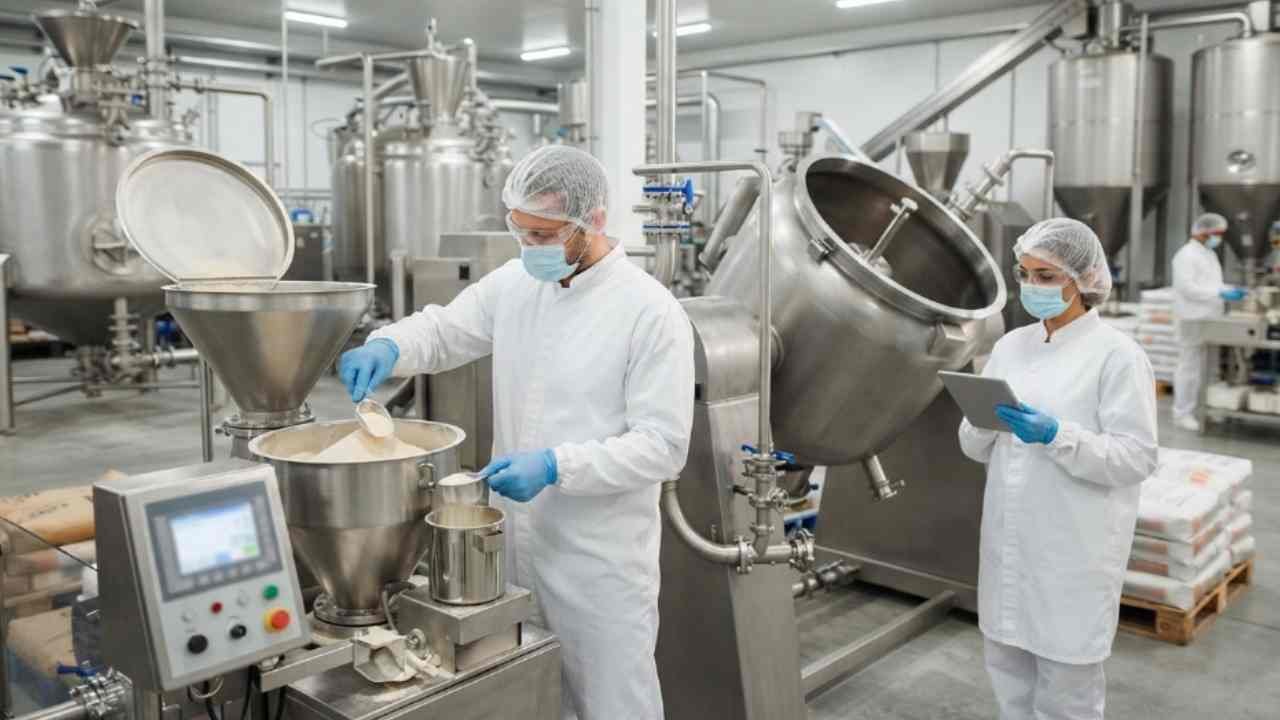
Formulating homogeneous nutritional premixes requires selecting a Vitamin H form that chemically and physically matches the surrounding ingredients. The density and particle size of the vitamin carrier must align with the rest of the powder blend to prevent particle segregation during transport and handling. In the agricultural feed sector, premixes are highly dense because they contain significant amounts of heavy trace minerals. Therefore, feed manufacturers require D-Biotin two percent on mineral-based carriers, such as calcium carbonate or dicalcium phosphate. These mineral carriers match the bulk density of the premix, preventing the active Biotin from settling at the bottom of the packaging drum.
Conversely, human food and beverage premixes utilize lighter organic ingredients, requiring starch or maltodextrin carriers. For these applications, allergen-free D-Biotin one percent or ten percent food-grade powders are the optimal choice. These organic carriers are highly soluble, making them ideal for powdered drinks and dietary supplement capsules. They also meet clean-label, non-GMO, and vegetarian standards required by health-conscious consumers. Sourcing partners like FINETECH verify these carrier types during cleanroom audits in China, ensuring that B2B buyers receive the exact carrier matrix required to maintain physical stability in their finished premix blends.
| Premix Type | Recommended Vitamin H Form | Carrier Base | Key Formulation Benefit |
|---|---|---|---|
| Animal Feed Premix | D-Biotin 2% Feed Grade | Calcium carbonate or silica | Matches density of heavy minerals |
| Human Food Premix | D-Biotin 1% Food Grade | Modified starch / maltodextrin | Dissolves cleanly in liquid mixes |
| Supplement Premix | D-Biotin 10% Dry Powder | Microcrystalline cellulose | Optimized for high-compression tableting |
| Beverage Premix | D-Biotin 1% CWS Powder | Acacia gum or dextrin | Prevents sedimentation in cold liquids |
How Do Different Product Forms Affect Handling and Mixing?
Sourcing fine, static-prone vitamin powders can cause severe dust emissions, material loss, and hopper clogging during factory operations. Poor flowability slows production lines. Assessing handling physical traits optimizes efficiency.
Product forms dictate flowability, dust generation, and electrostatic charges. Coated or granulated spray-dried beadlets have low dusting and superior flowability, whereas fine, untreated pure crystals carry high static charges and stick to processing machinery.
Dive Deeper into Powder Flowability and Electrostatic Behavior
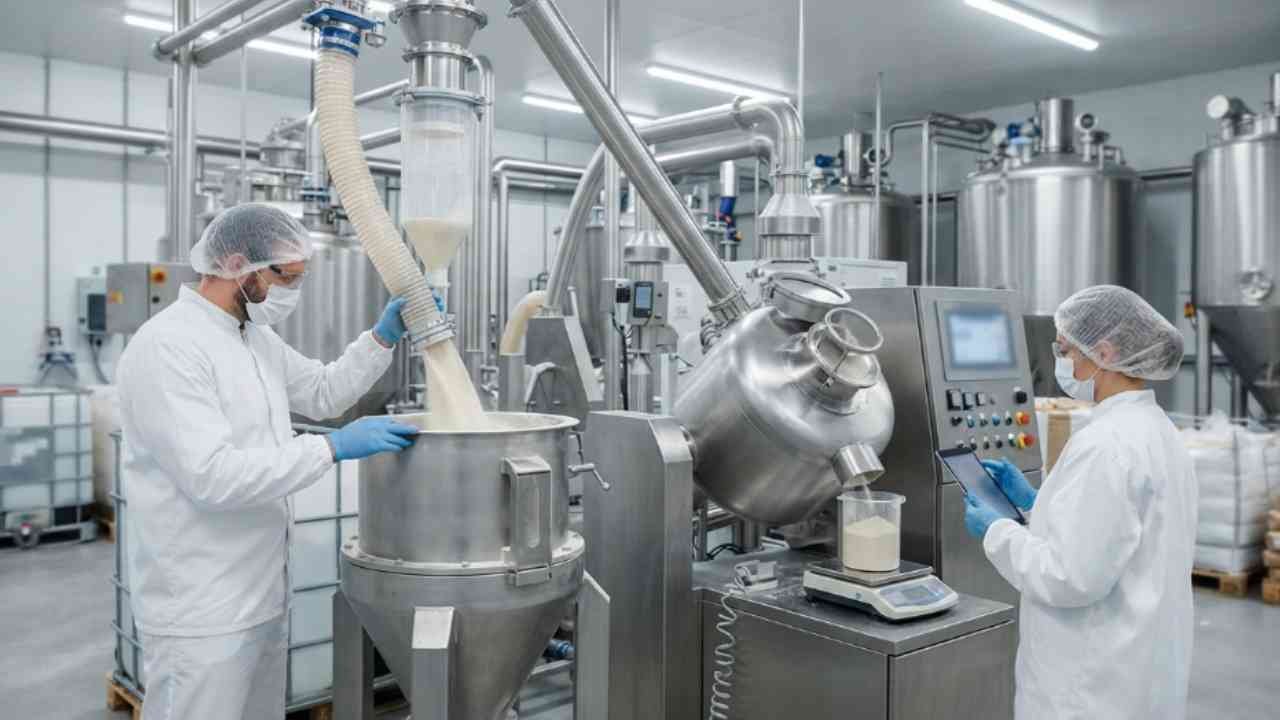
The physical form of Vitamin H directly impacts factory processing efficiency, operator safety, and dosing precision. Fine, untreated pure D-Biotin crystals carry high electrostatic charges, causing active particles to cling to packaging bags, stainless steel hoppers, and mixing paddles. This static cling leads to material loss and makes cleaning difficult. Furthermore, very fine powders generate significant airborne dust, creating inhalation hazards for plant workers and increasing the risk of cross-contamination3 in shared cleanrooms.
To improve flowability and reduce dusting, manufacturers use advanced spray-drying4 and granulation technologies to produce microencapsulated beadlets. These granulated forms have a larger, more spherical particle size, which reduces the angle of repose and allows the powder to flow smoothly through automated feeding systems. This free-flowing behavior is essential to ensure a continuous, block-free manufacturing process. It also prevents the active particles from separating from the carrier during high-speed blending. Sourcing partners like FINETECH inspect these physical characteristics during pre-shipment quality checks. They check sieve analysis logs and evaluate flowability, helping buyers import stable, easy-to-handle vitamin powders that minimize waste and maximize production speed.
| Physical Form | Sieve Particle Size | Flowability Level | Electrostatic Cling Risk |
|---|---|---|---|
| Fine Crystals | 80 to 100 mesh | Poor (clumps easily) | High (clings to stainless steel) |
| Granulated Powder | 40 to 60 mesh | Excellent (free-flowing) | Low (designed for automated hoppers) |
| Spray-Dried Beadlet | 60 to 80 mesh | Good (low dust) | Low (optimized for dry tablet pressing) |
| Liquid Dilution | Liquid solution | Non-applicable | Zero (ideal for liquid cosmetics/drinks) |
How Can Buyers Choose the Right Vitamin H Series Specification?
Purchasing cheap, unverified vitamin specifications can lead to production line blockages and failed final product quality assays. Inconsistent sourcing methods waste company funds. Establishing a clear selection plan ensures buying success.
Buyers can choose the right specification by identifying their target industry (feed vs. food), matching carrier density to their mixers, checking dietary certifications (Kosher, Halal, Non-GMO), and working with experienced sourcing teams to verify cleanroom compliance.

Dive Deeper into Grade Selection and Regulatory Vetting
Selecting the correct Vitamin H series specification requires a systematic evaluation of technical parameters and supplier credentials. Sourcing managers must begin by identifying their primary formulation objective. If the goal is to enrich animal feed, two percent D-Biotin with a mineral carrier is the correct choice. If the goal is to formulate human dietary supplements or infant nutrition, pure D-Biotin USP/EP or food-grade one percent CWS powder should be selected. Buyers must also evaluate their production processing conditions, choosing heat-resistant, spray-dried beadlets for dry tableting or water-soluble powders for liquid formulations.
Next, checking dietary and safety certifications is essential to avoid import rejections at foreign customs. Buyers must verify whether their target markets require Kosher, Halal, Non-GMO, or pharmaceutical-grade GMP certifications5. Sourcing partners like FINETECH simplify this complex vetting process for B2B buyers. They handle factory audits, check cleanroom logs, verify active certificate registration numbers, and manage direct logistics with low MOQs. This comprehensive support allows buyers to purchase smaller, fresh batches of raw materials, reducing inventory storage risks while keeping their international supply pipeline consistent, compliant, and highly cost-effective even during periods of high market volatility.
| Sourcing Selection Step | Technical Sourcing Parameter | Critical Verification Action | Sourcing Outcome |
|---|---|---|---|
| Identify Application | Food-grade vs. Feed-grade | Match purity to target consumer | Prevents regulatory import rejections |
| Check Solubility | Hot-water vs. Cold-water CWS | Verify clear dispersing in liquids | Eliminates sedimentation issues |
| Verify Compliance | Audit Kosher, Halal, & FAMI-QS | Check active registration numbers | Ensures legal customs clearance |
| Audit Carrier | Starch, calcium carbonate, silica | Match carrier density to mixers | Prevents particle segregation |
Conclusion
Choosing the right Vitamin H form depends on potency, carrier matrix, and mixing machinery. Partnering with a dedicated sourcing team ensures consistent, compliant, and highly cost-effective imports.
-
Linus Pauling Institute (Oregon State University) – Explains biotin's role as a vital metabolic coenzyme for carboxylase enzymes, including dietary sources and tissue absorption. ↩
-
U.S. Food and Drug Administration (FDA) – Regulatory standards, manufacturer checklists, and nutritional requirements for commercial infant formula formulations. ↩
-
FoodSafety.gov – Official federal guidelines outlining critical steps to prevent cross-contamination between raw ingredients and ready-to-eat foods during storage and preparation. ↩
-
MDPI – Peer-reviewed review of advances in spray-drying and sustainable wall materials utilized to optimize the microencapsulation and stability of sensitive bioactives. ↩
-
U.S. Food and Drug Administration (FDA) – In-depth guide detailing Current Good Manufacturing Practice (CGMP) standards and regulatory audits for pharmaceutical and food manufacturing facilities. ↩